The Financial Times recently reported that the European Commission has begun setting up a new intelligence coordination unit under President Ursula von der Leyen, in what could become one of the most politically sensitive moves of her second term. The new body—hosted within the Commission’s Secretariat-General—aims to improve how Brussels gathers and uses intelligence collected by national spy agencies (“The European
Continue reading Europe’s Intelligence Ambitions: Von der Leyen’s New Unit and the Quest for Strategic Autonomy
Author: Antonino Alì
How Russia learned from failure
How Russia learned from failure When Russian troops crossed into Ukraine in February 2022, many expected a swift victory—a demonstration of Moscow’s power and a humiliation for Kyiv. Within weeks, that illusion collapsed. The invasion turned into a series of humiliations for the Kremlin: broken logistics, mass desertions, and a military doctrine unprepared for modern,
Continue reading How Russia learned from failure
Workshop “Strategic Litigation in International Law: Concepts, Actors, and Impact” – 27–28 November 2025 – Faculty of Law, University of Trento
In the increasingly complex landscape of international law, strategic litigation has emerged as both a tool for individual justice and a catalyst for systemic change. The workshop “Strategic Litigation in International Law”, hosted by the University of Trento’s Faculty of Law on 27–28 November 2025, offers a unique opportunity to explore this practice through three central dimensions: concepts,
Continue reading Workshop “Strategic Litigation in International Law: Concepts, Actors, and Impact” – 27–28 November 2025 – Faculty of Law, University of Trento
Understanding BlackRock’s geopolitical risk dashboard: how markets perceive power and uncertainty
BlackRock’s Geopolitical Risk Dashboard is not just another data visualization. It is an attempt to quantify something that seems, by nature, unquantifiable — the market’s perception of geopolitical tension. Developed by the BlackRock Investment Institute (BII), the dashboard translates the vast and often chaotic landscape of political risk into a set of measurable indicators, revealing how investors react
Continue reading Understanding BlackRock’s geopolitical risk dashboard: how markets perceive power and uncertainty
Palliora: a decentralized framework for confidential computation and AI
Palliora is a decentralized platform for sharing intelligent thoughts and is designed to allow users to selectively share their data for trusted, confidential, and verifiable computation. Its primary purpose is to provide security and privacy guarantees, ensuring that only the intended recipients will have access to the data, which is essential for fostering growth in the knowledge economy and the
Continue reading Palliora: a decentralized framework for confidential computation and AI
Seventeen years since the bitcoin whitepaper: the day trust went decentralized
Seventeen years ago today, on November 1, 2008, an anonymous figure using the name Satoshi Nakamoto shared a nine-page document with a small cryptography mailing list. Its title was simple — “Bitcoin: A Peer-to-Peer Electronic Cash System.” Yet within those pages lay the seed of a transformation that would ripple across technology, economics, and political thought. The paper’s premise was
Continue reading Seventeen years since the bitcoin whitepaper: the day trust went decentralized
When Europe realized openness had a cost: the 2017 letter that changed EU investment policy
In early 2017, three of Europe’s most powerful economic ministers — Brigitte Zypries from Germany, Michel Sapinfrom France, and Carlo Calenda from Italy signed a letter that quietly reshaped the European Union’s approach to global investment. Their message, addressed to Cecilia Malmström, then European Commissioner for Trade, was brief but momentous. It called on Brussels to act — to protect Europe’s technological future
Continue reading When Europe realized openness had a cost: the 2017 letter that changed EU investment policy
The new space era: rethinking global governance beyond earth
On November 7, 2025, I’ll take part in the conference “The New Space Era: A Multidisciplinary Governance for the Future of Public Policies”, hosted by Luiss University’s Research Center for International and Strategic Studies (CISS) at the Aula Toti, Luiss Campus (Viale Romania 32, Rome). From 8:30 a.m. to 12:45 p.m., leading voices from academia, industry, and government will explore
Continue reading The new space era: rethinking global governance beyond earth
Federated Learning: the quiet revolution in machine intelligence
In the traditional world of machine learning, data has always been the raw fuel. Corporations, research organisations and governments collect it, centralise it and feed it into models that learn to recognise patterns, predict outcomes and make decisions. But what if the data could stay where it is—on your phone, in a hospital, on a
Continue reading Federated Learning: the quiet revolution in machine intelligence
IP address geolocation: mechanisms, applications, and limitations
1.0 Introduction: the business and regulatory imperative for geolocation The enforcement of region-specific regulations and content policies is a primary operational challenge for global online services. These services must reliably determine a user’s geographical location to tailor content and ensure compliance, but must do so without resorting to intrusive methods like GPS or Wi-Fi scanning,
Continue reading IP address geolocation: mechanisms, applications, and limitations
The France National Intelligence Strategy 2025
The France National Intelligence Strategy 2025 presents a structured overview of how the French government defines, organizes, and prioritizes its intelligence activities in light of evolving global threats and strategic transformations. The document represents both a doctrinal framework and a political declaration, articulating the principles that guide intelligence work and its integration into national decision-making. Below is an analytical summary
Continue reading The France National Intelligence Strategy 2025
The official statement from Nexperia China, dated October 23rd, 2025, addressing a dispute between Nexperia Netherlands (the Dutch headquarters) and Nexperia China Ltd.
This is an official statement from Nexperia China, dated October 23rd, 2025, addressing a dispute between Nexperia Netherlands (the Dutch headquarters) and Nexperia China Ltd. The Dutch headquarters reportedly dismissed John Chang, Vice President of Global Sales and Marketing.Nexperia China rejects that decision, declaring it legally invalid in China and asserting its own managerial independence. 1. The Dutch decision has no legal effect in
Continue reading The official statement from Nexperia China, dated October 23rd, 2025, addressing a dispute between Nexperia Netherlands (the Dutch headquarters) and Nexperia China Ltd.
Safeguarding maritime graves in the Baltic sea: legal challenges and state duties regarding the MS Estonia wreck under international law
1. Context and relevance The ferry MS Estonia sank on 28 September 1994 in the Baltic Sea, with approximately 852 casualties. The States of Estonia, Finland and Sweden signed on 23 February 1995 the “Agreement regarding the MS Estonia” which designates the wreck as a “final place of rest” and prohibits diving or salvage activities that
Continue reading Safeguarding maritime graves in the Baltic sea: legal challenges and state duties regarding the MS Estonia wreck under international law
The adoption of the EU’s 19th sanctions package against Russia, significantly intensifying pressure on its war economy.
On 23 October 2025, the European Commission announced the adoption of the EU’s 19th sanctions package against Russia, significantly intensifying pressure on its war economy. European Commission Key measures include: This package marks a major escalation in the EU’s sanctions regime, expanding the scope far beyond previous energy and finance-measures, and aiming to close existing loopholes and tighten
Continue reading The adoption of the EU’s 19th sanctions package against Russia, significantly intensifying pressure on its war economy.
The Semicon coalition and the legal imperative for a reinforced EU Chips Act
The Declaration of the Semicon Coalition marks a decisive moment in Europe’s ongoing effort to consolidate technological sovereignty within the global semiconductor ecosystem. Signed in Brussels on 29 September 2025 by ministers from twenty-seven Member States, the document calls for a “revised and forward-looking EU Chips Act”—a legal and strategic recalibration of the Union’s approach to a sector
Continue reading The Semicon coalition and the legal imperative for a reinforced EU Chips Act
When a single chip can halt a factory: the strategic exposure of Europe’s automotive supply chain
Volkswagen AG’s recent production halt at its Wolfsburg plant has become a symbol of how technological dependencies can turn into strategic vulnerabilities. The issue is not steel, labor, or consumer demand — it is semiconductors. The immediate trigger: Nexperia and the Dutch intervention Nexperia NV, a Dutch semiconductor manufacturer owned by Chinese investors, has been
Continue reading When a single chip can halt a factory: the strategic exposure of Europe’s automotive supply chain
Foreign entity of concern (FEOC)
1. Origin and context The term foreign entity of concern emerged within U.S. legislation designed to protect national security, economic interests, and technological supply chains. It appears prominently in: In short, it designates a foreign entity that poses a potential or actual risk to U.S. national or strategic security. 2. Legal definition The definition is detailed but can be summarized
Continue reading Foreign entity of concern (FEOC)
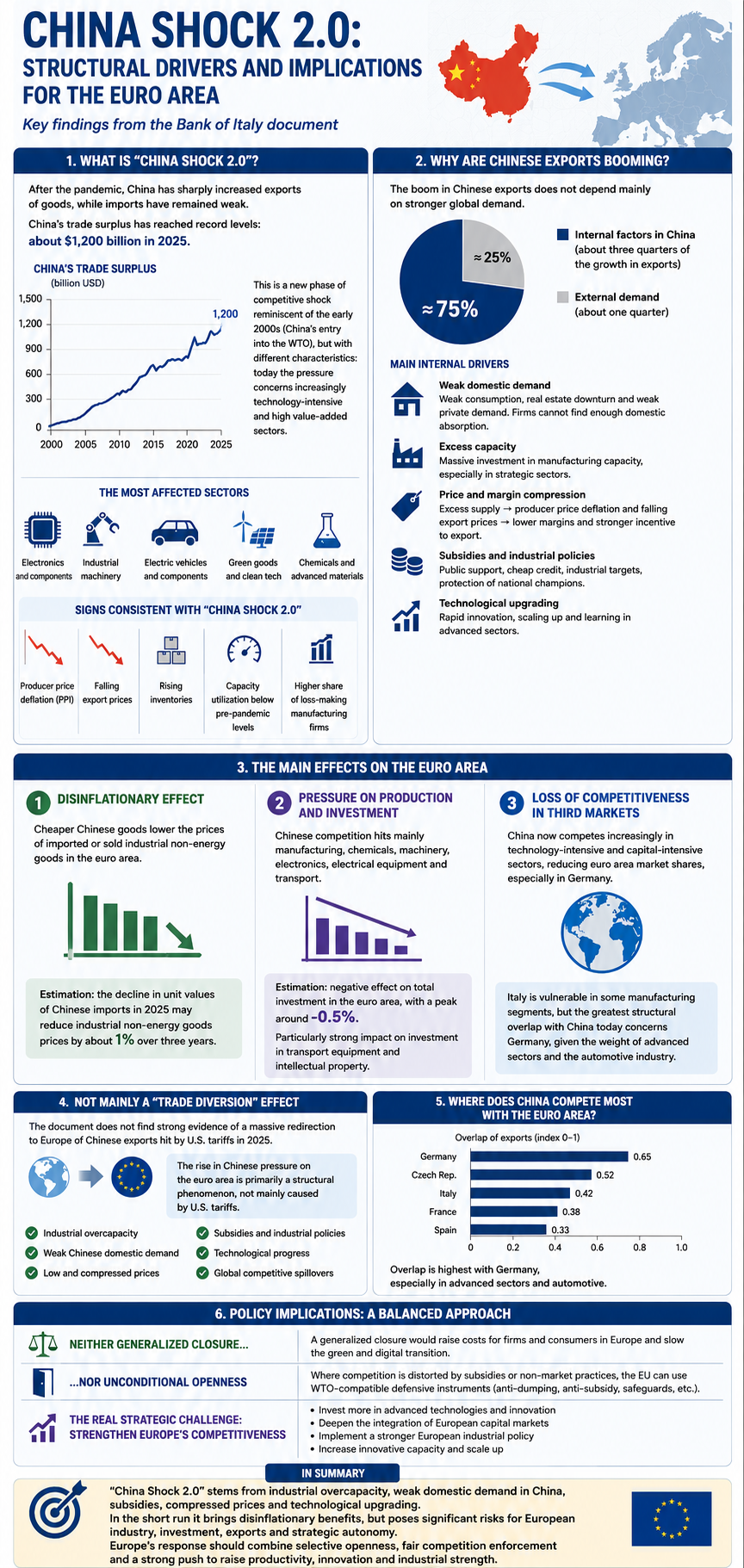
Italy’s imports from China after U.S. Section 301 tariffs (2018–2025): evidence, method, and legal–policy context
Euro-area evidence from the ECB shows that the 2018 U.S. Section 301 tariffs on Chinese goods redirected part of China’s exports towards Europe, consistent with trade diversion. The ECB quantifies non-trivial shifts in export destinations and discusses channels through which an influx of Chinese goods can affect euro-area prices and trade composition. ECB economists, using product-level data, document that
Continue reading Italy’s imports from China after U.S. Section 301 tariffs (2018–2025): evidence, method, and legal–policy context
China turns its rare earth dominance into a national security weapon
In recent months China has tightened its export regime for rare earth elements and related technologies, describing these steps as essential to its national security. The change is not a minor adjustment but a structural move that turns China’s dominance in critical minerals into an explicit instrument of geopolitical strategy. In early October 2025, the
Continue reading China turns its rare earth dominance into a national security weapon
The Nexperia Case: Europe’s New Line in the Silicon Sand
Who is Nexperia ? Nexperia is a European semiconductor company based in Nijmegen, the Netherlands.It produces essential electronic components — diodes, transistors, MOSFETs, and logic circuits — used in mobile devices, automobiles, consumer electronics, and industrial systems.The company is controlled by China’s Wingtech Technology, a large tech manufacturer integrated into global supply chains. The origins of the
Continue reading The Nexperia Case: Europe’s New Line in the Silicon Sand
The “Frequency Battle”: How SpaceX’s spectrum deal reshapes the global space economy
The competition for radio frequencies—especially those enabling mobile communications—has become one of the defining fronts of the new space economy. Control of the spectrum now determines not only who connects the planet, but who shapes the architecture of global information, defense, and digital sovereignty. 1. The Spectrum Deal: Verified Facts In September 2025, SpaceX announced the acquisition of wireless
Continue reading The “Frequency Battle”: How SpaceX’s spectrum deal reshapes the global space economy
Unlocking Freedom: Hurst’s vision of 19th-century American law
James Willard Hurst’s Law and the Conditions of Freedom in the Nineteenth?Century United States (1956) is a landmark collection of essays that redefines how we see American legal history. Drawing on his 1955 Rosenthal Lectures at Northwestern, Hurst offers a compelling reinterpretation: law was not merely a restrictive force but a dynamic engine for unleashing individual and collective
Continue reading Unlocking Freedom: Hurst’s vision of 19th-century American law
Frozen funds, court doors, and a narrow key: CJEU on paying docket fees under Russia sanctions (C-384/24, 11 September 2025)
Sanctions freeze assets with a heavy hand; court systems often demand money up front just to open the door. What happens when these two logics collide? In C-384/24 (RKDF v Belgium), the Court of Justice (Tenth Chamber) offers a crisp answer: Member State authorities may authorize the release of frozen funds to pay the mandatory fees needed
Continue reading Frozen funds, court doors, and a narrow key: CJEU on paying docket fees under Russia sanctions (C-384/24, 11 September 2025)
The Italian and European efforts on the transition to post-quantum cryptography (PQC) for critical infrastructures and digital services.
The Quantum threat and the urgent need for PQC The coming era of quantum computing threatens to undermine much of the cryptographic infrastructure we rely on today. The asymmetrical algorithms that protect data, communications and digital services may, in time, become vulnerable. In response, both the European Commission and the Italian government have signalled that
Continue reading The Italian and European efforts on the transition to post-quantum cryptography (PQC) for critical infrastructures and digital services.
The night Moscow knocked on NATO’s door
When Russian drones breached Polish airspace on September 9–10, they carried no warheads—only a message. Stripped of explosives but heavy with intent, these aircraft weren’t instruments of war but tools of psychological warfare, probing for cracks in the Western alliance. The Kremlin’s calculus was transparent: test NATO’s reflexes while America grapples with electoral uncertainty and
Continue reading The night Moscow knocked on NATO’s door
EU General Court endorses sanctions on cybersecurity firm connected to Russian intelligence services
The General Court of the European Union has upheld the EU’s decision to maintain restrictive measures against Positive Group PAO, active in Russia’s IT sector, following its judgment in Case T-573/23. The court dismissed the company’s challenge, reinforcing the legitimacy of the so-called “IT criterion” employed by the Council of the EU. This criterion targets entities operating with FSB-issued or military/arms-related
Continue reading EU General Court endorses sanctions on cybersecurity firm connected to Russian intelligence services
Japan Funds TSMC’s U.S. Semiconductor Expansion
Japan is now pledging that part of its US bound $550 billion trade investment package could help finance a Taiwanese chipmaker, most likely TSMC, to build fabs in America. Why Japan is doing this • Hedging geopolitical risk With TSMC’s fabs concentrated in Taiwan and China’s increasing coercion in the Taiwan Strait, the US wants TSMC onshore. Japan wants
Continue reading Japan Funds TSMC’s U.S. Semiconductor Expansion
EU General Court Upholds New EU–US Data Transfer Framework
Luxembourg, 3 September 2025 The General Court of the European Union has dismissed a challenge against the Commission’s July 2023 adequacy decision, which established the latest framework for the transfer of personal data between the EU and the United States. The action was brought by Philippe Latombe, a French citizen, who argued that the U.S.
Continue reading EU General Court Upholds New EU–US Data Transfer Framework
TSMC in Arizona: geopolitics, technology and the future of semiconductors
A significant transformation is occurring in chip manufacturing, shifting control over the global economy. The United States, which invented the semiconductor industry and still leads in design, equipment, and software, saw its manufacturing dominance decline from 40% in 1990 to about 10% today. To address this, TSMC is building an advanced chip factory, Fab 21,
Continue reading TSMC in Arizona: geopolitics, technology and the future of semiconductors
Europe at a Crossroads: Mario Draghi’s Urgent Call for a New Era of European Integration
In a pivotal speech, Mario Draghi delivered a stark message regarding the European Union’s current standing on the global stage, arguing that a long-held illusion about economic power automatically translating into geopolitical influence has evaporated. His address serves as a powerful call to action, urging Europe to fundamentally transform its political organization and deepen integration
Continue reading Europe at a Crossroads: Mario Draghi’s Urgent Call for a New Era of European Integration
The Russian approach to deterrence
The Russian approach to deterrence, referred to as “deterrence à la Russe,” differs significantly from the Western conceptualization in several fundamental aspects, including its etymology, underlying logic, scope, typology, and the cultural factors that influence it. Here are the main differences: • Etymology and logic The English term “deterrence” is derived from “terror” (fear) and
Continue reading The Russian approach to deterrence
The EU-US Tariff Agreement: beyond the 15%, Carlo Altomonte’s Analysis of European Fragilities and US Geopolitical Strategy
Carlo Altomonte, a professor at Bocconi University and Vice President of ISPI, provided a detailed analysis of the tariff agreement between the European Union and the United States, placing it within a broader geopolitical and trade policy context (ISPI YOUTUBE CHANNEL) Here are the key points of his intervention:
How Europe may end up paying for America’s debt
While headlines are fixated on tariffs and trade spats, a more dangerous mechanism may be quietly unfolding under Donald Trump’s second presidency. Italian economist and journalist Federico Fubini lays out a disturbing yet well-documented argument: the real price of Trump’s economic strategy may not be paid by Americans, but by Europeans. And it won’t come
Continue reading How Europe may end up paying for America’s debt
Petros C. Mavroidis, Litigating National Security in the WTO Era (in: K. Nadakavukaren Schefer, R. Polanco, P. Sauvé (eds), International Economic Law as Symphony, Hart Publishing, 2025, pp. 80–92)
Petros C. Mavroidis has identified a major problem in how the WTO handles national security disputes. Countries are increasingly using “national security” as an excuse to break trade rules, and the WTO’s courts don’t know how to respond effectively. When countries claim their actions are necessary for national security, WTO panels are caught in a
Continue reading Petros C. Mavroidis, Litigating National Security in the WTO Era (in: K. Nadakavukaren Schefer, R. Polanco, P. Sauvé (eds), International Economic Law as Symphony, Hart Publishing, 2025, pp. 80–92)
The United States and the unraveling of the WTO Appellate Body
The World Trade Organization (WTO) dispute settlement system is considered a central pillar of the multilateral trading system, providing a structured mechanism for managing disputes among its members. Established in 1995 with the creation of the WTO, the Understanding on Rules and Procedures Governing the Settlement of Disputes (DSU) offers a legal framework for addressing violations
Continue reading The United States and the unraveling of the WTO Appellate Body
The America’s AI Action Plan
The America’s AI Action Plan (July 2025), issued under the Trump administration, sets out an expansive and unapologetically assertive roadmap for establishing the United States as the unchallenged global leader in artificial intelligence. The document is framed not merely as a technology strategy but as a national security imperative, a geopolitical contest, and a civilizational opportunity. It
Continue reading The America’s AI Action Plan
Stablecoins are quietly becoming major players in the U.S. Treasury Market
Recent analyses published by the Bank for International Settlements (BIS) highlight a significant but underappreciated development: the increasing structural role of stablecoins in the U.S. short-term sovereign debt market. As of early 2025, leading stablecoin issuers—most notably Tether and Circle—collectively hold over $200 billion in dollar-denominated assets, with a substantial portion invested in U.S. Treasury bills. During 2024
Continue reading Stablecoins are quietly becoming major players in the U.S. Treasury Market
The Decline of U.S. Soft Power: Key Problems and Implications
Conclusion The decline of U.S. soft power is not just symbolic; it has tangible effects—from diplomatic alienation and strategic loss in key regions, to economic fallout and diminished influence. Without renewed investment in foreign aid, public diplomacy, and cultural outreach, the U.S. risks relinquishing the narrative and agenda-setting power that underpin its global leadership.
White Paper “China’s National Security in the New Era”
On May 12, 2025, China’s State Council Information Office released a major white paper titled “China’s National Security in the New Era”. It presents a comprehensive shift in Beijing’s strategic thinking—distinguishing this as their first dedicated national security declaration since 1949 . The paper analyzes China’s holistic national security strategy—spanning political, economic, technological, and social spheres—and its global
Continue reading White Paper “China’s National Security in the New Era”
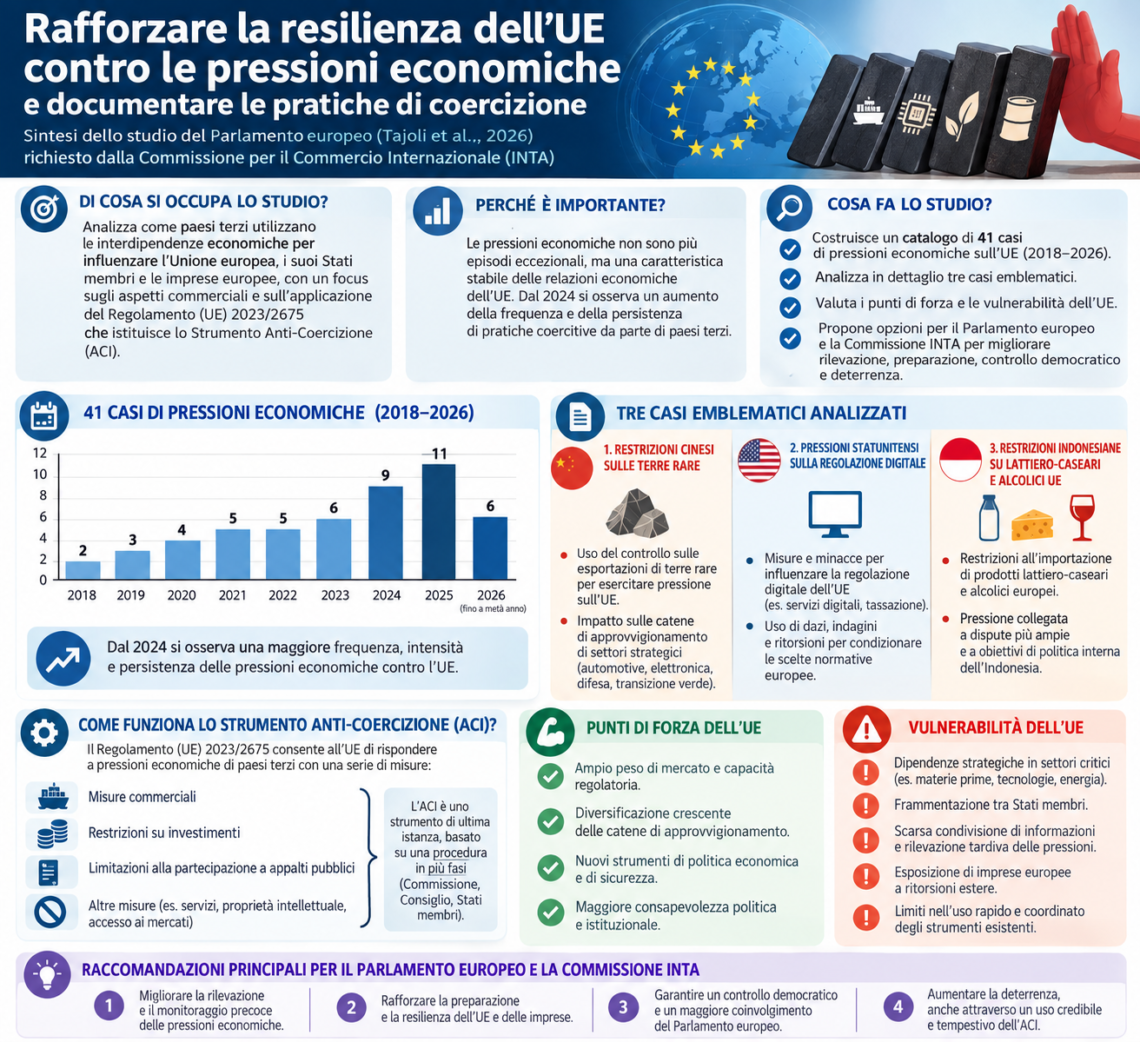
The Anti-Coercion Instrument and the Paradox of Deterrence
The EU regulation on countering foreign economic coercion (Reg. 2023/2675) sets up an instrument that, at first glance, appears robust: it allows the Union to identify coercive acts by third countries, initiate consultations, and—if necessary—adopt response measures. The stated goal is to “deter economic coercion” (see Recital 7, 8 and Article 1(2)). “Recital (7) Whilst
Continue reading The Anti-Coercion Instrument and the Paradox of Deterrence