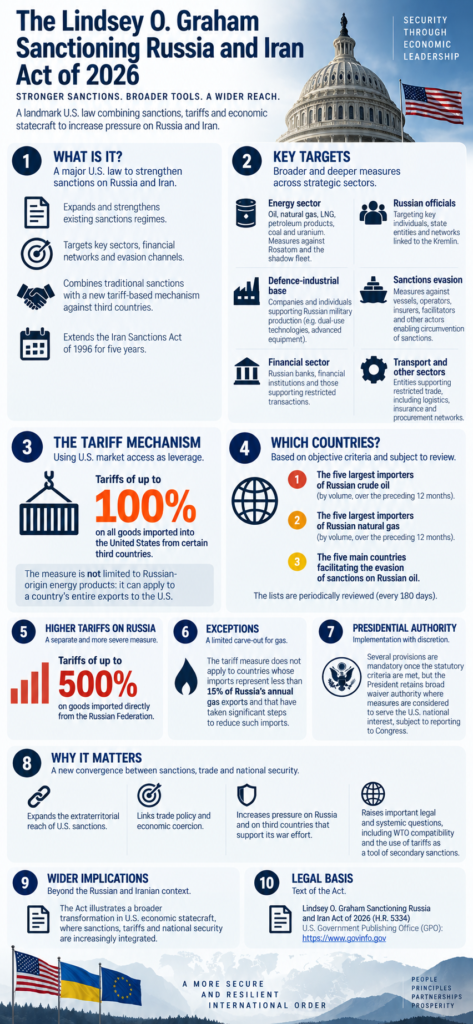
The United States Congress has approved the Lindsey O. Graham Sanctioning Russia and Iran Act of 2026, the most significant legislative package of new sanctions against Russia adopted since the beginning of the second Trump administration. Named after Senator Lindsey Graham, who had been one of the principal sponsors of the initiative before his death in July 2026, the legislation substantially expands the architecture of US economic coercion against the Russian Federation. Its scope extends well beyond the traditional model of targeted financial sanctions. It combines measures directed at Russian state institutions, financial actors, the energy sector, the defence-industrial base and the so-called shadow fleet with a reinforced system of secondary sanctions aimed at third-country actors maintaining significant economic relations with Russia.
The energy sector occupies a central place in the new regime. The legislation targets transactions involving Russian oil, natural gas, liquefied natural gas, petroleum products, coal and uranium, while also providing for measures against entities and networks involved in the transportation, insurance and financing of Russian energy exports. Particular attention is devoted to mechanisms designed to circumvent existing restrictions, including the use of vessels and intermediary structures associated with the Russian shadow fleet. The legislation also strengthens measures against actors supporting Russia’s defence-industrial base, including companies and individuals involved in the supply of dual-use technologies, advanced manufacturing equipment and other goods capable of contributing to Russian military production.
The most innovative feature of the legislation, however, lies in its integration of tariff policy into the machinery of secondary sanctions. The Act authorises, and in certain circumstances requires, the imposition of tariffs of up to 100 per cent on goods imported into the United States from third countries that remain among the principal purchasers of Russian energy or that play a significant role in facilitating the circumvention of sanctions. The mechanism is not limited to taxing Russian-origin energy products. Rather, it makes access to the US market itself a source of leverage against third States whose commercial relations with Russia are considered inconsistent with US sanctions policy.
The legislation identifies, in particular, the five largest importers by volume of Russian crude oil, the five largest importers of Russian natural gas, and the principal countries involved in facilitating the evasion of restrictions applicable to Russian oil. These determinations are subject to periodic review. The Act therefore introduces a dynamic mechanism in which exposure to US trade measures depends not merely on a direct legal relationship with the United States, but on the nature and scale of a third country’s economic relations with Russia.
From a legal and systemic perspective, this represents a significant development. The legislation further blurs the conventional distinction between sanctions law and trade policy. Tariffs, traditionally understood as instruments of commercial policy, are employed here as instruments of economic coercion designed to influence the conduct of third States and private economic actors outside the United States. The practical effect is to transform US market access into a central enforcement mechanism of sanctions policy.
This development also highlights the increasingly extraterritorial character of US economic sanctions. Whereas primary sanctions regulate transactions involving persons or entities subject to US jurisdiction, secondary sanctions seek to influence the behaviour of foreign actors by attaching adverse economic consequences to conduct occurring outside US territory and, in many cases, involving no US person. The new tariff mechanism extends this logic from individual companies and financial institutions to entire national economies. A State that continues to purchase substantial quantities of Russian energy may therefore face significant restrictions affecting its broader exports to the United States.
At the same time, the legislation preserves a considerable degree of presidential discretion. Although several provisions are framed in mandatory terms once the statutory criteria are satisfied, the Act also provides the President with waiver authority where the suspension or non-application of measures is considered to serve the national interest of the United States. The effectiveness of the regime will therefore depend not only on the statutory text but also on its implementation by the executive branch, including the identification of the countries concerned, the level of tariffs actually imposed and the use of presidential waivers.
The legislation is particularly significant because it illustrates a broader convergence between sanctions policy, trade policy and national security. Economic instruments that were previously treated as belonging to distinct regulatory fields are increasingly being combined within a single architecture of economic statecraft. In this respect, the Graham Act can be understood not simply as another expansion of the sanctions imposed on Russia, but as part of a wider transformation in the legal techniques through which the United States seeks to exercise economic pressure internationally.
The implications are potentially important for international economic law. The use of broad tariffs against third countries raises questions concerning the consistency of such measures with WTO obligations, including the principles of most-favoured-nation treatment and tariff bindings, as well as the possible invocation of national-security exceptions. More generally, it reinforces the tension between the territorial structure of the multilateral trading system and the increasingly extraterritorial character of unilateral economic sanctions.
The Act therefore marks an important stage in the evolution of US sanctions practice. Its significance lies less in the addition of individual restrictive measures than in the institutional fusion of sanctions and tariff instruments. By linking third-country access to the US market to their commercial relations with Russia, Congress has moved towards a model in which trade restrictions function directly as secondary sanctions. This development may have consequences well beyond the Russian context, particularly if similar mechanisms are subsequently incorporated into US sanctions regimes concerning other States.