There is a vocabulary that saturates almost every conversation about education today.
Learning outcomes. Skills. Performance indicators. Employability. Assessment. Measurable results.
You hear it in faculty meetings, in ministerial documents, in accreditation reports, in the way students themselves describe what they expect from a degree. It is not that any of this is wrong, exactly. Schools and universities must equip people with knowledge, develop abilities, certify competences. Nobody serious disputes that. But there is something suffocating about a discourse that treats education as if it were, at bottom, a logistics problem — inputs in, outputs out, the rest is decoration.
Gert Biesta thinks the problem runs deeper. In a paper that has become something of a reference point in the philosophy of education (“Good Education in an Age of Measurement”, Educational Assessment, Evaluation and Accountability, 21(1), 2009, pp. 33–46), he argues that we have become extraordinarily good at asking whether students are learning, and extraordinarily bad at asking a prior question: what is education for?
The distinction sounds simple. It is not.
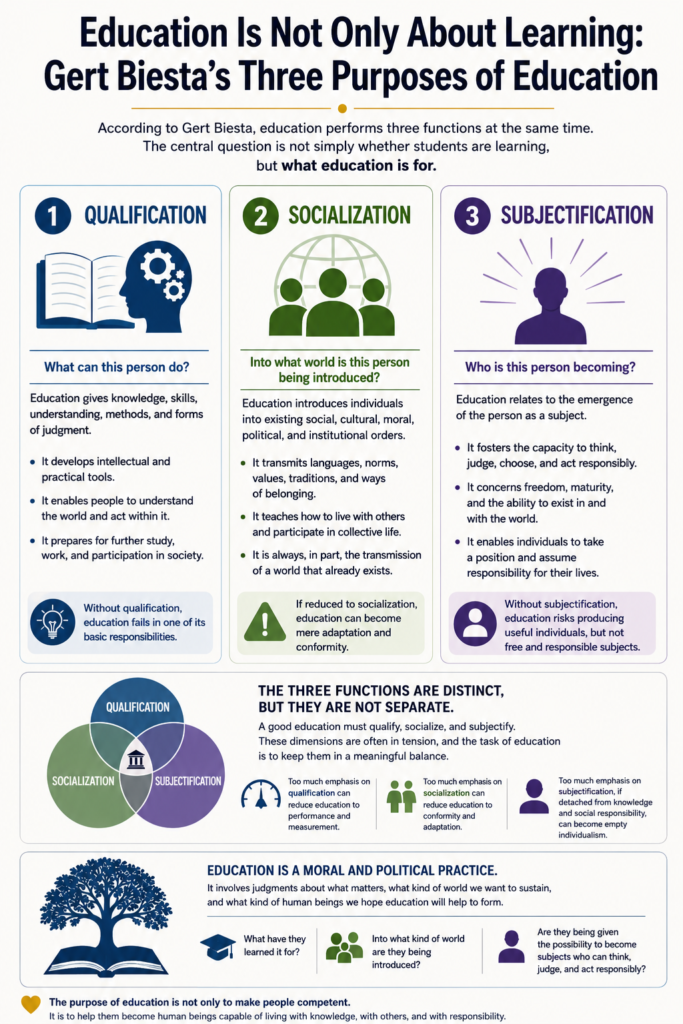
You cannot answer the question of purpose by pointing to test scores. Or competence frameworks. Or graduate employment rates. Education — if the word is to mean anything beyond credentialing — is a human, social, ethical, and political practice. And it does not do one thing. It does, according to Biesta, at least three things simultaneously, which are in constant and productive tension with each other.
Qualification. This is the familiar part. Education gives people tools: knowledge, methods, skills, forms of judgment, intellectual habits. Through education a person learns to read a contract, parse an argument, design an experiment, write in a second language, interpret a dataset, navigate a professional field. Qualification answers a blunt question — what can this person do? — and the answer matters. An education that does not qualify is a fraud. Students need real intellectual and practical instruments to understand the world and act within it. Knowledge is not ornamental. Competence is not optional. Method is not a luxury. A gauzy idea of “personal formation” that leaves people unable to think rigorously or do anything in particular is not education. It is atmosphere.
But here is the trap. When qualification becomes the only metric — when education is reduced to the manufacturing of skills — something curdles. You produce competent people. Capable people. People who perform well on assessments. And yet. Competence without reflection is machinery. A system that optimises exclusively for what students can do may never ask what they should do, or who they are becoming while they learn to do it. Biesta’s insistence is that qualification, taken alone, turns students into outputs. Useful outputs, perhaps. But outputs.
Socialization. This one is trickier, and often invisible. Education does not happen in a void. Every classroom, every syllabus, every examination, every unwritten rule about how to address a professor or when to speak or what counts as a good question — all of this transmits, whether anyone intends it or not, an image of the world. Languages. Norms. Values. Hierarchies. Traditions. What a community considers meaningful, legitimate, acceptable. What it considers beneath discussion.
Socialization answers a different question: into what world is this person being introduced?
To educate someone is always, in part, to insert that person into a world that was there before them. We do not admit this often enough. We prefer to talk about critical thinking, autonomy, creativity — all desirable things — while simultaneously reproducing, through the very structure of the institution, a highly specific set of assumptions about authority, merit, obedience, and belonging. The tension is baked in.
And the risk is obvious. If education is only socialization, it becomes adaptation. Conformity. The production of well-behaved participants in an order that is never itself questioned. You can train people to fit. That is not the same as educating them.
Which is why Biesta adds a third function, and it is the one that changes everything.
Subjectification. The word is ungainly. The idea is not. Subjectification is about the emergence of the person as a subject. Not as a skilled individual. Not as a well-integrated member of a group. As someone who thinks, judges, chooses, responds, takes responsibility. Someone who is not reducible to their function in a system — not reducible to “future worker”, “citizen”, “graduate”, “assessed learner”. A subject, in Biesta’s sense, is a person who can encounter resistance, take a position, respond to others, and bear the weight of their own freedom.
Freedom. But not the adolescent version — not “I do what I want”. Freedom, here, is entangled with responsibility, with maturity, with the willingness to exist in and with the world rather than merely for oneself. Subjectification asks the most unsettling question of the three: who is this person becoming?
This is the dimension that prevents education from collapsing into either training or social reproduction. Without it, you can have excellent qualification and seamless socialization and still produce human beings who have never once been asked — by the institution, by a teacher, by themselves — to appear as persons capable of independent judgment.
The three functions are distinct. They are not separable.
A good education qualifies: it gives knowledge and competence. It socializes: it introduces people into a shared world of meanings, practices, and obligations. It subjectifies: it creates the conditions in which persons can emerge as free and responsible subjects. Take any one of the three away and something essential breaks. Qualification without socialization produces technicians adrift. Socialization without subjectification produces conformists. Subjectification without knowledge produces — what? Earnest, liberated people with nothing to say. The caricature writes itself.
And here lies the difficulty. The three dimensions pull against each other. Push qualification too hard and education becomes a performance factory. Push socialization too hard and it becomes indoctrination by other means. Push subjectification too hard, untethered from knowledge and social responsibility, and you end up celebrating individuality in the abstract — a freedom that is all posture and no substance.
The task is not to choose. The task is balance — and balance, in education as in most things, is not a formula. It is a judgment. It must be made again and again, in context, under pressure, with imperfect information. Which is to say: it is itself an exercise in exactly the kind of thinking that education, at its best, is supposed to cultivate.
This is why Biesta still matters. In a landscape colonised by rankings, Key Performance Indicators, accreditation cycles, and the relentless rhetoric of efficiency, his work is a reminder — uncomfortable, perhaps, but necessary — that education is not a technical problem awaiting a technical solution. It is a moral and political practice. It involves choices about what matters, what kind of world we want to sustain, what kind of human beings we think are worth forming.
The real questions, then, are not the ones we usually ask. Not only how much have students learned. But: what have they learned it for? Into what kind of world are they being introduced? And — most demanding of all — are they being given the space to become subjects who can think, judge, and act on their own authority?
A society can produce highly qualified people who lack judgment. Well-socialized people who lack freedom. Efficient institutions that never educate anyone in any sense that matters.
Biesta’s wager is that education must resist this. That it is not simply the transfer of knowledge, not simply preparation for the labour market, not simply the reproduction of the existing social order. That at its best, education does something more precarious and more important: it gives people the tools to understand the world, introduces them into a world they share with others, and helps them appear in that world as subjects — capable of living with knowledge, with others, and with the responsibility that both entail.
Whether our institutions are currently designed to do this is, of course, another question entirely.