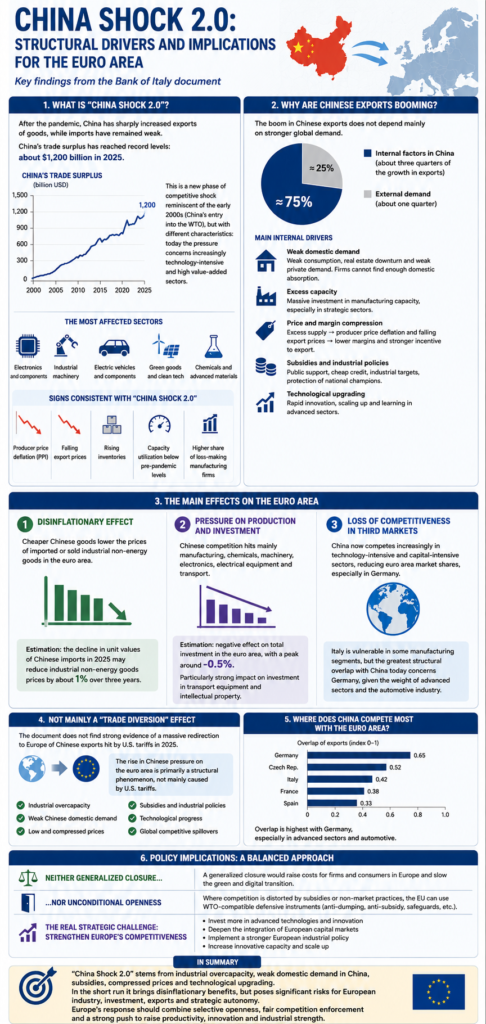
This is not simply a replay of the early-2000s “China shock” following China’s accession to the WTO. That earlier episode was largely driven by low-cost manufacturing integration into global markets. Today’s shock is different. It is shaped by overcapacity, weak domestic demand, industrial subsidies, technological upgrading, and China’s growing strength in higher-value sectors such as green technologies, electronics, machinery, transport equipment and advanced manufacturing.
The paper’s central finding is striking: around three quarters of China’s recent export growth appears to be driven by China-specific domestic factors rather than by stronger foreign demand. Weak domestic demand is the main driver. As China’s internal market absorbs less production, firms redirect output abroad, often at lower prices. This is reinforced by state support, soft budget constraints and an industrial model that continues to expand production capacity in strategic sectors.
For the euro area, the implications are ambivalent.
On the one hand, cheaper Chinese imports exert disinflationary pressure. The paper estimates that the fall in Chinese import prices in 2025 could reduce euro-area prices of non-energy industrial goods by around 1% over three years.
On the other hand, the real-economy effects are more concerning. Stronger Chinese competition weighs on European manufacturing, production and investment, especially in chemicals, machinery, electronics and transport equipment. The estimated impact on total investment peaks at around -0.5%, with particularly persistent effects on investment in intellectual property. This matters because it may affect not only current industrial performance, but also innovation capacity and long-term growth.
The external channel is also significant. China is increasingly competing with euro-area exporters in third markets, not only in low-cost goods but also in technologically advanced sectors. Germany appears particularly exposed, while Italy is vulnerable in several manufacturing segments.
A key point is that the paper finds little evidence that the recent pressure on Europe is mainly due to trade diversion from US tariffs. The phenomenon is more structural: weak Chinese domestic absorption, industrial overcapacity, lower prices, subsidies and technological upgrading.
The policy implication is not a choice between naïve openness and blanket protectionism. Europe needs a selective strategy. Openness to efficient Chinese inputs may support decarbonisation and reduce costs. But where competition is distorted by subsidies and non-market practices, defensive instruments may be justified. Above all, the European response must focus on competitiveness: investment, capital market integration, EU-level industrial policy, innovation, and technological capacity.
China Shock 2.0 is therefore not just a trade issue. It is an industrial, technological and strategic challenge for Europe.