The EU shift from sanctions adoption to criminal enforcement
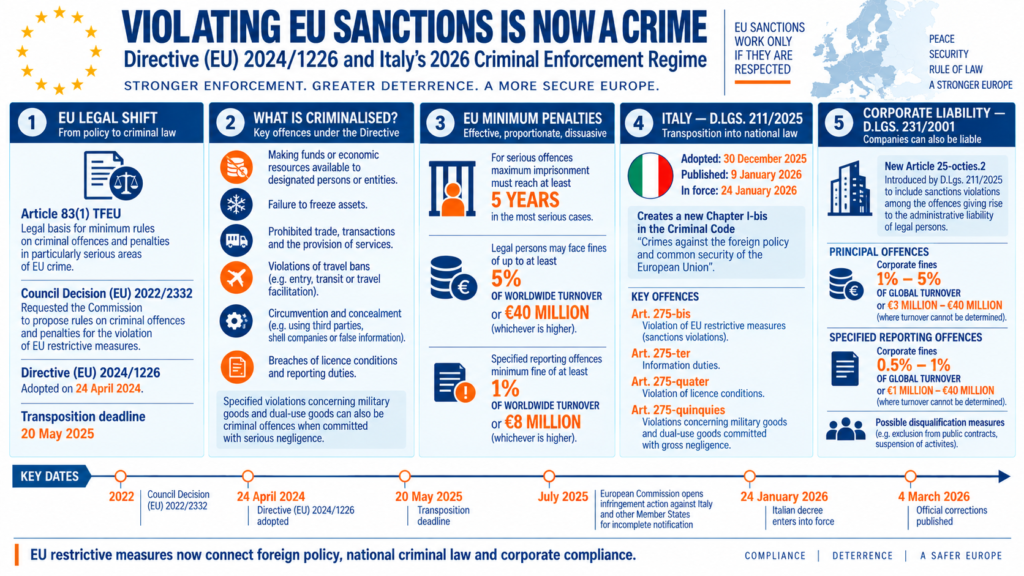
For many years, a structural weakness of EU sanctions policy lay in enforcement. Restrictive measures such as asset freezes, trade restrictions, export bans and prohibitions on services are adopted at Union level, but the criminal consequences of violating them traditionally depended on national law. Directive (EU) 2024/1226 seeks to reduce that fragmentation by laying down common minimum rules on offences, penalties, liability of legal persons, jurisdiction, freezing and confiscation, cooperation and enforcement.
The constitutional step preceding the Directive was Council Decision (EU) 2022/2332. Acting under the third subparagraph of Article 83(1) TFEU, the Council identified the violation of Union restrictive measures as an area of crime meeting the Treaty criteria for EU criminal-law harmonisation. Directive (EU) 2024/1226, adopted on 24 April 2024, then established the corresponding minimum rules.
The Directive does not itself create new restrictive measures. Those continue to arise principally from CFSP Decisions under Article 29 TEU and, where economic measures are required, Regulations under Article 215 TFEU. The Directive harmonises the enforcement layer.
Conduct covered by the Directive
Article 3 requires Member States to criminalise, when intentional and contrary to a Union restrictive measure, conduct including:
- making funds or economic resources available to designated persons or entities;
- failure to freeze their funds or economic resources;
- enabling designated persons to enter or transit through Member State territory contrary to a travel ban;
- prohibited transactions with third States, their bodies or controlled entities;
- prohibited trade, import, export, sale, purchase, transfer, transit or transport of goods;
- prohibited financial, business and other services;
- circumvention;
- specified failures to comply with reporting duties; and
- breaches of conditions attached to authorisations.
The Directive also requires specified trade-related violations involving items on the EU Common Military List or dual-use items listed in Annexes I and IV to Regulation (EU) 2021/821 to be criminal offences when committed with serious negligence.
For specified categories, Member States may treat conduct below EUR 10,000 as non-criminal, but linked conduct of the same kind must be capable of aggregation. This does not turn sub-threshold transactions into lawful conduct under the underlying restrictive measure.
Penalties and legal persons
For several serious offences involving at least EUR 100,000, national law must provide for a maximum term of imprisonment of at least five years. Enabling a travel-ban violation must be punishable by a maximum term of at least three years. Certain military and dual-use offences require a maximum term of at least five years irrespective of value.
Articles 6 and 7 make corporate liability a central part of the Directive. Legal persons must be capable of being held liable when offences are committed for their benefit by senior persons and when lack of supervision or control by such persons enables a subordinate to commit the offence for the entity’s benefit.
For the principal offences, the maximum available fine must be at least 5% of total worldwide turnover or EUR 40 million. For specified reporting offences, the benchmark is 1% of worldwide turnover or EUR 8 million.
Italy: Legislative Decree No 211/2025
Italy transposed the Directive through Legislative Decree No 211 of 30 December 2025. It was published in the Gazzetta Ufficiale on 9 January 2026 and entered into force on 24 January 2026. The EU transposition deadline had been 20 May 2025. In July 2025, the European Commission had included Italy among eighteen Member States receiving letters of formal notice for failure to notify full transposition measures.
The Italian reform is structurally significant. It inserts into Book II, Title I of the Criminal Code a new Chapter I-bis, “Crimes against the foreign policy and common security of the European Union”.
Article 275-bis Criminal Code
Article 275-bis is the core offence. It criminalises intentional breaches of prohibitions, obligations and restrictions deriving from EU restrictive measures or national implementing provisions, including making funds or economic resources available to designated persons, failure to freeze, prohibited transactions, restricted trade and prohibited services.
The basic penalty is imprisonment from two to six years and a fine from EUR 25,000 to EUR 250,000.
The provision also addresses circumvention, including the use, transfer or disposal of frozen resources and false declarations or documents used to obstruct identification of beneficial ownership.
For specified conduct involving less than EUR 10,000, Italy generally applies an administrative fine of EUR 15,000 to EUR 90,000. The low-value administrative treatment does not apply to the specified military and dual-use goods. Linked lower-value transactions forming part of the same economic design are aggregated.
Article 275-ter: reporting duties
Article 275-ter criminalises specified breaches of sanctions-related information obligations. The penalty is imprisonment from six months to two years and a fine from EUR 15,000 to EUR 50,000. Specified sub-EUR 10,000 cases are subject to an administrative fine from EUR 5,000 to EUR 45,000.
The implementing legislation also preserves the professional-secrecy safeguard for lawyers in the circumstances required by the Directive.
Article 275-quater: authorisation conditions
Article 275-quater punishes breaches of conditions attached to authorisations permitting otherwise restricted activities. The penalty is imprisonment from two to five years and a fine from EUR 25,000 to EUR 150,000. Below EUR 10,000, the administrative fine is EUR 15,000 to EUR 80,000.
On 4 March 2026, the Gazzetta Ufficiale published a formal correction clarifying that this low-value rule is a separate second paragraph of Article 275-quater.
Article 275-quinquies: gross negligence
Article 275-quinquies implements the Directive’s serious-negligence rule. Where the relevant trade-related conduct concerns goods on the EU Common Military List or specified dual-use items and is committed with gross negligence (colpa grave), the penalty is imprisonment from six months to three years and a fine from EUR 15,000 to EUR 90,000.
Travel-ban violations
The decree also amends Article 12 of Legislative Decree No 286/1998 on immigration, addressing the facilitation of unlawful entry by a person subject to EU restrictive measures.
Aggravating factors, cooperation and confiscation
The reform introduces aggravating circumstances for, among other things, organised-crime involvement, false documentation, commission in the exercise of professional, commercial, banking or financial activity, abuse of public functions, substantial profit or advantage, and destruction or concealment of evidence.
Effective cooperation may reduce the sentence by between one third and two thirds where it prevents further consequences, secures evidence, identifies other offenders or facilitates seizure.
Mandatory confiscation applies to instrumentalities and to the price, proceeds or profit of the offence, with equivalent-value confiscation when direct confiscation is impossible. The reform also regulates publication of convictions and extends Italian jurisdiction to the relevant offences committed abroad by Italian citizens.
D.Lgs. 231/2001: corporate sanctions based on global turnover
The decree inserts Article 25-octies.2 into Legislative Decree No 231/2001.
For the principal offences expressly covered, the pecuniary sanction is 1% to 5% of global turnover. Where turnover cannot be established, the alternative range is EUR 3 million to EUR 40 million.
For specified Article 275-ter reporting offences, the sanction is 0.5% to 1% of global turnover, or EUR 1 million to EUR 8 million when turnover cannot be established.
Interdictive sanctions may also apply. The reform therefore places sanctions compliance squarely within the Italian corporate-liability and organisational-compliance framework.
A conformity issue worth monitoring
A textual comparison reveals a point that merits further scrutiny.
Article 6 of Directive 2024/1226 requires Member States to ensure liability of legal persons for the criminal offences referred to in Articles 3 and 4. Article 3(3) includes the serious-negligence offence concerning military and specified dual-use goods.
Italy criminalises that conduct through Article 275-quinquies, but the new Article 25-octies.2 of D.Lgs. 231/2001 does not expressly list Article 275-quinquies among the predicate offences for entity liability.
This does not, by itself, prove incorrect transposition. A full conformity assessment must consider whether another national mechanism supplies the legal-person liability required by Article 6 and, ultimately, the interpretation of the Commission and Court of Justice. The textual discrepancy is nevertheless real and should be monitored.
Institutional coordination
The decree strengthens coordination between authorities responsible for sanctions implementation and criminal enforcement. UAMA remains central for export-control and restrictive-measure authorisations within its competence. The Financial Security Committee (CSF), UAMA and other competent authorities are integrated into information flows involving the National Anti-Mafia and Anti-Terrorism Prosecutor. Whistleblower protection under Legislative Decree No 24/2023 is also extended to the new sanctions offences.
A second technical erratum published on 4 March 2026 corrected the numbering of the provision concerning the UAMA-related institutional arrangement.
Why this matters
The Italian reform does more than increase penalties. It changes the legal character of sanctions compliance.
For companies exposed to international trade, finance, defence, aerospace, logistics, advanced technology or dual-use goods, sanctions screening now intersects directly with criminal law and D.Lgs. 231/2001. Relevant controls include beneficial-ownership analysis, counterparty and ownership/control screening, supply-chain and end-user review, export classification, licence management, documentation, reporting duties and circumvention risk.
More broadly, Directive 2024/1226 connects three layers that had previously remained more fragmented: EU external action, national criminal law and corporate compliance. Italy’s decision to place the new offences in a Criminal Code chapter expressly protecting the EU’s foreign policy and common security makes that constitutional shift particularly visible.