
Congress, the President, and the changing constitutional law of U.S. trade policy
Tariffs have returned to the centre of U.S. economic and foreign policy. They are increasingly used not only to protect domestic industries, but also to pursue broader objectives involving national security, economic security, strategic competition, supply chains, and relations with major trading partners.
Yet behind the political controversy lies a prior legal question that is sometimes overlooked: who actually has the authority to impose tariffs under the U.S. constitutional system?
The answer is more complex than the frequent reference to “presidential tariffs” might suggest.
The constitutional power belongs primarily to Congress. The President may impose or modify tariffs only when Congress has delegated that authority through legislation and when the conditions established by the relevant statute are satisfied.
This institutional structure is examined in detail in the Congressional Research Service report Congressional and Presidential Authority to Impose Import Tariffs, updated on 19 March 2026. The report analyses Congress’s constitutional powers, the statutory authorities delegated to the executive branch, the role of judicial review, and the consequences of the Supreme Court’s recent intervention in the field.
Tariffs begin with Congress
The constitutional starting point is Article I.
The Constitution gives Congress the power to regulate commerce with foreign nations and the power to “lay and collect Taxes, Duties, Imposts and Excises.” In other words, the authority to establish import tariffs forms part of the legislative powers assigned to Congress.
The President does not possess an equivalent inherent constitutional authority to impose tariffs.
That point has recently acquired renewed importance. As the CRS report notes, U.S. courts have repeatedly distinguished the President’s substantial authority in foreign affairs from the power to regulate commerce through tariffs. The Supreme Court stated in 2026 that, whatever the scope of presidential authority may be in other contexts, the President has no inherent peacetime authority to impose tariffs.
This does not mean that the President lacks important tariff powers. On the contrary, modern U.S. trade law gives the executive branch very considerable room for manoeuvre.
But that authority is delegated authority.
Congress has enacted a series of statutes allowing the President, the U.S. Trade Representative, or other executive authorities to adopt tariffs when specified conditions are met. The legal issue is therefore not simply whether the President wishes to impose a tariff. It is whether a statute enacted by Congress authorizes the measure in question.
Delegation is the key to understanding modern U.S. tariff policy
The modern system is built on a tension that runs through much of U.S. public law.
Congress possesses the constitutional power, but Congress has delegated substantial portions of that power to the executive.
Historically, the Supreme Court has accepted relatively broad delegations in the tariff field. The foundational case is J.W. Hampton, Jr. & Co. v. United States, in which the Court accepted that Congress could authorize the President to adjust tariff rates so long as Congress supplied an “intelligible principle” governing the exercise of the delegated authority.
Later decisions continued that approach. In particular, the Supreme Court upheld the constitutionality of Section 232 of the Trade Expansion Act because presidential action depends upon statutory preconditions, including a finding that imports threaten to impair national security.
The result is a legal framework in which the President may exercise very significant authority, but that authority takes different forms depending on the statutory basis invoked.
The CRS report identifies five particularly important tariff authorities currently available under federal law: Section 232 of the Trade Expansion Act of 1962; Sections 201, 301 and 122 of the Trade Act of 1974; and Section 338 of the Tariff Act of 1930.
They should not be treated as interchangeable.
Each responds to a different legal problem.
Section 232: tariffs and national security
Section 232 of the Trade Expansion Act of 1962 is perhaps the clearest example of the growing interaction between trade law and national-security policy.
The provision authorizes the President to adjust imports when the Secretary of Commerce finds that particular goods are being imported “in such quantities or under such circumstances as to threaten to impair the national security.”
The procedure therefore begins with an investigation by the Department of Commerce.
The Secretary of Commerce must investigate the effects of the relevant imports on national security, consult with other parts of the government — including the Department of Defense — and submit findings and recommendations to the President.
If the Secretary makes the necessary national-security finding, the President decides whether to concur and, if so, determines the nature and duration of the action necessary to adjust imports.
The breadth of the provision is striking.
Section 232 does not prescribe a general maximum tariff rate, nor does it impose a fixed maximum duration on tariffs imposed under the provision. The President is also not legally required to follow the Secretary of Commerce’s specific recommendations.
This explains why Section 232 has become so important in contemporary U.S. trade policy. It provides a comparatively broad statutory foundation for measures connecting imports to national-security concerns.
Section 201: protection against serious injury from imports
Section 201 of the Trade Act of 1974 addresses a different problem.
It is a safeguard mechanism.
Rather than focusing on national security or allegedly unfair conduct by foreign governments, Section 201 concerns situations in which increased imports cause, or threaten to cause, serious injury to a domestic industry.
The institutional structure is also different.
The U.S. International Trade Commission plays the central role in investigating whether the statutory conditions are satisfied. Only after the required injury determination does the statutory framework permit presidential action.
Section 201 is therefore an example of a more tightly structured delegation: executive action is preceded by a specialised institutional determination concerning the economic effects of imports.
It illustrates an important point about U.S. tariff law more generally. Presidential tariff powers differ not only in purpose, but also in the extent to which Congress has imposed procedures, findings, time limits, or quantitative restrictions before executive action becomes legally available.
Section 301: foreign trade practices and unilateral enforcement
Section 301 of the Trade Act of 1974 serves another function.
It is designed to respond to foreign governmental measures, policies, or practices that affect U.S. trade.
The statute gives the U.S. Trade Representative an important enforcement role where U.S. rights under trade agreements are violated or where foreign practices are considered unjustifiable, unreasonable, or discriminatory and burden or restrict U.S. commerce.
Section 301 is therefore not primarily a safeguard mechanism and is not centred on national security. It is a mechanism for responding to foreign trade practices.
Its importance has grown because it provides a legal basis for unilateral U.S. trade measures, including additional duties, while still operating within a statutory framework established by Congress.
The difference in institutional design also has consequences for judicial review. The CRS report notes that actions taken by the U.S. Trade Representative under Section 301 are reviewed according to the standards of the Administrative Procedure Act, including whether agency action is arbitrary, capricious, an abuse of discretion, contrary to law, or unsupported by substantial evidence.
Section 122: emergency action, but with explicit limits
Section 122 of the Trade Act provides a narrower authority directed at fundamental international payments problems.
It is particularly interesting because it demonstrates how Congress can authorize emergency economic action while simultaneously imposing clear statutory limits.
Unlike Section 232, Section 122 contains express restrictions concerning both the magnitude and duration of the measure.
A temporary import surcharge may reach up to 15 per cent and may generally remain in force for no more than 150 days.
This becomes especially significant in light of the Supreme Court’s 2026 judgment concerning the International Emergency Economic Powers Act.
The contrast is revealing. Where Congress intended to permit the executive branch to impose temporary tariffs in response to international payments problems, it did so explicitly and imposed identifiable limits on the delegated authority.
Section 338: discrimination against U.S. commerce
Section 338 of the Tariff Act of 1930 offers yet another legal basis for additional tariffs.
It addresses situations in which foreign countries discriminate against U.S. commerce or impose burdens or disadvantages on U.S. trade.
The statute allows additional duties, subject to statutory limits, as a response to such discriminatory treatment.
Unlike Sections 232, 201 and 301, Section 338 does not contain the same type of express requirement for a preliminary investigation and finding by a designated federal agency.
Its inclusion alongside the more frequently discussed modern trade statutes is useful because it demonstrates the diversity of tariff powers accumulated in U.S. legislation over time.
There is no single “tariff statute.” There is instead a collection of legal authorities adopted for different purposes and conferring different degrees of executive discretion.
The Supreme Court draws a line: IEEPA is not a tariff statute
The most consequential recent development came in February 2026.
In Learning Resources, Inc. v. Trump, the Supreme Court held that the International Emergency Economic Powers Act of 1977 — IEEPA — does not authorize the President to impose tariffs.
The issue was of considerable constitutional significance.
IEEPA grants the President broad powers over economic transactions following the declaration of certain national emergencies. Among other things, it authorizes the President to “regulate” or “prohibit” imports.
But the statute does not expressly authorize tariffs.
The Court rejected the proposition that the general authority to regulate imports could be read as an independent power to impose customs duties. As the CRS report explains, the Court relied both on the statutory language and on the broader structure of federal trade legislation.
That conclusion matters well beyond the specific tariffs challenged in the case.
If a broadly worded emergency statute were sufficient to authorize tariffs, the executive branch could potentially bypass the numerous trade statutes in which Congress deliberately specified particular triggers, procedures, institutional findings, tariff ceilings, and time limits.
The Supreme Court’s decision therefore reinforces the principle that presidential power over tariffs must ultimately be traced back to Congress.
Emergency powers do not automatically become tariff powers.
Judicial review may now become more important
The scope of presidential tariff authority also depends on the intensity of judicial review.
Historically, the Federal Circuit has adopted a relatively deferential approach when reviewing presidential action in the trade field.
Under the standard developed in Maple Leaf Fish Co. v. United States, judicial intervention has traditionally been associated with situations involving a “clear misconstruction” of the governing statute, significant procedural violations, or action outside the authority delegated by Congress.
That approach may now come under greater scrutiny.
In Loper Bright Enterprises v. Raimondo, decided in 2024, the Supreme Court rejected the Chevron doctrine of judicial deference to reasonable agency interpretations of ambiguous federal statutes. Courts, the Supreme Court explained, must exercise their own independent judgment when determining the meaning of statutory provisions.
The relationship between Loper Bright and the traditionally deferential review of presidential tariff decisions has not yet been completely resolved.
But the question is important.
If courts scrutinise statutory delegations and their exercise more closely, disputes over tariffs may increasingly turn on the precise wording of the statute invoked by the executive branch.
The deeper issue is separation of powers
Tariffs are often discussed primarily as instruments of economic policy.
They may protect domestic production, respond to foreign trade practices, encourage industrial investment, alter supply chains, or serve national-security objectives.
But legally they also raise a fundamental question of separation of powers.
The U.S. constitutional system does not simply ask whether a tariff is economically justified or strategically useful. It asks which institution has the legal authority to impose it.
Congress holds the underlying constitutional power.
Congress may delegate portions of that power to the executive, and historically it has done so extensively. But the President acts within a legal framework created by legislation. The scope of executive authority therefore depends on the text, structure, conditions and limits of the particular statute being invoked.
The 2026 Supreme Court decision on IEEPA makes this institutional distinction especially visible.
The President may possess extensive powers in foreign affairs and during national emergencies. But those powers do not themselves produce an independent constitutional authority to tax imports.
That is why Sections 232, 201, 301, 122 and 338 matter.
They are not merely technical provisions of trade legislation. They mark the legal boundaries between congressional power and executive discretion.
And as tariffs assume an increasingly important role in U.S. economic security and foreign policy, those boundaries are likely to become as important as the tariffs themselves.
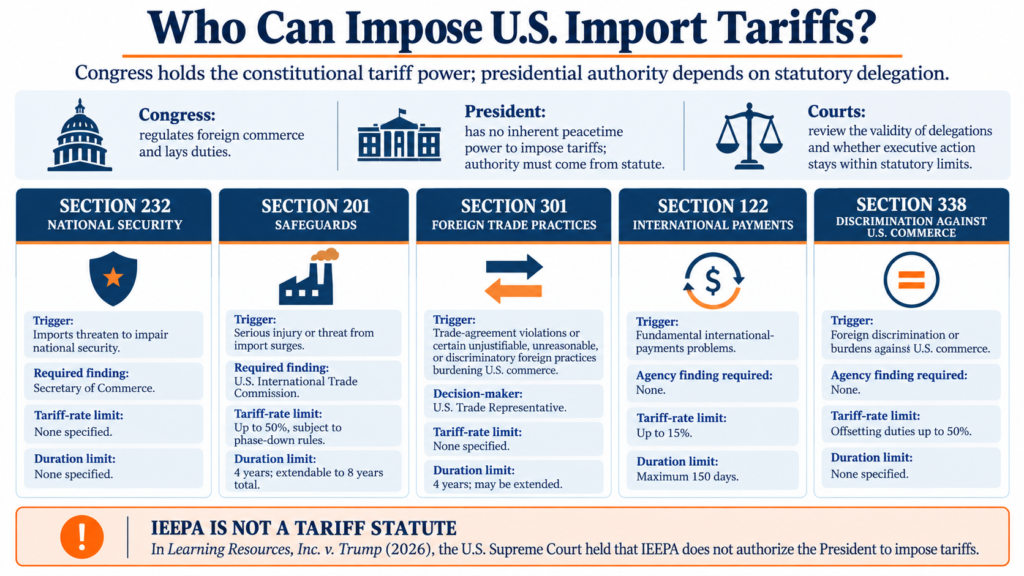
Chi ha il potere di imporre dazi negli Stati Uniti?
Congresso, Presidente ed evoluzione del diritto costituzionale statunitense in materia di politica commerciale
I dazi sono tornati al centro della politica economica ed estera degli Stati Uniti. Vengono utilizzati sempre più spesso non soltanto per proteggere le industrie nazionali, ma anche per perseguire obiettivi più ampi connessi alla sicurezza nazionale, alla sicurezza economica, alla competizione strategica, alle catene di approvvigionamento e alle relazioni con i principali partner commerciali.
Dietro la controversia politica si pone, tuttavia, una questione giuridica preliminare che talvolta viene trascurata: a chi spetta, nel sistema costituzionale statunitense, il potere di imporre dazi?
La risposta è più complessa di quanto possa suggerire il frequente riferimento ai «dazi presidenziali».
Il potere costituzionale appartiene principalmente al Congresso. Il Presidente può imporre o modificare dazi soltanto quando il Congresso gli abbia attribuito tale potere mediante una legge e siano soddisfatte le condizioni stabilite dalla relativa disciplina legislativa.
È proprio questa distinzione tra titolarità costituzionale del potere e suo esercizio delegato a rappresentare la chiave per comprendere il sistema statunitense.
Il punto di partenza è il Congresso
Il fondamento costituzionale si trova nell’Articolo I della Costituzione.
La Costituzione attribuisce al Congresso il potere di regolare il commercio con le nazioni straniere e quello di «imporre e riscuotere imposte, dazi, tributi e accise». L’autorità di stabilire dazi sulle importazioni rientra, dunque, nelle competenze legislative attribuite al Congresso.
Il Presidente non dispone di un corrispondente potere costituzionale inerente di imporre dazi.
Questo punto è essenziale perché consente di distinguere il potere presidenziale in materia tariffaria dagli ampi poteri riconosciuti al Presidente nell’ambito delle relazioni internazionali e della sicurezza nazionale.
Che il Presidente disponga di rilevanti competenze in materia di politica estera non significa, infatti, che possa ricavarne automaticamente un potere autonomo di assoggettare le importazioni a dazi.
Ciò non significa, naturalmente, che il Presidente sia privo di importanti poteri in materia tariffaria.
Al contrario, il diritto commerciale statunitense gli attribuisce un margine di manovra molto ampio.
Ma si tratta di poteri delegati dal Congresso.
Nel corso del tempo il Congresso ha adottato numerose disposizioni che consentono al Presidente, allo U.S. Trade Representative o ad altre autorità dell’esecutivo di imporre dazi o altre restrizioni commerciali quando ricorrono determinate condizioni.
La questione giuridica fondamentale, quindi, non è semplicemente se il Presidente voglia imporre un dazio.
Occorre chiedersi quale legge lo autorizzi a farlo, in presenza di quali presupposti e entro quali limiti.
La delega legislativa è la chiave del sistema
Il sistema contemporaneo riflette una tensione tipica del diritto costituzionale statunitense.
Da un lato, il Congresso è titolare del potere costituzionale.
Dall’altro, nel corso del XX secolo ha progressivamente delegato una parte molto significativa delle proprie competenze commerciali all’esecutivo.
La Corte Suprema ha storicamente ammesso deleghe relativamente ampie in materia tariffaria.
Il precedente classico è J.W. Hampton, Jr. & Co. v. United States, nel quale la Corte riconobbe che il Congresso potesse autorizzare il Presidente a modificare le aliquote tariffarie, purché il legislatore avesse stabilito un «principio intelligibile» — intelligible principle — destinato a guidare l’esercizio del potere delegato.
L’idea di fondo è dunque chiara: il Presidente può disporre di una considerevole discrezionalità, ma tale discrezionalità deve trovare la propria base in una legge del Congresso.
Da qui deriva l’importanza delle diverse disposizioni legislative oggi utilizzate in materia tariffaria.
Tra le più rilevanti vi sono:
Section 232 del Trade Expansion Act del 1962; Sections 201, 301 e 122 del Trade Act del 1974; Section 338 del Tariff Act del 1930.
Non sono strumenti intercambiabili.
Ciascuno risponde a una diversa logica giuridica, prevede differenti presupposti e attribuisce all’esecutivo un diverso grado di discrezionalità.
Section 232: dazi e sicurezza nazionale
La Section 232 del Trade Expansion Act del 1962 costituisce uno degli esempi più evidenti dell’interazione tra politica commerciale e sicurezza nazionale.
La disposizione autorizza il Presidente ad adottare misure volte ad «adjust imports» quando il Secretary of Commerce accerti che determinati beni vengono importati «in quantità o in circostanze tali da minacciare di compromettere la sicurezza nazionale».
La procedura prende avvio con un’indagine del Department of Commerce.
Il Secretary of Commerce deve valutare gli effetti delle importazioni interessate sulla sicurezza nazionale, consultare altre amministrazioni — incluso il Department of Defense — e trasmettere al Presidente le proprie conclusioni e raccomandazioni.
Se viene formulato il necessario accertamento relativo alla sicurezza nazionale, spetta al Presidente decidere se condividerlo e, in caso affermativo, determinare la natura delle misure necessarie per adeguare le importazioni.
L’ampiezza della disposizione è considerevole.
La Section 232 non stabilisce un’aliquota tariffaria massima generale e non prevede una durata massima predeterminata per le misure adottate sulla sua base.
Il Presidente, inoltre, dispone di un significativo margine di discrezionalità nella determinazione delle misure da adottare.
È precisamente questa ampiezza a spiegare perché la Section 232 sia diventata uno degli strumenti più importanti della moderna politica di economic security statunitense.
Essa consente infatti di collegare direttamente la regolazione degli scambi commerciali a considerazioni di sicurezza nazionale.
Section 201: protezione contro il grave pregiudizio causato dalle importazioni
La Section 201 del Trade Act del 1974 risponde a una logica differente.
È un meccanismo di salvaguardia.
Non riguarda principalmente la sicurezza nazionale né comportamenti illeciti o discriminatori di Stati stranieri.
Opera invece quando l’aumento delle importazioni causa, o minaccia di causare, un grave pregiudizio a un’industria nazionale.
Anche la struttura istituzionale è diversa.
La U.S. International Trade Commission svolge un ruolo centrale nell’accertare se ricorrano le condizioni previste dalla legge.
Soltanto una volta effettuato il necessario accertamento relativo al pregiudizio può aprirsi lo spazio per l’intervento presidenziale.
La Section 201 rappresenta quindi una forma di delega maggiormente strutturata: la discrezionalità dell’esecutivo interviene all’interno di una procedura nella quale un’autorità specializzata deve previamente valutare gli effetti economici delle importazioni sull’industria statunitense.
La disposizione mostra bene come i poteri presidenziali in materia commerciale differiscano non soltanto per finalità, ma anche per intensità dei vincoli procedurali e sostanziali stabiliti dal Congresso.
Section 301: pratiche commerciali straniere ed enforcement unilaterale
La Section 301 del Trade Act del 1974 persegue un’altra finalità ancora.
Essa è destinata a reagire a misure, politiche o pratiche di governi stranieri che incidono negativamente sul commercio degli Stati Uniti.
La disposizione attribuisce allo U.S. Trade Representative un importante ruolo di enforcement nei casi in cui siano violati diritti degli Stati Uniti derivanti da accordi commerciali oppure quando pratiche straniere siano considerate ingiustificabili, irragionevoli o discriminatorie e comportino un onere o una restrizione per il commercio statunitense.
La Section 301 non è quindi principalmente uno strumento di salvaguardia e non è fondata sulla sicurezza nazionale.
È uno strumento di trade enforcement.
La sua importanza è cresciuta soprattutto perché consente agli Stati Uniti di adottare misure commerciali unilaterali, compresi dazi aggiuntivi, nei confronti di pratiche straniere considerate lesive degli interessi commerciali statunitensi.
Anche in questo caso, tuttavia, la possibilità di adottare tali misure deriva da una specifica attribuzione legislativa del Congresso.
Section 122: poteri d’emergenza, ma con limiti precisi
La Section 122 del Trade Act attribuisce un potere più circoscritto, connesso a gravi problemi relativi alla bilancia internazionale dei pagamenti.
La disposizione è particolarmente interessante perché mostra come il Congresso possa attribuire poteri economici d’emergenza all’esecutivo e, nello stesso tempo, definirne con precisione i limiti.
A differenza della Section 232, la Section 122 prevede infatti restrizioni espresse sia per quanto riguarda l’entità sia per quanto riguarda la durata delle misure.
Un sovrapprezzo temporaneo sulle importazioni può raggiungere un massimo del 15 per cento e può generalmente rimanere in vigore per non più di 150 giorni.
Questo elemento è giuridicamente significativo.
Quando il Congresso ha voluto consentire all’esecutivo di imporre dazi temporanei in risposta a specifiche difficoltà economiche internazionali, lo ha fatto espressamente, precisando presupposti e limiti del potere delegato.
La Section 122 offre quindi un utile termine di confronto rispetto a disposizioni formulate in termini molto più generali.
Section 338: discriminazioni contro il commercio statunitense
La Section 338 del Tariff Act del 1930 costituisce un’ulteriore base giuridica per l’imposizione di dazi aggiuntivi.
Essa riguarda le situazioni nelle quali Stati stranieri discriminino il commercio degli Stati Uniti oppure impongano oneri o svantaggi alle attività commerciali statunitensi.
La disposizione consente l’imposizione di dazi aggiuntivi, entro determinati limiti legislativi, come risposta a tali forme di trattamento discriminatorio.
La Section 338 presenta una struttura diversa rispetto alle Sections 232, 201 e 301 e non è costruita attorno allo stesso tipo di procedimento preliminare affidato a una specifica agenzia federale.
La sua presenza nel sistema mostra tuttavia un dato importante: il diritto tariffario statunitense non è organizzato attorno a un’unica fonte normativa.
Esiste piuttosto una pluralità di basi giuridiche, elaborate in periodi storici diversi e destinate a rispondere a problemi differenti.
La Corte Suprema traccia un limite: l’IEEPA non autorizza i dazi
Il passaggio più importante nell’evoluzione recente del sistema si è verificato nel febbraio 2026.
In Learning Resources, Inc. v. Trump, la Corte Suprema ha stabilito che l’International Emergency Economic Powers Act del 1977 — IEEPA — non autorizza il Presidente a imporre dazi.
La questione aveva una portata costituzionale particolarmente rilevante.
L’IEEPA attribuisce infatti al Presidente ampi poteri sulle transazioni economiche in seguito alla dichiarazione di determinate emergenze nazionali.
Tra l’altro, autorizza il Presidente a «regolare» o «proibire» le importazioni.
Ma non attribuisce espressamente il potere di imporre dazi.
La Corte ha respinto l’idea che il generale potere di «regolare» le importazioni potesse essere interpretato come una delega implicita del potere di imporre dazi doganali.
La conclusione ha implicazioni che vanno ben oltre le singole misure oggetto della controversia.
Se una disposizione generale sui poteri economici d’emergenza fosse sufficiente a consentire l’imposizione di dazi, l’esecutivo potrebbe potenzialmente eludere l’intero sistema di deleghe legislative specifiche costruito dal Congresso.
Verrebbero infatti messi in secondo piano proprio quei presupposti, quelle procedure, quei limiti quantitativi e temporali che caratterizzano le diverse fonti legislative in materia commerciale.
La decisione rafforza quindi un principio fondamentale:
il potere presidenziale di imporre dazi deve poter essere ricondotto a una specifica attribuzione del Congresso.
I poteri d’emergenza non si trasformano automaticamente in poteri tariffari.
Il controllo giurisdizionale potrebbe assumere un ruolo crescente
L’estensione dei poteri presidenziali in materia tariffaria dipende anche dal grado di controllo esercitato dai giudici.
Tradizionalmente, la Federal Circuit ha adottato un approccio relativamente deferente nel controllo degli atti presidenziali in materia commerciale.
Nella giurisprudenza sviluppatasi a partire da Maple Leaf Fish Co. v. United States, l’intervento giudiziario è stato generalmente associato a ipotesi di evidente interpretazione erronea della legge, significative violazioni procedurali oppure esercizio di poteri eccedenti quelli attribuiti dal Congresso.
Questo quadro deve però essere letto oggi alla luce della più generale trasformazione del diritto amministrativo statunitense.
In Loper Bright Enterprises v. Raimondo, nel 2024, la Corte Suprema ha abbandonato la Chevron doctrine, secondo la quale i giudici riconoscevano una particolare deferenza alle interpretazioni ragionevoli formulate dalle agenzie amministrative in presenza di disposizioni legislative ambigue.
La Corte ha invece ribadito che spetta ai giudici determinare autonomamente il significato delle disposizioni legislative.
Il rapporto tra Loper Bright e il tradizionale controllo relativamente deferente esercitato sulle decisioni presidenziali in materia commerciale non è ancora completamente definito.
Ma la questione è importante.
Più il controllo giudiziario si concentra sul testo preciso della delega legislativa, più diventa rilevante individuare con esattezza la disposizione che autorizza l’intervento dell’esecutivo.
Le controversie sui dazi diventano così anche controversie sull’interpretazione dei confini del potere delegato.
La questione di fondo è la separazione dei poteri
I dazi vengono generalmente discussi come strumenti di politica economica.
Possono proteggere la produzione nazionale, reagire a pratiche commerciali straniere, incentivare investimenti industriali, modificare le catene di approvvigionamento oppure perseguire obiettivi di sicurezza nazionale.
Ma, sul piano costituzionale, pongono una questione ancora più fondamentale: chi può decidere di imporli?
Il diritto statunitense non si limita quindi a chiedere se un dazio sia economicamente giustificato o strategicamente utile.
Chiede anzitutto quale istituzione disponga del potere giuridico necessario per adottarlo.
Il punto di partenza rimane il Congresso.
È il Congresso a detenere il potere costituzionale di regolare il commercio con le nazioni straniere e di imporre dazi.
Il Congresso può delegare una parte significativa di tale potere all’esecutivo — e storicamente lo ha fatto in misura molto ampia — ma il Presidente opera comunque all’interno di un quadro legislativo.
L’estensione della sua autorità dipende quindi dal testo, dalla struttura, dai presupposti e dai limiti della specifica legge invocata.
La vicenda dell’IEEPA rende questa distinzione particolarmente evidente.
Il Presidente può disporre di ampi poteri in materia di politica estera, sicurezza nazionale ed emergenze economiche.
Ma tali poteri non producono, di per sé, un autonomo potere costituzionale di tassare le importazioni.
È precisamente per questa ragione che le Sections 232, 201, 301, 122 e 338 assumono una rilevanza che va ben oltre la tecnica del diritto commerciale.
Esse rappresentano diverse modalità attraverso le quali il Congresso definisce il confine tra il proprio potere costituzionale e la discrezionalità dell’esecutivo.
E proprio mentre i dazi tornano a essere utilizzati come strumenti di sicurezza economica, competizione strategica e politica estera, la questione dei confini giuridici del potere presidenziale rischia di diventare importante quanto quella dell’efficacia economica dei dazi stessi.
