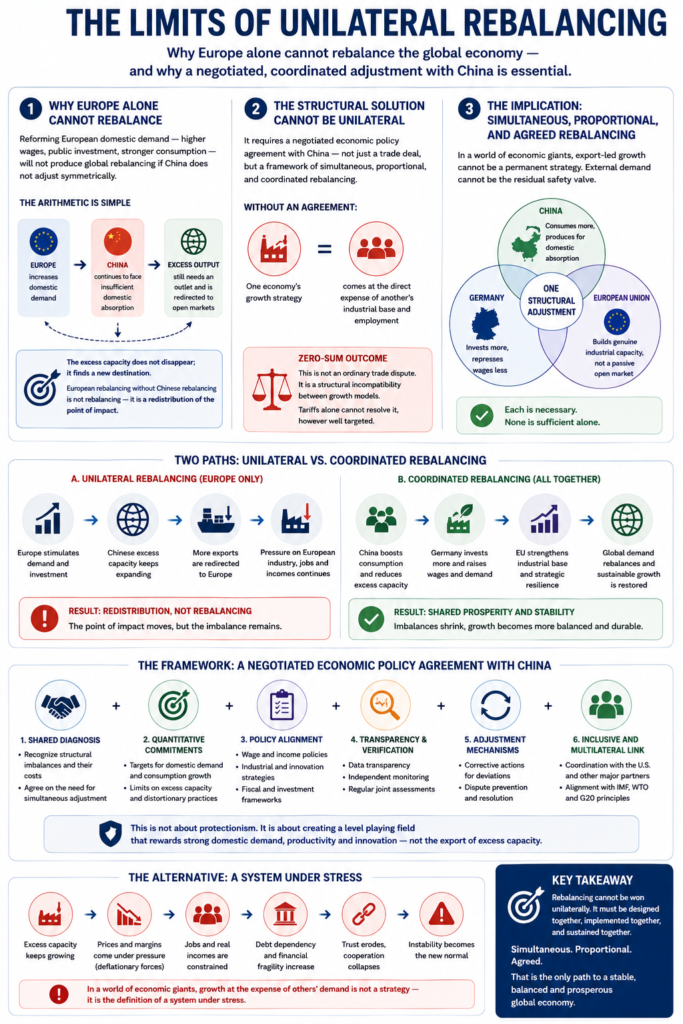
Germany did not win globalisation in general. It won a particular globalisation — one that handsomely rewarded countries willing to run persistent trade surpluses, hold wages down, starve domestic demand, and ride a real exchange rate that competitors locked inside the euro could not devalue away. The research on this is extensive and, at this point, fairly damning: German wage moderation accounts for roughly half of the divergence in trade balances between Germany and its eurozone partners. Not productivity miracles. Not superior innovation. Wage compression. Labour costs held artificially low, year after year, while the export sector swelled and partner countries found themselves squeezed from both sides — unable to compete on cost, unable to devalue, forced into the familiar downward spiral of internal devaluation that the eurozone imposes on its weaker members with the regularity of a natural law.
The model worked. For a while.
It worked because someone was buying. Above all, China. Germany’s export machine was not self-sustaining — it depended on a specific global configuration: high Chinese domestic investment, voracious appetite for capital goods, limited competition in the segments where German industry was strongest (machinery, cars, industrial equipment), and a world economy growing fast enough to absorb the output of a country that was, in effect, exporting its way out of the need to develop its own internal market. The numbers tell the story with brutal clarity. German exports to China surged from €52 billion in 2009 to a record €123 billion in 2021 — nearly double the combined exports of France, the United Kingdom, and Italy to the same destination. That is not trade. That is dependency dressed up as competitive advantage.
Then the music stopped.
China’s property bubble burst in 2021. Domestic demand cratered and never recovered. But instead of pivoting toward household consumption — the rebalancing that economists had been urging for a decade — Beijing did the opposite. It doubled down on state-directed manufacturing investment. More factories. More capacity. More output. The logic was industrial dominance, not domestic welfare, and the consequences for Germany were immediate and severe. Chinese exports in volume terms wildly outperformed global trade in 2024. German exports in capital and durable goods shrank. In automotive — the crown jewel, the sacred sector — German car exports to China collapsed by almost 70 percent between 2022 and 2024. Seventy percent. In machine tools, the reversal came even earlier: Germany became a net importer of Chinese machine tools already in 2015, a fact that was noted at the time but whose full significance is only now becoming apparent.
What happened is structurally intelligible, even if politically inconvenient. China’s overcapacity is not an accident. It is the product of more than a decade of deliberate industrial policy — subsidised credit, directed investment, strategic targeting of sectors where foreign competitors could be displaced. Chinese firms now produce far more than a saturated domestic market can absorb, and they are doing what surplus producers have always done: they are exporting the excess. China’s trade surplus approached one trillion dollars in 2024. Exports grew. Imports barely moved. The gap is not a blip. It is a structural imbalance between production capacity and domestic demand, sustained by a political system that has chosen supply-side dominance over the messy, redistributive, politically costly business of raising household incomes.
And here is the uncomfortable symmetry. Germany spent two decades doing a version of the same thing. Suppressing wages. Compressing domestic demand. Accumulating surpluses. Exporting the consequences. The difference is that Germany did it within a monetary union whose rules made retaliation by partners nearly impossible, while China is doing it on a global stage where the backlash — tariffs, screening mechanisms, industrial policy responses — is building fast. Germany has gone from being a beneficiary of surplus-led globalisation to being one of its casualties. Same system. Same logic. Different seat at the table.
The political temptation, naturally, is to reach for an anti-China strategy. Tariffs. Screening. De-risking. These are not pointless — some of them are necessary — but they do not address the structural problem. They treat the symptom. The disease is an international trading regime that rewards countries which suppress household income, compress domestic demand, and grow by absorbing external demand through persistent surpluses. As long as that regime remains intact, it will keep generating the same pathologies: imbalances, deflationary pressure, rising inequality, mounting debt dependence. Change the surplus country and you change the name on the invoice. You do not change the dynamic.
Keynes saw this. At Bretton Woods, he proposed an International Clearing Union in which persistent surpluses would incur interest charges alongside the penalties already imposed on deficits — symmetric pressure on creditors and debtors alike to rebalance. The idea was simple and, in retrospect, prophetic: an international system that punishes only deficit countries while allowing surpluses to pile up unproductively will always force deflationary adjustment onto the weak while subsidising the strong. The Americans killed the proposal. They were the surplus country in 1944. They had no interest in symmetry. The asymmetry Keynes sought to correct has never been corrected. It has merely changed hands.
A serious response, then, would look less at the nationality of today’s surplus country and more at the mechanism that makes surpluses so attractive in the first place. The question is not who exports too much in any given decade. The question is why the system continues to reward strategies that export the consequences of insufficient domestic demand onto everyone else — compressing global aggregate demand, hollowing out industrial capacity in deficit countries, and generating, with metronomic predictability, the conditions for the next adjustment crisis.
Fixing that requires changing incentives, not merely rotating enemies.
It is a harder problem. It is also the only one worth solving.
The Limits of Unilateral Rebalancing
Here is the part that European policymakers prefer not to dwell on.
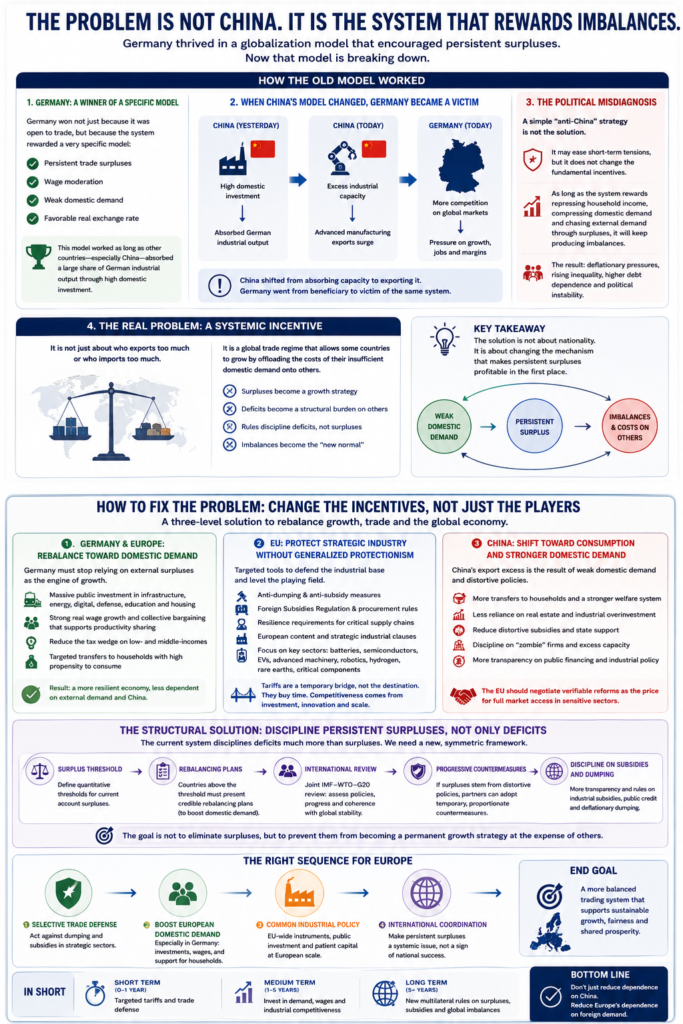
Raise German wages. Expand public investment. Strengthen household consumption across the eurozone. All of this is desirable — overdue, in fact, by at least a decade. But will it produce global rebalancing? No. Not by itself. Not even close. Because the arithmetic is merciless: if Chinese producers continue to face structurally insufficient domestic absorption — and they do, and Beijing shows no serious intention of changing this — any increase in European demand will simply be met by additional Chinese supply. More purchasing power in Stuttgart or Milan does not shrink the overcapacity in Shenzhen. It redirects it. The excess output does not vanish. It finds a new address.
European rebalancing without Chinese rebalancing is not rebalancing. It is moving the bruise.
This point tends to get buried under the more comfortable parts of the discussion — the ones about what Europe should do differently, the ones that involve self-criticism and reform agendas and the implicit promise that the problem is within our control. It is not entirely within our control. A structural surplus on one side of the global economy cannot be absorbed by good intentions on the other.
So what follows?
Something that no one in Brussels or Berlin is eager to say out loud: the structural solution cannot be unilateral. It requires a negotiated framework with China. Not a trade deal in the ordinary sense — not the familiar choreography of tariff schedules, market access commitments, and face-saving communiqués. Something more demanding. A framework for simultaneous, proportional, and coordinated rebalancing. Without it, the logic is zero-sum, and inescapably so. One economy’s growth strategy is sustained at the direct expense of another’s industrial base. That is not a trade dispute. Trade disputes are about quotas and dumping margins. This is a structural incompatibility between growth models. Tariffs will not resolve it, however surgically applied. They can slow the bleeding. They cannot fix the circulatory system.
Take the proposition seriously for a moment. Export-led growth, as a permanent national strategy, no longer works in a world of economic giants. The United States, China, the European Union — each represents a market too vast and an economy too consequential to treat external demand as a residual safety valve, a convenient dumping ground for whatever the domestic market cannot absorb. If that is true — and the evidence of the last five years suggests it is — then the implication is unavoidable. Rebalancing must be simultaneous. It must be proportional. It must be agreed.
A China that consumes more and produces for its own households instead of for everyone else’s markets. A Germany that invests in its own infrastructure and stops treating wage compression as an economic philosophy. A European Union that builds genuine industrial capacity rather than operating as a passive open market, available to anyone with a cost advantage and a shipping container. These are not three separate reform agendas. They are three faces of the same structural adjustment. Pull one out and the others collapse. A consuming China without a investing Germany leaves Europe still exposed. An investing Germany without a consuming China leaves the surplus problem intact, merely relocated. A Europe with industrial ambition but no coordinated framework with its trading partners is a Europe building sandcastles at high tide.
Each is necessary. None is sufficient. And the chances of all three happening at once, in coordination, through negotiation rather than confrontation?
Slim. Possibly vanishing.
But that does not make the analysis wrong. It makes the politics hard. The alternative — each major economy attempting to grow at the expense of the others’ demand, grabbing market share in a world where aggregate demand is structurally insufficient — is not a stable equilibrium. It is not even an unstable one. It is a system eating itself, and the only question is how long the meal takes.