This continues from the previous post.
Those who do research in a law faculty don’t disappear. But the source of their value changes.
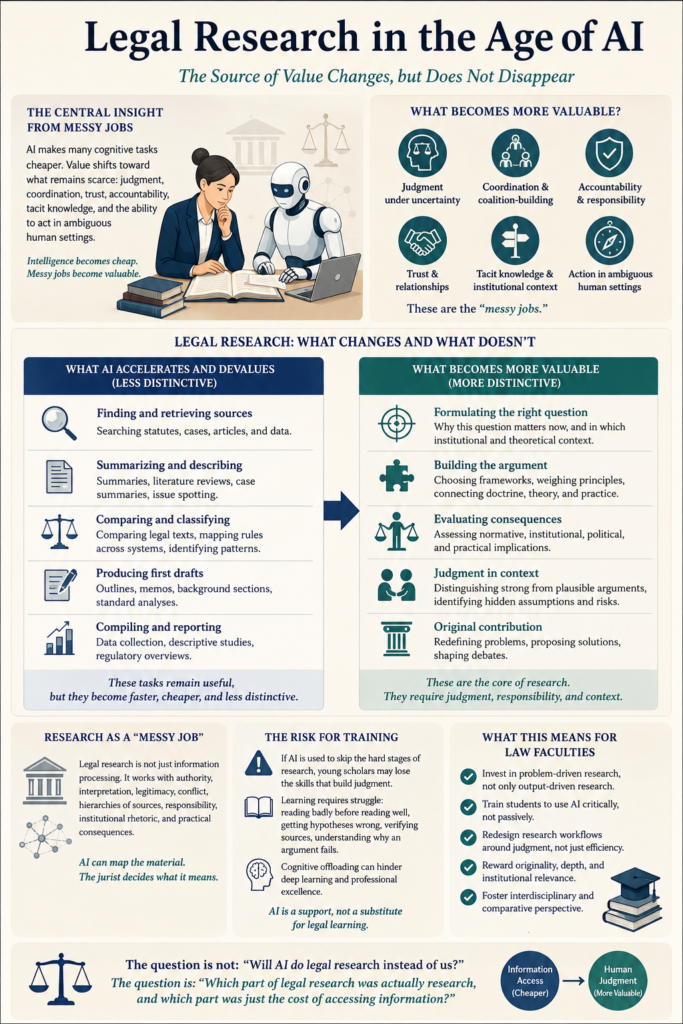
The most fragile part of legal research is the part that resembles standardizable informational work: searching for sources, summarizing articles, reconstructing case law, producing literature reviews, comparing legal texts, preparing first drafts. These activities don’t become useless, but they become less distinctive, because AI drastically reduces their cost. This is exactly the logic of Messy Jobs: when certain forms of cognition become cheap, the economic and professional premium shifts toward judgment, coordination, responsibility, tacit knowledge, and human relationships.
The decisive point is that genuine legal research is not the same as legal information retrieval. A good researcher isn’t valuable simply because they “find” statutes, judgments, and doctrine. They’re valuable because they know how to formulate a relevant question, understand why that question matters now, situate it within an institutional system, distinguish a strong argument from a merely plausible one, assess the normative consequences of a thesis, and recognize the political or theoretical assumptions hidden behind a technical solution.
So the legal researcher of the future will be less of a compiler and more of an architect of the legal problem.
AI will be able to help a great deal with legal research. Cornell Law, for instance, describes AI as a tool that can assist in identifying patterns in legal texts, generating and testing legal theories, and expanding empirical legal study. But this is precisely what makes the human capacity to decide more important: which patterns matter, which hypotheses deserve trust, which correlations are legally significant, and which conclusions are institutionally sustainable.
For those working in a law faculty, the transformation will likely be asymmetric.
Those who produce purely descriptive research — “what does the literature say about X,” “what are the rulings on Y,” “how is Z regulated across five legal systems” — will be more exposed. That kind of work will be accelerated, automated, or devalued. It will remain useful, but it will no longer be enough to distinguish a researcher.
Those who can build an original contribution, on the other hand, will have more room. Original doesn’t necessarily mean “brilliant” or “revolutionary.” It means being able to do one of the things AI struggles to do reliably: redefine the problem, choose the theoretical framework, weigh competing principles, identify institutional implications, and connect positive law, theory, practice, and historical-political context.
In law, moreover, research is a typical “messy job” because it doesn’t work only with data. It works with authority, interpretation, legitimacy, conflict, hierarchies of sources, responsibility, institutional rhetoric, and practical consequences. A model can generate a formally elegant answer; the jurist must determine whether that answer is correct, defensible, coherent with the system, compatible with practice, and responsible in its consequences.
This is even more true for fields such as international law, EU law, constitutional law, administrative law, security law, criminal law, labor law, or the law of new technologies. In these fields, the legal problem is never purely technical. It is interwoven with sovereignty, institutions, power, fundamental rights, economic interests, security, democratic legitimacy, and conflicts between legal orders. AI can help map the material; it cannot replace the legal-political judgment that decides what that map means.
The most serious risk concerns the training of young researchers. If PhD students and research fellows use AI to skip the laborious stages of research, they may lose precisely the skills that build judgment: reading badly before reading well, getting hypotheses wrong, verifying sources, understanding why an argument doesn’t hold up, and learning the style of a disciplinary tradition. The UCL Laws document on the relationship between AI, training, and legal assessment insists precisely on this balance: AI can be a useful support, but the development of legal excellence remains crucial, and the risk of “cognitive offloading” can hinder learning.
So the question isn’t: “Will AI do legal research instead of us?” The question is: “Which part of legal research was actually research, and which part was just the cost of accessing information?”
The first part remains human and can become more valuable. The second becomes cheaper.