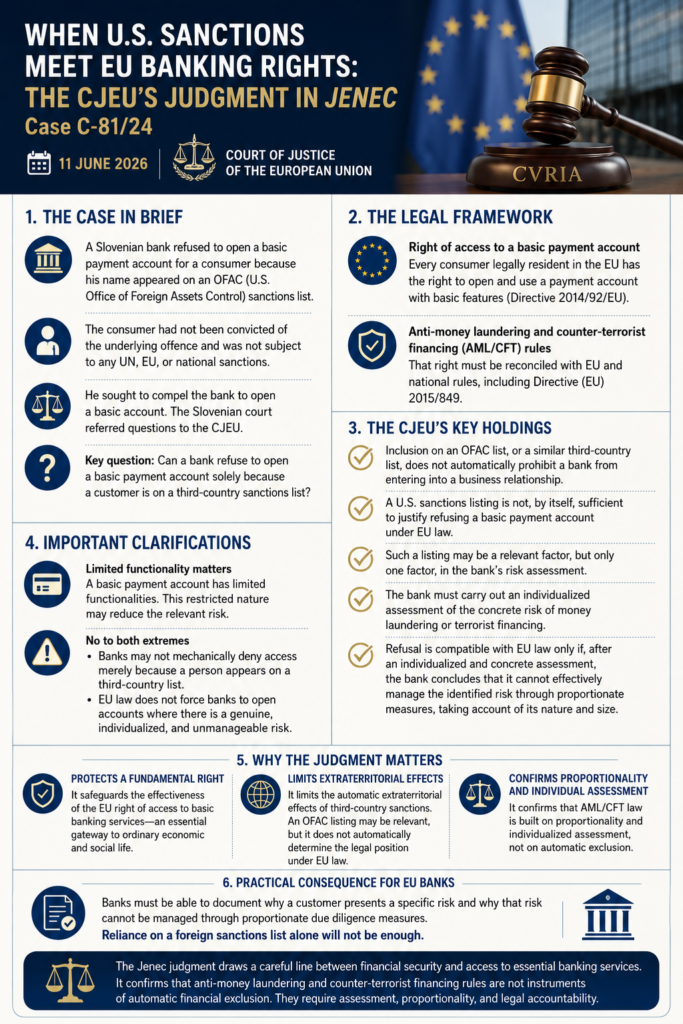
When U.S. Sanctions Meet EU Banking Rights: The CJEU’s Judgment in Jenec — Case C-81/24
On 11 June 2026, the Court of Justice of the European Union delivered its judgment in Jenec, Case C-81/24, concerning access to basic banking services where a consumer appears on a United States sanctions list.
The case arose in Slovenia. In 2022, a Slovenian bank refused to open a basic payment account for a consumer because his name appeared on a sanctions list maintained by the U.S. Office of Foreign Assets Control, commonly known as OFAC. The bank argued that the refusal was necessary in order to comply with Slovenian rules on the prevention of money laundering and terrorist financing.
The consumer, however, had not been convicted of the offence underlying his inclusion on the OFAC list. Nor had any sanctions been imposed on him by the United Nations, the European Union, or Slovenia. He therefore brought proceedings before the Slovenian courts, seeking to compel the bank to open a basic payment account. The Slovenian court referred questions to the CJEU on whether such a refusal was justified under EU law.
The Court’s answer is significant.
The CJEU first recalled that every consumer legally resident in the European Union has the right to open and use a payment account with basic features. This right derives from Directive 2014/92/EU, which is designed to ensure access to essential banking services such as deposits, withdrawals, transfers, direct debits, and card payments.
However, that right is not absolute. It must be reconciled with EU and national rules on anti-money laundering and counter-terrorist financing, including Directive (EU) 2015/849.
The key point in the judgment is that inclusion on an OFAC list, or on a similar list drawn up by a third country, does not automatically prohibit an EU bank from entering into a business relationship with the person concerned.
In other words, a U.S. sanctions listing is not, by itself, sufficient to justify refusing a basic payment account under EU law.
The Court held that such a listing may be a relevant factor in the bank’s risk assessment. But it must be only one factor. The bank must carry out an individualized assessment of the concrete risk of money laundering or terrorist financing associated with that customer.
This is the central legal standard: the refusal to open a basic payment account is compatible with EU law only if, after an individualized and concrete assessment, the bank concludes that it cannot effectively manage the identified risk through proportionate measures, taking account of its nature and size.
The Court also noted that a basic payment account has limited functionalities. That matters because the restricted nature of the account may reduce the relevant risk. Still, the Court did not exclude the possibility that, in a specific case, even a basic account could present a risk that the bank cannot manage adequately.
The judgment therefore rejects both extremes.
On the one hand, banks may not mechanically deny access to basic banking services merely because a person appears on a third-country sanctions list. On the other hand, EU law does not force banks to open accounts where a genuine, individualized, and unmanageable money-laundering or terrorist-financing risk has been established.
The decision is important for at least three reasons.
First, it protects the effectiveness of the EU right of access to basic banking services. A basic payment account is not a luxury financial product. It is a gateway to ordinary economic and social life.
Second, the judgment limits the automatic extraterritorial effects of third-country sanctions within the EU legal order. An OFAC listing may be relevant, but it does not automatically determine the legal position under EU law.
Third, the ruling confirms the centrality of proportionality and individualized assessment in EU anti-money laundering law. Compliance obligations cannot be reduced to automatic exclusion. Banks must assess risk concretely and justify restrictive decisions on that basis.
The practical consequence is clear: EU banks must be able to document why a customer presents a specific risk and why that risk cannot be managed through proportionate due diligence measures. Reliance on a foreign sanctions list alone will not be enough.
The Jenec judgment thus draws a careful line between financial security and access to essential banking services. It confirms that anti-money laundering and counter-terrorist financing rules are not instruments of automatic financial exclusion. They require assessment, proportionality, and legal accountability.