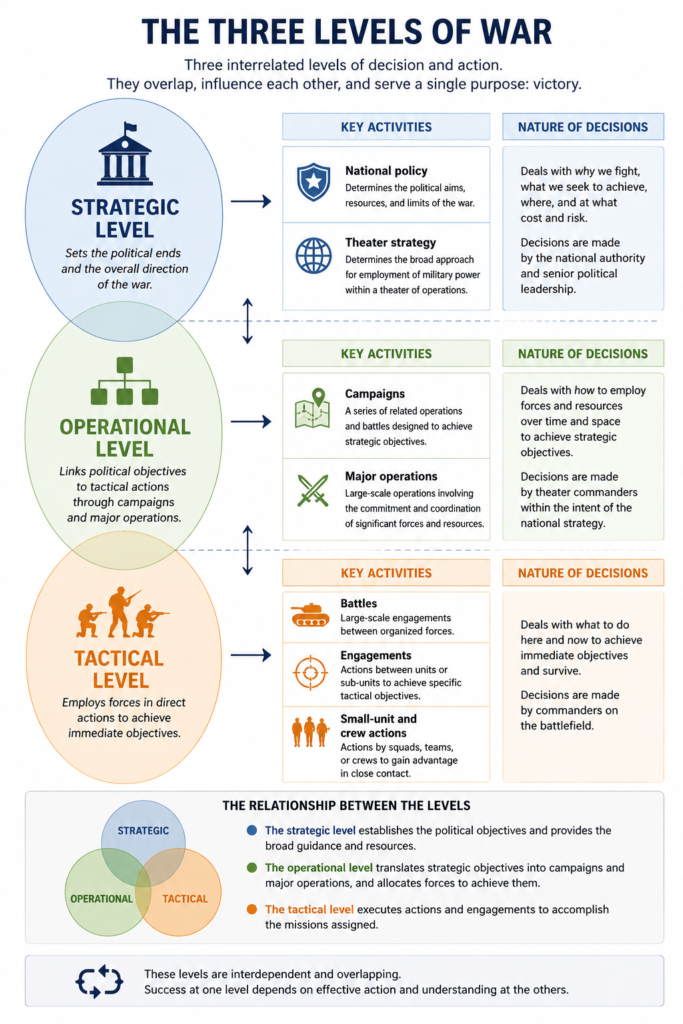
When discussing the strategic, operational, and tactical levels, the first mistake to avoid is treating them as three rigidly separated steps in a hierarchy. It is not enough to say that the strategic level is “more important,” the operational level is “intermediate,” and the tactical level is “lower.” That representation may be useful as a first approximation, but it becomes misleading if taken as a complete description of military reality.
The three levels correspond to three different ways of looking at the same phenomenon: the organized use of force to achieve a political-military result. The lens changes, the scale changes, and the type of decision changes, but the object remains one. War, crisis management, and military operations are not made of three separate worlds. They are made of decisions that must be connected to one another.
Strategic vision must be capable of translation into operational plans. Operational plans must be capable of translation into tactical actions. Tactical actions must produce effects that make sense within the operational design and, ultimately, within the strategic purpose.
The correct formulation is therefore this: the strategic level defines the purpose; the operational level organizes the way to achieve it; the tactical level concretely produces military effects on land, at sea, in the air, in space, in cyberspace, and in the information environment.
This tripartition is not merely a teaching device. It reflects a long doctrinal evolution. In Clausewitz, we find the classical distinction between tactics and strategy: tactics concerns the use of armed forces in combat; strategy concerns the use of combats for the purpose of the war. In Svechin, the need for an intermediate level becomes explicit: operational art, meaning the ability to connect battles, operations, and campaigns into a coherent sequence. NATO doctrine, particularly AJP-5, organizes this insight through the framework of joint operational planning, namely the translation of political-strategic direction into plans, campaigns, and operations. U.S. doctrine, especially JP 3-0, further develops the relationship among campaigns, joint operations, operational art, operational design, and tactical activities.
The essential point is that the three levels are not watertight compartments. They overlap, influence one another, and often condition one another. A tactical decision may have strategic consequences, especially in contexts of high political, media, legal, or informational visibility. Conversely, a strategic decision may directly affect what a tactical commander may or may not do through rules of engagement, political constraints, legal limitations, coalition caveats, escalation-management requirements, and restrictions on the use of particular capabilities.
The distinction among the levels does not exist to divide reality artificially. It exists to clarify who decides what, with what time horizon, under what responsibility, and with what expected effect.
The Strategic Level: Political Purpose and Overall Direction
The strategic level is where general political and military objectives are established. It is the level of “why”: why force is being used or threatened, what political result is sought, what costs are acceptable, what risks may be assumed, and what limits must not be crossed.
In the classical sense, the strategic level does not simply mean “high-level military activity.” Strategy is the point of connection between politics and the use of force. It is where the ultimate purposes of action are defined: deterrence, collective defence, coercion, stabilization, protection of a population, restoration of territorial integrity, containment of an adversary, preservation of international order, protection of critical infrastructure, protection of sea lines of communication, counterterrorism, or support to an ally or partner.
The strategic level also defines limits. It determines how far the operation may go, what means are authorized, what level of intensity is politically sustainable, what collateral effects are acceptable, and what consequences would undermine the legitimacy or sustainability of the operation. Strategy therefore does not only define positive objectives. It also defines the perimeter within which military action must remain.
Institutionally, the strategic level is normally occupied by political authority and strategic military leadership. Political authority defines the political end state, authorizes the use of force, determines the legal and political framework of the operation, and ensures consistency with alliances, international obligations, parliamentary mandates, United Nations resolutions, or decisions of regional organizations. Strategic military leadership translates political guidance into military-strategic direction, assesses military feasibility, and identifies risks arising from any mismatch among ends, ways, means, and constraints.
The strategic level therefore answers the question: what do we want to achieve, why, with what general means, within what limits, and at what acceptable cost?
Its primary responsibility is to ensure coherence between political purpose, available means, and the use of force. A strategy that establishes unrealistic objectives without adequate means, or without a credible theory of success, exposes the entire operation to failure. Likewise, a strategy that does not clearly define the desired political result leaves the operational and tactical levels without proper orientation. In that case, forces may fight effectively, but they may not know what larger outcome their fighting is meant to serve.
The Operational Level: The Connection Between Strategy and Tactics
The operational level is the level of connection. It is not merely an administrative or logistical layer. It is the level that transforms strategic objectives into campaigns, major operations, lines of operation, lines of effort, sequencing, prioritization, and allocation of resources.
Its typical question is: how do we achieve the intermediate objectives required by the strategic purpose?
This is where operational art becomes central. Operational art is the ability to combine time, space, forces, functions, risks, and opportunities in order to build a coherent sequence of actions. It is not enough to win individual combats. Each combat, each manoeuvre, each support activity, each informational activity, each interdiction, protection, stabilization, or sustainment effort must contribute to a superior result.
Svechin is decisive on this point. Compared with Clausewitz’s distinction between tactics and strategy, Svechin makes explicit the need for an intermediate level. Modern war cannot be understood as a simple sum of battles, nor as a direct passage from political will to tactical action. Between the political-strategic purpose and the tactical engagement lies a specific field: the construction of the campaign.
The operational level is therefore where operational objectives are defined, forces are organized, tasks are assigned to subordinate commands, priorities are established, domains are coordinated, scarce resources are managed, and the progression of the operation is built. It is the level of campaigns and major operations: not only what to do, but in what order, with what combination of means, against which centre of gravity, producing which intermediate effects, and according to which criteria of success.
NATO AJP-5 expresses this logic through joint operational planning. The commander and staff must connect operational art, operational design, and the planning process in order to produce a plan that is coherent, feasible, and adaptable. AJP-5 is not primarily a doctrine of tactical fighting. It is a doctrine of planning that enables strategic direction to become organized operations.
At the operational level, responsibility normally belongs to the operational, theatre, or joint force command. This command does not decide the ultimate political purpose. It decides how to create the military conditions required to achieve it. It coordinates land, maritime, air, space, cyber, special operations, intelligence, logistics, strategic communications, civil-military cooperation, force protection, and sustainment.
In short, the operational level is the art of connection. Without it, tactical action risks becoming a sequence of local successes without direction. Without it, strategy risks remaining an elegant but unexecuted declaration of intent.
The Tactical Level: The Concrete Employment of Forces
The tactical level is the level of concrete action. It is where forces are directly employed to execute assigned tasks, conduct combat actions, carry out engagements, manoeuvre, apply fires, protect assets, control areas, sustain units, secure immediate effects, and produce measurable results in the short term.
The tactical level answers the question: how do I employ forces here and now to achieve the assigned effect?
This definition is more precise than a merely hierarchical one. The tactical level is not simply the “small” level. A tactical decision may concern a small unit, but it may also involve sophisticated systems, complex platforms, long-range fires, advanced sensors, air assets, naval capabilities, cyber tools, or informational effects. What makes a decision tactical is not only the size of the force involved, but its relationship to immediate action and to the concrete execution of an assigned task.
The tactical level includes engagements, battles, combat actions, manoeuvre, fires, protection, immediate sustainment, local control of terrain or effects, small-unit actions, crew actions, patrol actions, defence of a point, seizure or interdiction of an area, protection of a convoy, neutralization of a threat, acquisition of a target, evacuation, reaction to contact, local stabilization, control of a checkpoint, securing of infrastructure, conduct of a boarding operation, execution of an air mission, or employment of a cyber effect in immediate support of an operational task.
However, the tactical level must not be reduced to mechanical execution. This is one of the most important points. The tactical commander is not a mere implementer of orders. He or she interprets the assigned mission, understands the higher commander’s intent, evaluates the terrain or operating environment, observes the adversary, manages risk, coordinates available resources, reacts to the unexpected, and adapts action under pressure.
Tactical action requires judgment, initiative, discipline, technical competence, and decision-making under uncertainty. Yet tactical initiative is not strategically free. It is constrained by the mission, higher intent, rules of engagement, applicable international law, the law of armed conflict, orders received, coordinating measures, limits on the use of force, availability of means, and the need not to compromise the operational design.
In Clausewitzian terms, the tactical level is the place of combat. Clausewitz distinguishes tactics, meaning the use of armed forces in combat, from strategy, meaning the use of combats for the purpose of the war. This distinction remains essential because it shows that combat is not an end in itself. Combat is the means; strategy determines how that means is used for a higher purpose.
Two consequences follow. First, tactical success is necessary but not sufficient. One may win a combat and lose the campaign. One may seize a local objective and simultaneously produce a negative political effect. One may obtain superiority on the ground while undermining the legitimacy of the operation. Second, tactical failure may have effects far beyond its material dimension, especially when it produces political shock, media exposure, escalation, civilian harm, loss of consent, coalition fracture, or narrative advantage for the adversary.
The tactical level therefore produces immediate or local effects, but those effects do not necessarily remain local. In a contemporary operating environment characterized by instantaneous information, persistent surveillance, global communication, social media, contested narratives, legal scrutiny, and political sensitivity, every tactical action may be observed, recorded, interpreted, and transformed into a strategic fact.
For this reason, the tactical level must be disciplined by a strong understanding of the higher framework. The tactical commander must know not only what must be done, but why it must be done, what effects must be avoided, what legal and political constraints matter, what image or narrative the action may generate, and how the local objective relates to the operational result.
Tactics Does Not Mean Irrelevant Detail
A frequent error is to equate the tactical level with technical detail. It is true that the tactical level is close to execution and to military technique. But tactics is not merely technique. Technique concerns the functioning of the instrument. Tactics concerns the employment of that instrument in a conflictual situation.
Knowing how to operate a weapon system, sensor, vehicle, aircraft, ship, platform, or procedure is not yet the same as knowing how to conduct tactical action. Tactics requires the combination of different means under conditions of uncertainty, friction, threat, limited time, and imperfect information. It requires decisions about when to move, when to stop, when to strike, when to wait, when to disperse, when to concentrate, when to conceal, when to expose a force, when to assume risk, when to request support, and when to change the plan.
Tactics is therefore the art of immediate effectiveness. It is not the level of ultimate purpose, but the level where concrete effects are produced. It operates within a given framework, but inside that framework it must solve real problems: terrain, enemy fire, logistics, communications, morale, fatigue, surprise, error, friction, ambiguity, risk to civilians, coordination with other units, time pressure, and decision-making under stress.
In this sense, the tactical level is deeply Clausewitzian. It is the level where friction appears most immediately. It is where simple things become difficult. It is where uncertainty becomes choice. It is where political will, operational planning, and military organization meet the resistance of the enemy, the environment, and reality.
The Relationship Between the Tactical and Operational Levels
The relationship between the tactical and operational levels is the most delicate part of the whole architecture. The operational level assigns to the tactical level a task that must make sense within the campaign. The tactical level executes that task and produces effects that sustain, modify, or sometimes call into question the operational plan.
The operational level asks: which tactical actions, in what sequence, with what priorities, and under what conditions, will achieve the operational objective?
The tactical level asks: with the forces available, in this specific environment, against this concrete threat, how can I obtain the required effect?
The operational level must avoid two opposite errors. The first is excessive abstraction: planning effects without understanding the real conditions of tactical execution. The second is tactical micromanagement: interfering continuously with subordinate action and depriving commanders on the ground of initiative. The tactical level, in turn, must avoid acting as if local success were self-sufficient. It must understand that the value of action depends on its function within the operational design.
This is why commander’s intent is central. Intent enables the tactical level to adapt when circumstances change without losing coherence with the operational level. The tactical commander may modify methods, timing, and means, provided that he or she remains faithful to the assigned purpose. Without clear intent, tactical action may become rigid. Without discipline, tactical initiative may become divergent.
The correct relationship is therefore this: detail serves the plan; the plan serves the broader vision. The tactical level is not an autonomous microcosm. It is the point of contact between plan and reality. Precisely because it is the point of contact with reality, it may confirm, correct, or refute operational assumptions.
The Relationship Between the Tactical and Strategic Levels
The relationship between the tactical and strategic levels is less direct, but no less important. In theory, the tactical level is mediated by the operational level. In practice, some tactical actions may produce immediate strategic effects.
This occurs especially when tactical action touches politically sensitive elements: civilian casualties, treatment of prisoners, use of particular weapons, perceived violation of international law, incident involving allied forces, border crossing, damage to critical infrastructure, destruction of cultural property, spectacular failure, capture of personnel, dissemination of images, humanitarian crisis, targeting error, or unwanted escalation.
In such cases, an apparently tactical decision becomes strategic because it changes the political perception of the entire operation. It does not merely alter the local result. It affects legitimacy, sustainability, consent, narrative, and sometimes the international position of the actors involved.
This does not mean that the tactical commander “makes strategy” in the proper sense. It means that the tactical level must be aware of the potential strategic significance of its effects. Strategy remains the determination of the purpose and overall use of force; tactics remains the concrete employment of forces in action. But between the two dimensions there is increasing permeability.
A practical consequence follows: tactical training must include not only technique and procedure, but also contextual understanding, legal discipline, awareness of commander’s intent, sensitivity to informational effects, and the ability to operate under political constraints. The contemporary tactical actor no longer operates in an isolated space. He or she operates in an observed, contested, and interpreted environment.
Who Decides What
At the strategic level, decisions are made by political authority and strategic leadership. They determine the political purpose, the framework of action, the general allocation of resources, the acceptable threshold of risk, and the relationship among objectives, means, and limits. Strategic decision-making concerns the “why,” the “how far,” and the “at what cost.”
At the operational level, decisions are made by the operational, theatre, or joint force command. It transforms strategic purpose into operational objectives, campaigns, major operations, priorities, sequences, force allocation, cross-domain synchronization, and criteria of success. Operational decision-making concerns how to achieve intermediate objectives.
At the tactical level, decisions are made by tactical commanders in the relevant domain. They conduct concrete action, employ available forces, select immediate methods, coordinate manoeuvre, fires, protection, and sustainment, react to the enemy and the environment, and make decisions under pressure. Tactical decision-making concerns how to execute the action here and now.
Responsibility therefore changes in nature. The strategic level is responsible for coherence among war, politics, and resources. The operational level is responsible for the construction of the campaign. The tactical level is responsible for the conduct of action and for immediate effectiveness, but also for compliance with orders, rules of engagement, and applicable law.
Main Functions of the Three Levels
The main functions of the strategic level are the definition of national or allied policy, the formulation of the overall strategy, the determination of the legal and political framework, the selection of general objectives, and the management of escalation. In the language of the original scheme, this is where “national policy” and “theatre strategy” belong, provided that theatre strategy is understood as the strategic adaptation of political purpose to a specific theatre.
The main functions of the operational level are the construction of campaigns and major operations. This includes planning, synchronization, sequencing, joint integration, resource management, cross-domain coordination, and the definition of intermediate objectives. In the language of the scheme, this is where “campaigns” and “major operations” belong.
The main functions of the tactical level are battles, engagements, tactical actions, unit actions, manoeuvre, fires, protection, immediate sustainment, local control, and execution of assigned tasks. This is not where the purpose of the war is decided. It is where the necessary action is conducted to produce an assigned effect.
A doctrinally more precise formulation of the tactical section would be:
Tactical level: the direct employment of forces in combats, engagements, and concrete military actions to achieve assigned objectives. It produces immediate or local effects, which acquire higher military value only when integrated into the operational design and aligned with the political-military purpose.
This formulation avoids two errors. It does not reduce the tactical level to material execution. At the same time, it does not improperly assign to the tactical level the function of defining strategic purpose.
What Happens When Linkage Is Missing
The part of the scheme concerning broken linkage is essential. The three levels must be connected. When one of the connections breaks, military action loses coherence.
The first case is tactics without operations. Here the risk is technical success without direction. Units may fight well, obtain local successes, neutralize immediate threats, and solve technical problems, yet fail to contribute to a higher result. One obtains immediate success that does not advance the campaign. This is the case of a well-conducted action without operational value. The result is consumption of resources, exposure to risk, and possible local victory without overall progress.
The second case is operations without strategy. Here the risk is the administration of force without a clear political end. The operational command plans, coordinates, allocates resources, and conducts campaigns, but lacks a sufficiently clear definition of political purpose. The operation may become technically sophisticated but strategically empty. Activity is produced, but not necessarily result. The question “are we doing things well?” improperly replaces the question “are we doing the right things for the political purpose given?”
The third case is strategy without operations and tactics. Here strategy remains a declaration of intent. It may be elegant, politically coherent, and rhetorically persuasive, but it does not become reality because it has not been translated into plans, campaigns, resources, timelines, responsibilities, and executable actions. In this case, the purpose exists, but there is no practicable theory of success.
These three failures show why the correct relationship is indispensable. Tactics needs operations in order not to dissipate itself. Operations need strategy in order not to run in circles. Strategy needs operations and tactics in order not to remain abstract.
Focus, Decisions, and Responsibilities
The distinction among the levels can also be expressed through three categories: focus, decisions, and responsibilities.
The strategic level focuses on why, how far, and at what cost. It decides ends, means, and political limits. Its responsibility belongs to political authority and strategic leadership. The strategic question is: what political result do we seek through the use, or threat of use, of force?
The operational level focuses on how to reach intermediate objectives. It decides plans, sequencing, priorities, coordination, resource allocation, and timing. Its responsibility belongs to the operational, theatre, or joint force command. The operational question is: how do we transform strategic purpose into a coherent and sustainable campaign?
The tactical level focuses on how to execute action here and now. It decides immediate methods of employment, manoeuvre, fires, protection, priorities, reaction to the enemy, local coordination, and immediate risk management. Its responsibility belongs to tactical commanders. The tactical question is: how do I obtain the assigned effect under the concrete conditions of action?
This tripartition should not be understood as a one-way mechanical chain. It is true that guidance flows from the strategic level to the operational level and then to the tactical level. But information also flows upward from the tactical level to the operational and strategic levels. What happens on the ground may modify the understanding of the theatre, the feasibility of the plan, the calculation of risk, and even the sustainability of the strategy.
The Same Objective: From Vision to Results
The final element of the scheme is correct: the three levels share the same general objective, namely to transform vision into concrete results. The sequence may be represented as follows: strategic vision, operational planning, tactical action, results.
But this sequence must be read carefully. Strategic vision without planning remains intention. Operational planning without tactical action remains a document. Tactical action without vision and planning remains movement, combat, or activity without higher meaning. Only the connection among the three levels produces results.
The result is not necessarily the destruction of the enemy. In contemporary operations, it may consist of deterring, containing, protecting, stabilizing, reassuring allies, degrading a capability, preventing an adversary’s manoeuvre, ensuring access, maintaining presence, supporting a partner, securing freedom of navigation, defending critical infrastructure, or creating conditions for a political settlement. Whatever the result, it must be conceived strategically, organized operationally, and produced tactically.
Final Synthesis on the Tactical Level
The tactical level is the place of action. It is where force is actually employed. It is where the order becomes movement, the plan becomes conduct, intent becomes decision, and capability becomes effect.
But the tactical level is not minor. It is subordinate, not irrelevant. It is concrete, not mechanical. It is local, but it may have general consequences. It is immediate, but it may affect the campaign and the strategy. It is constrained, but it requires initiative.
Its essential formula may be stated as follows:
The tactical level is the direct employment of forces to achieve immediate or local effects through concrete actions, combats, engagements, manoeuvre, fires, protection, and sustainment. Its value depends not only on the success of the action itself, but on the coherence of that action with the operational design and the strategic purpose.
Or, more synthetically:
The strategic level is the art of purpose. The operational level is the art of connection. The tactical level is the art of immediate effectiveness.
This is the key point of the lesson. The tactical level should not be taught as the “lower” level of war, but as the level at which war becomes reality. Yet precisely because it is the level of reality, it must remain connected to the operational and strategic levels. Without that connection, even the most effective action may become useless, counterproductive, or politically disastrous.