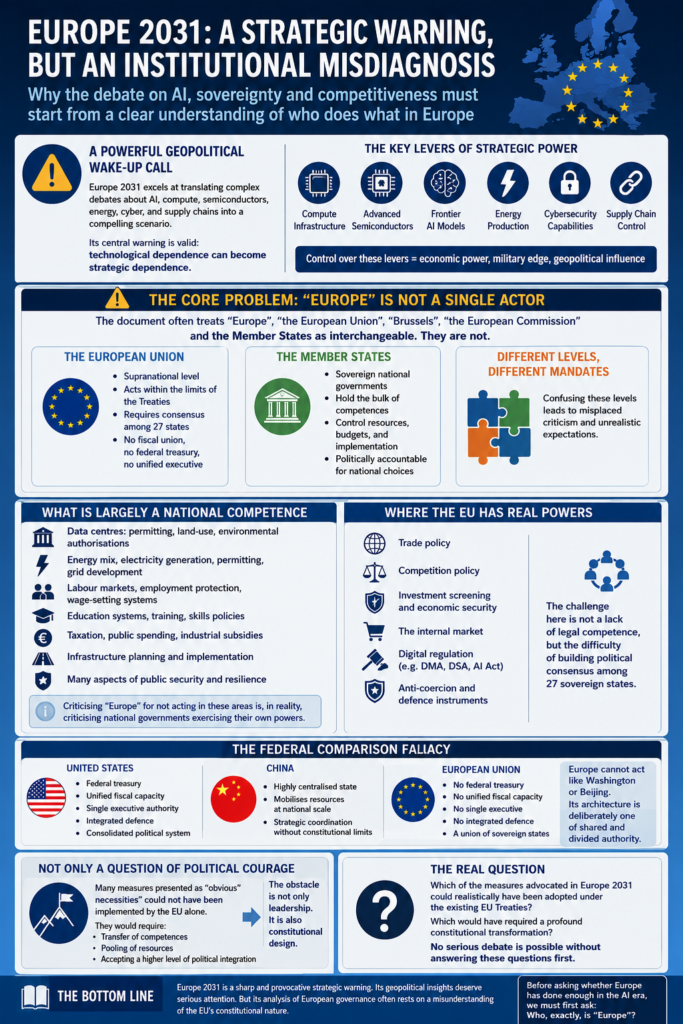
Europe 2031 is one of the most stimulating contributions to the current debate on artificial intelligence, technological sovereignty, and Europe’s place in a rapidly changing geopolitical order. Written as a fictional scenario rather than a conventional policy report, it succeeds in translating abstract discussions about AI, compute, industrial policy, and strategic dependence into a compelling narrative. Its greatest strength lies precisely in this: it forces readers to confront the possibility that artificial intelligence may become a decisive factor in the distribution of economic power, military capabilities, and geopolitical influence over the coming decade.
As an exercise in geopolitical strategy, the document is remarkably effective. It highlights the growing importance of compute infrastructure, advanced semiconductors, frontier AI models, energy production, cybersecurity capabilities, and control over technological supply chains. It also correctly emphasises that technological dependence can easily become strategic dependence. The scenario therefore performs a valuable function by challenging the widespread European assumption that regulatory influence alone is sufficient to shape the future of AI. Its central warning—that Europe risks becoming increasingly dependent on technological systems, infrastructures, and capabilities controlled elsewhere—deserves to be taken seriously.
However, the document becomes significantly less convincing when it moves from geopolitical analysis to the assessment of the European Union’s institutional and legal capacities. At this point, a deeper conceptual problem emerges. Throughout the narrative, “Europe”, “the European Union”, “Brussels”, “the European Commission”, and the Member States are frequently treated as if they were interchangeable actors. Yet they are not. They represent different levels of authority operating under different legal mandates and political constraints.
This is not merely a technical legal issue. It is a cognitive problem that affects the entire diagnosis of Europe’s alleged failure. Many of the measures presented as examples of European inaction concern policy areas that are only partially, or not primarily, within the competences of the European Union. The construction of large-scale data centres depends heavily on national permitting procedures, land-use planning, environmental authorisations, and energy policies. Likewise, labour-market reforms, employment protections, wage-setting systems, education policies, taxation, industrial subsidies, and much of the infrastructure required for an AI-driven economy remain largely within the competence of the Member States. Energy policy itself is a paradigmatic example: despite increasing coordination at the European level, decisions concerning the national energy mix, electricity generation, permitting, and grid development remain fundamentally national choices.
To criticise “Europe” for not acting therefore often means, in reality, criticising decisions that could only have been taken by national governments. The narrative frequently attributes failures to the European Union that are, from a constitutional perspective, more accurately attributable to Member States exercising their own competences. This distinction is not incidental. It goes to the heart of how the European project is structured.
Conversely, the document sometimes underestimates areas where the European Union does possess significant powers. Trade policy, competition policy, investment screening, the internal market, economic security instruments, digital regulation, and anti-coercion mechanisms are domains in which the Union exercises genuine authority. The challenge in these fields is not primarily a lack of legal competence but rather the difficulty of building political consensus among twenty-seven sovereign states.
The result is an analytical ambiguity. Europe 2031 frequently evaluates the European Union against the benchmark of a federal state. It implicitly assumes that Europe could have acted like the United States or China if only its leaders had shown sufficient political courage. Yet the comparison is problematic. The United States possesses a federal treasury, a unified fiscal capacity, a single executive authority, integrated defence structures, and a consolidated political system. China, likewise, can mobilise resources through a highly centralised state apparatus. The European Union possesses none of these characteristics. Its institutional architecture is deliberately designed around the coexistence of supranational and national authority.
This distinction matters because it fundamentally changes the policy debate. The relevant question is not whether Europe should have behaved like Washington or Beijing. The relevant question is which of the measures advocated by the authors could realistically have been adopted under the existing EU Treaties, and which would have required a profound constitutional transformation of the Union itself. Once this distinction is taken seriously, a substantial part of the document’s prescriptions appears not simply politically difficult but institutionally unavailable without a major reallocation of powers from the Member States to the Union.
Indeed, one of the implicit assumptions running through the entire scenario is that Europe’s difficulties stem primarily from a lack of political courage. The epilogue explicitly advances this interpretation, suggesting that European leaders failed because they were unwilling to take politically costly decisions in the face of an unprecedented strategic challenge. Yet this diagnosis overlooks a more fundamental issue: many of the measures presented as obvious necessities could not have been implemented by the European Union acting alone. They would have required Member States to transfer additional competences, pool resources on a much larger scale, and accept a level of political integration that does not currently exist. The obstacle was therefore not merely one of leadership, but also one of constitutional design.
From this perspective, Europe 2031 should be read primarily as a strategic warning rather than as an institutional diagnosis. Its geopolitical insights are often sharp and provocative. Its portrayal of technological dependence as a source of strategic vulnerability deserves serious attention. Yet its analysis of European governance occasionally rests on an insufficiently precise understanding of the constitutional nature of the European Union. The document ultimately reveals a broader tendency that is increasingly common in discussions about technological sovereignty: the assumption that Europe is already a state-like geopolitical actor, when in reality it remains a complex and incomplete political union whose capacity to act depends, to a considerable extent, on the willingness of its Member States to act together.
In that sense, the most important lesson of Europe 2031 may not concern artificial intelligence at all. Rather, it concerns a persistent misunderstanding of the European Union itself. Before asking whether Europe has done enough to confront the geopolitical challenges of the AI revolution, one must first ask a more basic question: who, exactly, is “Europe”? Until that distinction is made clear, analyses of European success or failure risk conflating the responsibilities of the Union with those of its Member States, thereby obscuring the real institutional constraints within which European policymaking operates.