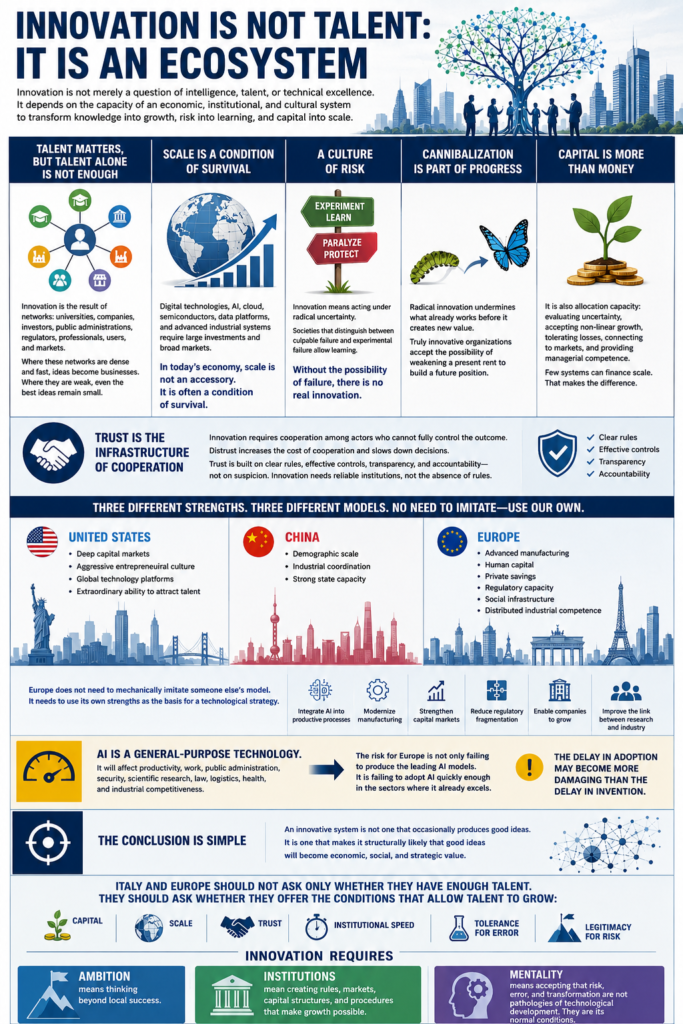
Innovation is not the same thing as invention. Invention produces novelty; innovation transforms novelty into value. That transformation depends on an ecosystem: capital able to finance uncertainty, markets large enough to reward scale, institutions fast enough to enable experimentation, and a culture mature enough to distinguish failure from negligence.
Innovation is not merely a question of intelligence, talent, or technical excellence. It depends on the capacity of an economic, institutional, and cultural system to transform knowledge into growth, risk into learning, and capital into scale.
A country may have excellent researchers, strong universities, creative entrepreneurs, and advanced technological capabilities. Yet it may still remain marginal in global competition if it lacks the systemic conditions that allow innovation to expand. The real challenge is not only to invent something new. It is to build the environment in which invention can become a product, a market, an infrastructure, an enterprise, and eventually economic power.
Talent matters, but talent alone is not enough.
Individual ability creates value only when it is embedded in an ecosystem capable of absorbing it, financing it, connecting it, and scaling it. Innovation is rarely an isolated act. It is the result of networks: universities, companies, investors, public administrations, regulators, professionals, users, and markets. Where these networks are dense and fast, ideas become businesses more easily. Where they are weak, fragmented, or slow, even the best ideas remain prototypes, local experiments, or successes that never scale.
Scale is therefore not an accessory. In today’s technological economy, it is often a condition of survival.
Digital technologies, artificial intelligence, cloud infrastructure, semiconductors, data platforms, and advanced industrial systems require large investments, access to broad markets, and the ability to sustain uncertainty before returns materialize. An innovative company confined to a small or fragmented market may lose not because it is less intelligent, but because it lacks the capital, customers, data, managerial depth, and speed required to compete globally.
This is one of Europe’s central problems: innovation without an integrated market remains fragile.
Europe produces talent, research, and industrial competence. But too often capital is fragmented, markets remain national, regulation is uneven, and growth is treated with suspicion rather than encouraged. The knowledge economy rewards speed and scale. Those who reach scale first attract more capital, more talent, more data, and more customers. Advantage becomes cumulative.
A second decisive issue is the culture of risk.
Innovation means acting under conditions of radical uncertainty. It is not simply about calculating known risks. It is about making decisions before it is clear whether a market exists, whether users will adopt a product, whether a technology will mature, or whether a business model will work.
This requires a culture able to distinguish between culpable failure and experimental failure. The first comes from negligence, opacity, or poor management. The second is part of the learning process.
A society that punishes every failure produces defensive prudence. Investors prefer mature assets. Managers protect what already exists. Researchers stay away from the market. Public administrations hide behind procedure. By contrast, a system that treats error as a cost of learning allows experimentation, correction, and renewed attempts. Failure is not valuable in itself. But without the possibility of failure, there is no real innovation.
The same applies to cannibalization.
Mature organizations tend to defend what already works. Yet radical innovation often undermines the existing business model before it creates a new one. New technologies can reduce the value of older products, alter supply chains, shift margins, or redefine the relationship with customers. Truly innovative organizations accept the possibility of weakening a present rent in order to build a future position. Less dynamic systems defend the present until disruption is imposed from outside.
This is also true for states and economies. A country can protect its traditional productive structures, or it can help them transform. Protection may create short-term stability, but it risks long-term decline. Transformation is more uncertain, but it preserves competitiveness.
Capital is another crucial element.
Technological innovation requires funding not only at the early stage, but above all during the scale-up phase. Many systems can finance research or the birth of small firms. Far fewer can support them when they need much larger investments to compete globally. This is the difference between the economy of invention and the economy of scale. The first generates ideas. The second generates industrial power.
But capital is not only money. It is also allocation capacity: the ability to evaluate uncertain projects, accept non-linear growth, tolerate initial losses, connect firms with international markets, and provide managerial competence. A financial system oriented mainly toward asset preservation or traditional credit will struggle to support high-risk technological companies.
Trust is equally important.
Innovation requires cooperation among actors who cannot fully control the outcome of their actions: founders, investors, employees, universities, public authorities, regulators, and customers. When a society is dominated by suspicion, every initiative is read as opaque, every success as questionable, and every public-private collaboration as potential favoritism. The cost of cooperation rises. Actors protect themselves. Procedures become rigid. Responsibility is avoided. Decisions slow down.
Trust does not mean naivety. It requires clear rules, effective controls, transparency, and accountability. But a society that confuses control with paralysis and prudence with suspicion will discourage the very energies it claims to mobilize. Innovation needs reliable institutions, not the absence of rules; efficient legality, not defensive bureaucracy; accountability, not generalized distrust.
The comparison between Europe, the United States, and China should not be treated as a sporting competition in which everyone must win in the same way.
The United States has deep capital markets, an aggressive entrepreneurial culture, global technology platforms, and an extraordinary ability to attract talent. China has demographic scale, industrial coordination, and strong state capacity. Europe has advanced manufacturing, human capital, private savings, regulatory capacity, social infrastructure, and distributed industrial competence.
Europe does not need to mechanically imitate someone else’s model. It needs to use its own strengths as the basis for a technological strategy. That means integrating artificial intelligence into productive processes, modernizing manufacturing, strengthening capital markets, reducing regulatory fragmentation, enabling companies to grow, and improving the relationship between research and industry.
Artificial intelligence is not just another sector. It is a general-purpose technology that will affect productivity, work, public administration, security, scientific research, law, logistics, health, and industrial competitiveness. The risk for Europe is not only failing to produce the leading AI models. It is failing to adopt AI quickly enough in the sectors where Europe already has productive strength and regulatory expertise.
The delay in adoption may become more damaging than the delay in invention.
The conclusion is simple: an innovative system is not one that occasionally produces good ideas. It is one that makes it structurally likely that good ideas will become economic, social, and strategic value.
Italy and Europe should not ask only whether they have enough talent. They should ask whether they offer the conditions that allow talent to grow: capital, scale, trust, institutional speed, tolerance for error, and legitimacy for risk.
Innovation requires ambition, institutions, and mentality.
Ambition means thinking beyond local success.
Institutions mean creating rules, markets, capital structures, and procedures that make growth possible.
Mentality means accepting that risk, error, and transformation are not pathologies of technological development. They are its normal conditions.