ABSTRACT
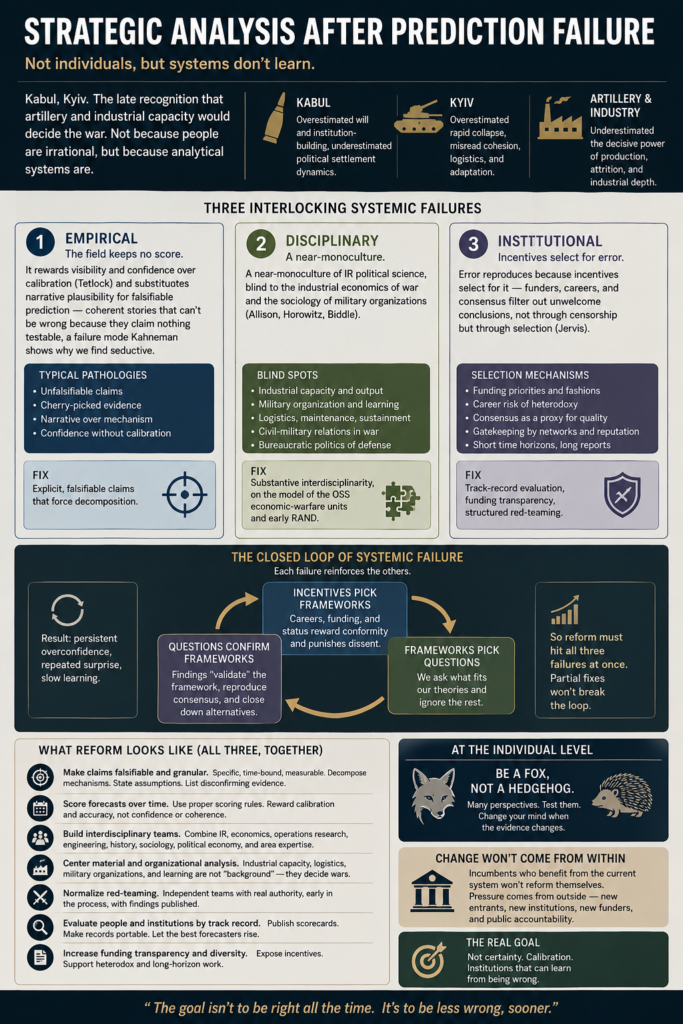
Strategic analysis keeps failing (Kabul, Kyiv, the late recognition that artillery and industrial capacity would decide the war) not because individuals err but because analytical systems don’t learn.
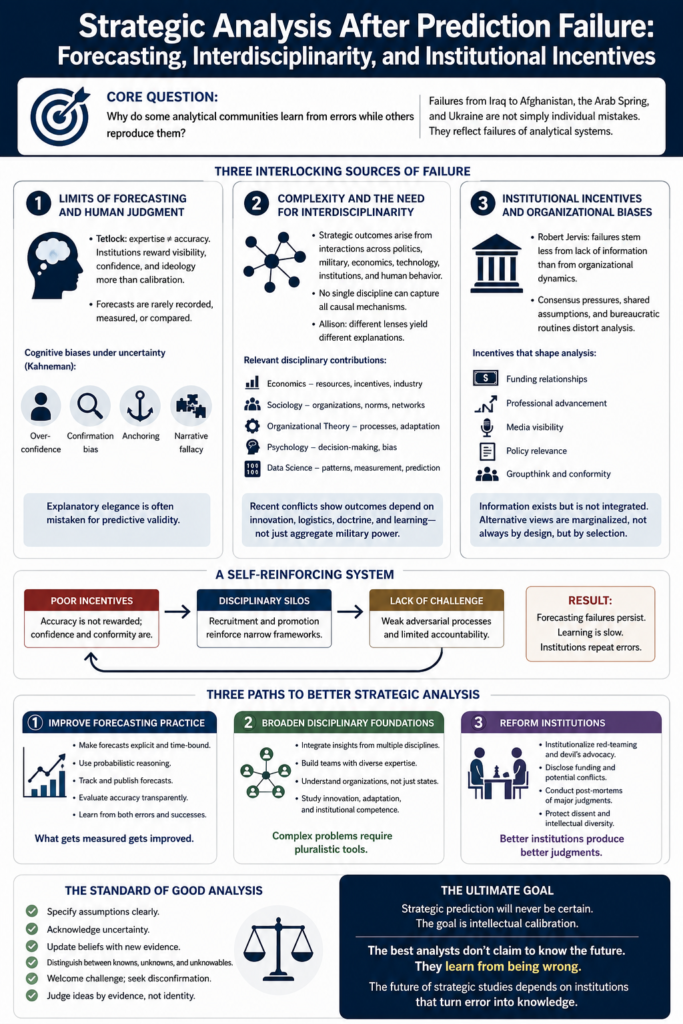
Three interlocking failures explain it.
Empirical: the field keeps no score. It rewards visibility and confidence over calibration (Tetlock) and substitutes narrative plausibility for falsifiable prediction — coherent stories that can’t be wrong because they claim nothing testable, a failure mode Kahneman shows why we find seductive. Fix: explicit, falsifiable claims that force decomposition.
Disciplinary: a near-monoculture of IR political science, blind to the industrial economics of war and the sociology of military organizations (Allison, Horowitz, Biddle). Fix: substantive interdisciplinarity, on the model of the OSS economic-warfare units and early RAND.
Institutional: error reproduces because incentives select for it — funders, careers, and consensus filter out unwelcome conclusions, not through censorship but through selection (Jervis). Fix: track-record evaluation, funding transparency, structured red-teaming.The three form a closed loop — incentives pick frameworks, frameworks pick questions, questions confirm frameworks — so reform must hit all three at once. At the individual level: be a fox, not a hedgehog. The incumbents who benefit won’t reform themselves; pressure comes from outside. The goal isn’t certainty but calibration — institutions that can learn from being wrong.
Something is wrong with strategic analysis, and it is not the kind of wrong you fix with a better argument. Over the past two decades — from Iraq to Afghanistan, from the Arab Spring to Ukraine — expert communities in international affairs have repeatedly failed to anticipate major developments or to estimate their consequences correctly. The Afghan government collapsed in eleven days, after twenty years of analysis predicting slow deterioration or managed transition. In the opening weeks of Russia’s full-scale invasion, the dominant consensus held that Kyiv would fall within days — a forecast wrong in almost every dimension. And almost no one recognized in advance that industrial capacity, logistics, and artillery ammunition stocks would become the decisive variables of a large conventional war in Europe.
These are not best understood as failures of intelligence collection or individual judgment. They are failures of analytical systems — and that reframing changes the question. The point is not why analysts occasionally err; in complex environments, error is inevitable. The point is why some analytical communities systematically learn from their mistakes while others reproduce them.
Three bodies of scholarship answer that question, and together they map onto three interlocking levels of failure: an empirical problem in how we forecast, a disciplinary problem in how we specialize, and an institutional problem in how analysis is funded and rewarded.
I. The empirical problem: forecasting and expert judgment
The field has no habit of keeping score. Philip Tetlock’s research on expert political judgment showed that expert status does not translate into forecasting accuracy — and, more damningly, that the most prominent public voices tend to perform worse than the average informed observer. Most important, institutions rarely reward analysts for predictive performance. Visibility, affiliation, rhetorical confidence, and ideological compatibility consistently count for more than calibration.
A discipline that rarely evaluates its forecasts cannot tell successful frameworks from failed ones. Unlike meteorology, finance, or epidemiology — fields that improved dramatically precisely because their predictions are checked against outcomes and their models updated accordingly — strategic analysis is largely insulated from feedback. Predictions are seldom recorded, measured, or compared with what actually happens. An analyst who was wrong in 2003 remains an authority in 2023, because nobody is keeping score.
Beneath this lies the substitution of narrative plausibility for falsifiable prediction. Strategic analysis has drifted toward accounts that are internally coherent and consistent with background assumptions, but that never expose themselves to verification. A narratively plausible account cannot be wrong, because it makes no testable claim. It explains events after they happen with the same confidence it described them before. This is not analysis; it is sophisticated storytelling. “Russia is militarily superior to Ukraine” is a premise, not a prediction — it carries no stated condition under which it could be shown false.
Daniel Kahneman explains why the failure mode is so seductive. Judgment under uncertainty is shaped by predictable biases: overconfidence, confirmation bias, anchoring, and above all the urge to build coherent stories from incomplete information. Strategic analysis is especially exposed, because geopolitical events are complex enough to support several competing narratives while occurring rarely enough to make learning slow. The result is an environment where explanatory elegance is routinely mistaken for predictive validity.
The corrective is understood, even if rarely practiced. Good analysis makes explicit, falsifiable claims — not “Russia’s capabilities are overstated” but “Russia will lose more than X armored vehicles in the first six months of a sustained offensive.” Claims like this have conditions of verification. They can be wrong. And they force decomposition: instead of a holistic judgment about who will win, they require naming the specific variables that will decide the outcome and assessing each separately. That is cognitively harder, and far more likely to catch errors — because mistakes that hide inside holistic assessments become visible the moment you have to state your premises one by one.
II. The disciplinary problem: the limits of a single lens
Strategic outcomes are multi-causal; the field is a near-monoculture. Strategic results emerge from interactions among political institutions, military organizations, economic systems, technological capacities, and human decision-makers. No single discipline has the conceptual tools to grasp all of them — yet strategic analysis has become, in practice, a near-monoculture dominated by international relations as taught in a handful of political science traditions.
Graham Allison’s Essence of Decision made the core point decades ago: different analytical lenses produce radically different explanations of the same event. State behavior cannot be understood through a rational-actor model alone; bureaucratic politics and organizational process matter too. Contemporary strategic studies concedes this rhetorically and then keeps operating within narrow boundaries.
Recent wars have made the cost of those boundaries unusually visible. Whether Russia could sustain its war effort was, at bottom, a question of industrial economics: how many shells per month can Russian factories produce, where are the bottlenecks in the supply chain for 152mm ammunition, how long does it take to reconstitute armored-vehicle production after catastrophic losses? A competent industrial economist can address these with some confidence — and most strategic analysts, trained in political science rather than industrial economics, were not equipped even to pose them correctly. Likewise, why Russian forces performed so poorly in the opening phase was not primarily a military-technical question but a sociological one: how does institutional corruption degrade readiness in ways invisible to formal capability assessments, and how do command structures that punish the bearer of bad news distort information flows until strategic surprise becomes not merely possible but likely?
Michael Horowitz’s work on military innovation and Stephen Biddle’s research on force employment both show that outcomes in war cannot be reduced to aggregate measures of capability. Material resources matter, but so do organizational adaptation, doctrinal learning, and institutional competence — variables that live in disciplines the mainstream rarely mobilizes. The field too often has the wrong specialists asking the wrong questions, because its training pipelines, hiring practices, and reward structures all point in a single direction.
The fix is genuine interdisciplinarity — not the decorative kind, where a political science paper cites one economics paper in its introduction, but the substantive kind, where an assessment of military capacity is co-produced by people who actually understand industrial economics, and an assessment of regime resilience by people who actually understand organizational sociology. The model worth studying is not the contemporary think tank but the best wartime analytical institutions: the economic-warfare divisions of the OSS, which put economists, geographers, and engineers together to produce strikingly accurate assessments of Axis industrial capacity; or the early RAND Corporation, genuinely interdisciplinary in ways that shaped strategic thought for decades. Both operated where being wrong was unaffordable. The lesson is not that we need a war to think clearly — it is that the pressure those institutions felt can be reproduced institutionally, if there is the will.
III. The institutional problem: incentives and the reproduction of error
The deepest problem reproduces the other two. Robert Jervis and the broader literature on intelligence failure have shown repeatedly that analytical errors rarely originate in a lack of information. More often they emerge from organizational incentives, shared assumptions, bureaucratic routine, and pressure toward consensus. Intelligence organizations frequently hold the fragments of a correct assessment but fail to integrate them into a coherent warning.
The dynamic extends well beyond intelligence agencies. Universities, think tanks, consulting firms, and policy organizations all operate inside incentive structures that shape which questions get asked and which conclusions look plausible. The effect is rarely direct censorship. It is a slower process of selection: the researcher who produces unwelcome conclusions is not renewed, not invited, not cited, while the one who confirms the sponsor’s premises advances. Over time this privileges some frameworks and marginalizes others.
This is not conspiracy; it is straightforward institutional economics. A research center dependent on defense-industry funding will not systematically produce analyses challenging the centrality of the hardware that industry sells. A center dependent on government contracts will not systematically produce analyses making its funders look incompetent. Genuinely disruptive frameworks — those that would require dismantling existing capabilities, abandoning alliances, or admitting fundamental strategic error — are structurally underproduced.
The self-reinforcing system
These three problems do not operate in parallel. They form a closed loop:
Institutional incentives select for certain disciplinary frameworks ? those frameworks determine which empirical questions count ? those questions generate data that confirm the framework ? the confirmed framework validates the incentives that produced it.
Forecasting failures persist because institutions do not reward predictive accuracy. Disciplinary silos persist because organizations recruit and promote within established traditions. Institutional bias persists because analytical communities lack robust mechanisms for adversarial challenge. Each pathology protects the others. This is why reform at a single level tends to fail: the system resists it. Improvement requires simultaneous intervention across all three.
What reform would require
First, on forecasting. Analytical communities should place far greater weight on explicit, probabilistic prediction and on the public evaluation of predictive performance — publishing not only the current analysis but the archive of past judgments and their outcomes. Credibility should rest on a verifiable track record, not on affiliation or rhetorical confidence.
Second, on disciplinary breadth. Strategic studies should broaden its foundations to incorporate, in substance rather than ornament, expertise from industrial economics, organizational sociology, psychology, and data science. Systems whose causal mechanisms span multiple domains cannot be understood through a single lens.
Third, on institutions. Organizations should cultivate structured analytical competition — red-teaming, transparent disclosure of funding relationships, systematic review of past assessments. Complex adaptive systems, from financial markets to scientific communities, produce better models of reality when there are real incentives for adversarial challenge rather than consensus. The intelligence community’s experiments with red teams point in the right direction, even where they have been underfunded and marginalized; the concept is sound and deserves to be taken seriously rather than tolerated as an occasional exercise.
The forecaster’s disposition
Beyond institutional reform — which will be slow and partial — there is a disposition individual analysts can cultivate, and it distinguishes better practice from worse. Tetlock calls the best forecasters “foxes” rather than “hedgehogs”: analysts who know many things rather than one big thing, who update frequently as new information arrives, who are comfortable with explicit uncertainty rather than false confidence, and who treat their frameworks as tools rather than identities. The hedgehog reads every development through a single master idea; the fox treats each development as potential evidence against any prior belief.
The fox’s disposition is institutionally uncomfortable. It produces analysis that is harder to brand, harder to sell as authoritative, less congenial to a pundit culture of confident assertion. The fox says, “I was seventy percent confident and turned out to be wrong; here is what I missed.” The hedgehog says, “events are consistent with my longstanding analysis.” The hedgehog gets invited back. But the fox’s stance is not merely a pose of humility — it is a more accurate model of how knowledge works in domains of genuine complexity, where outcomes turn on the interaction of many variables, several unobservable and some genuinely novel. The confidence of a claim should be proportional to the strength of the evidence behind it, and updating in the face of disconfirming evidence is a sign of analytical strength, not weakness. These principles sound obvious. What is striking is how consistently they are violated.
Who has an incentive to reform?
The structural critique raises an uncomfortable question: who has the incentive to fix any of this? The institutions with the most power to reform the field — major think tanks, government analytical bureaucracies, established academic departments — are precisely those that benefit from the present arrangement. They will not reform themselves voluntarily.
The most realistic vector for improvement is therefore external pressure: from policymakers badly burned by poor analysis who demand better; from publics grown skeptical of expert consensus after a sequence of visible failures; and from independent analysts who, working outside the constraints of funded organizations, build credibility through demonstrated accuracy rather than affiliation. This last route has historical weight. Many of the most important innovations in strategic studies have come from outside the mainstream — from domain experts in adjacent fields who brought different tools, from practitioners carrying operational knowledge that desk analysts lacked. The mainstream absorbs such innovations slowly and incompletely, but it does absorb them.
None of these reforms would eliminate uncertainty. Strategic prediction will never become an exact science, and that is not the goal. The goal is calibration. The most valuable analysts are not those who claim to know the future; they are those who understand the limits of their knowledge, specify their assumptions, update their beliefs when the evidence changes, and expose their judgments to empirical test.
The stakes are not academic. Strategic miscalculation has consequences — in lives, in resources, in the stability of the international order. Getting analysis right is not a luxury; it is a precondition for getting policy right. The future of strategic studies may ultimately depend less on acquiring new information than on building institutions capable of learning from being wrong.