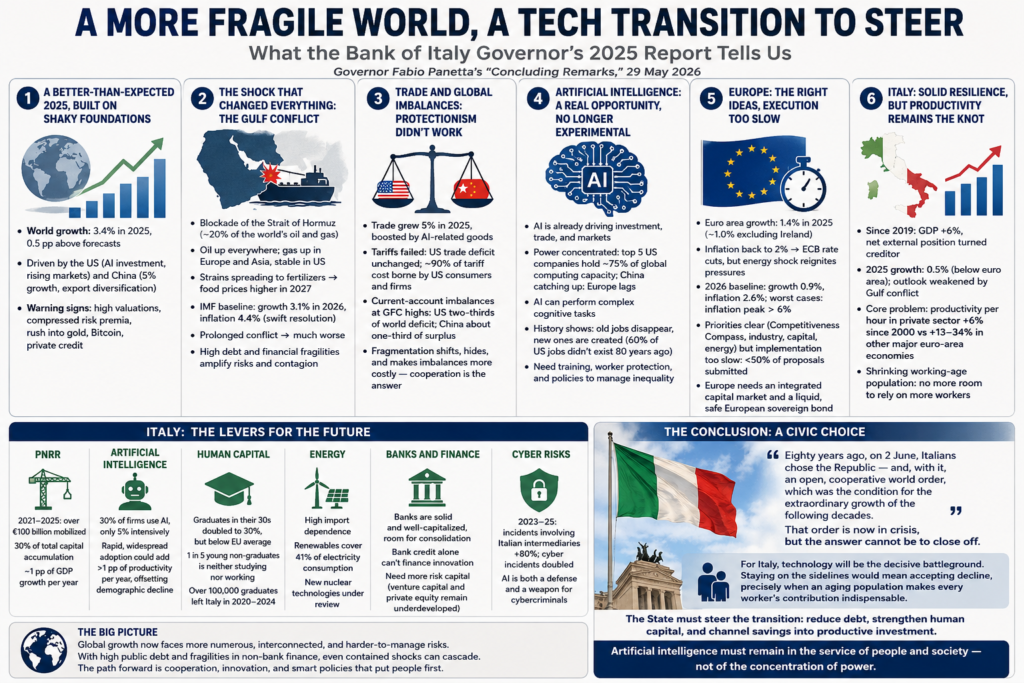
Governor Fabio Panetta’s “Concluding Remarks,” delivered on 29 May 2026, paint a picture of a surprisingly resilient global economy shaken by a new energy shock — and point to artificial intelligence as the decisive battleground for Italy’s future.
Every year, at the end of May, the Governor of the Bank of Italy closes the Annual Report with a speech — the “Concluding Remarks” — that serves as both a stocktaking of the past year and a compass for the one ahead. This year’s edition, the 132nd, arrives at a turning point: a 2025 that outperformed expectations, followed by a start to 2026 marked by a crisis that has reshaped the entire outlook. Here are the points worth knowing.
A Better-Than-Expected 2025, Built on Shaky Foundations
The world economy grew by 3.4 per cent, half a point above forecasts, despite wars, tariffs, and geopolitical tensions. The rally was driven mainly by the United States — propelled by investment in artificial intelligence and rising stock markets — and by China, which grew 5 per cent, responding to American tariffs by cutting export prices and diversifying its markets.
Beneath the market optimism, however, warning signs were already flashing: very high equity valuations, compressed risk premia, and a rush into gold, Bitcoin, and private credit. All signals of an exuberance that, between late 2025 and early 2026, began to deflate as investors started pricing in risks they had long overlooked.
The Shock That Changed Everything: the Gulf Conflict
The real watershed is the conflict in the Persian Gulf. The blockade of the Strait of Hormuz — through which roughly a fifth of the world’s oil and liquefied gas normally passes — triggered supply shortages and sharp increases in energy prices. Oil rose everywhere; gas climbed in Europe and Asia while staying stable in the United States, thanks to abundant domestic production.
The strains are now spreading to fertilizers, with effects on food prices that will be felt mainly next year, once the sowing and harvesting cycles are complete. This is a serious risk for the world’s poorest countries. The International Monetary Fund — assuming a swift resolution of the conflict — projects global growth slowing to 3.1 per cent in 2026 and inflation at 4.4 per cent. Should hostilities drag on, the scenario would be considerably worse.
The underlying message is clear: with high public debt and growing fragilities in non-bank finance, even contained shocks now risk cascading through the system. Global growth faces risks that are more numerous, more interconnected, and harder to manage than in the past.
Trade and Global Imbalances: Protectionism Didn’t Work
Despite the tariffs, international trade grew by 5 per cent, helped in part by AI-related goods. But protectionist policies failed to correct the imbalances they were meant to fix: the US trade deficit held steady, and about 90 per cent of the tariff burden fell on American consumers and firms.
Current-account imbalances reached their highest level since the global financial crisis: the United States accounts for two-thirds of the world’s deficit, China for roughly a third of the surplus. Fragmentation, Panetta warns, does not eliminate these imbalances — it shifts them, hides them, and makes them more costly to correct. The answer is not to close off, but to cooperate.
Artificial Intelligence: a Real Opportunity, No Longer Experimental
A central part of the speech is devoted to artificial intelligence, which is no longer a promise but a force already driving investment, trade, and markets. Its adoption is faster than in any previous technological revolution, but power is concentrated: five large US companies hold about three-quarters of the world’s computing capacity; China is catching up, while Europe lags behind.
On jobs, for the first time a technology can perform complex cognitive tasks. Yet history shows that great innovations destroy some professions but create new ones: today 60 per cent of US workers do jobs that did not exist eighty years ago. The transition, however, will carry costs and risks widening inequality. What’s needed is training, protection for the most exposed workers, and policies to manage the change.
Europe: the Right Ideas, Execution Too Slow
The euro area grew 1.4 per cent (around 1.0 per cent excluding Ireland’s statistical distortion), held back by manufacturing weakness in Germany and Italy. Inflation had returned to the 2 per cent target, allowing the ECB to cut rates — but the energy shock has reignited pressures: in the baseline scenario, growth would fall to 0.9 per cent in 2026, with inflation at 2.6; in the worst cases, the peak could exceed 6 per cent.
The verdict on the Union is blunt: the priorities have been identified — from the Competitiveness Compass to reforms on industry, capital, and energy — but implementation is too slow. Fewer than half the announced proposals have been put forward. To finance innovation, Europe needs a truly integrated capital market and, in Panetta’s view, a liquid and safe European sovereign bond. The legal and political obstacles, he reminds us, were already overcome in the face of the pandemic.
Italy: Solid Resilience, but Productivity Remains the Knot
Since 2019, the Italian economy has shown remarkable resilience: GDP has grown by over 6 per cent, and the net external position has turned creditor. But momentum has faded: in 2025 growth was just 0.5 per cent, below the euro-area average, and the Gulf conflict has weakened an already fragile outlook.
The deeper problem is structural: since the start of the century, productivity per hour worked in the private sector has risen by a mere 6 per cent, against 13–34 per cent in the area’s other major economies. With a shrinking working-age population, the country can no longer rely on a rising number of workers. Recurring themes in the speech:
- National Recovery and Resilience Plan (PNRR): between 2021 and 2025 it mobilized over €100 billion, contributing 30 per cent of total capital accumulation and lifting GDP by nearly 1 point a year.
- Artificial intelligence: 30 per cent of firms use AI, but only 5 per cent intensively. Rapid, widespread adoption could add more than 1 point of productivity a year, offsetting the demographic decline.
- Human capital: the share of graduates in their thirties has doubled (to 30 per cent) but remains below the European average; one in five young non-graduates is neither studying nor working; over 100,000 graduates left the country between 2020 and 2024.
- Energy: import dependence is still high; renewables now cover 41 per cent of electricity consumption; new nuclear technologies are under review.
- Banks: the system is solid and well-capitalized, with room for consolidation; but bank credit alone cannot finance innovation — more risk capital is needed (venture capital and private equity remain underdeveloped).
- Cyber risks: in 2023–25, incidents involving Italian intermediaries rose 80 per cent, with cyber incidents doubling. AI makes the picture more complex, serving both as a defense and as a weapon for cybercriminals.
The Conclusion: a Civic Choice, Not Just an Economic One
The speech closes with an appeal to history. Eighty years ago, on 2 June, Italians chose the Republic — and, with it, an open, cooperative world order that, as Panetta recalls quoting Luigi Einaudi, was the very condition for the extraordinary growth of the following decades. That order is now in crisis, but the answer cannot be to close off.
For Italy, technology will be the decisive battleground. Staying on the sidelines would mean accepting decline, precisely when an aging population makes every worker’s contribution indispensable. The State must steer the transition by reducing the debt burden, strengthening human capital, and channeling savings into productive investment. And artificial intelligence, the Governor concludes, must remain in the service of people and society — not of the concentration of power.
The ultimate measure of success, in the end, is a single one: the ability to offer opportunity and a future to the young. It is not only an economic responsibility — it is the civic task of our time.
Source: Bank of Italy, “Concluding Remarks by the Governor — Annual Report 2025,” Rome, 29 May 2026.