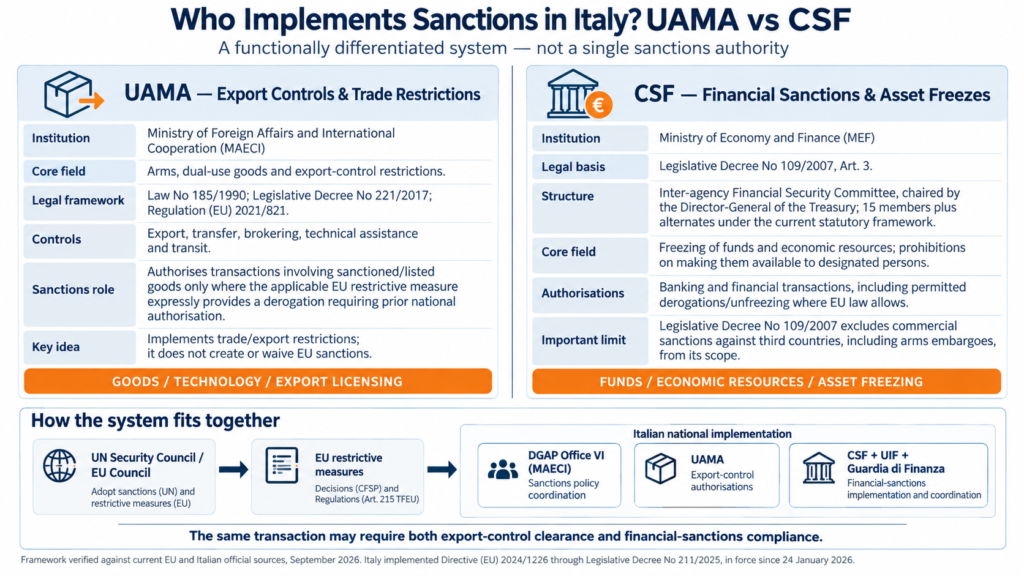
When lawyers speak of the “Italian sanctions authority”, the expression is convenient but potentially misleading. Italy does not entrust the implementation of international and European Union restrictive measures to a single administrative body. The national system is deliberately fragmented by function. The clearest example is the division between the Autorita Nazionale UAMA at the Ministry of Foreign Affairs and International Cooperation (MAECI) and the Comitato di Sicurezza Finanziaria (CSF) at the Ministry of Economy and Finance (MEF).
The distinction is not merely organisational. It follows the substantive architecture of sanctions themselves. Some restrictive measures prohibit or condition the export, transfer, brokering or transit of goods and technologies. Others require the freezing of funds and economic resources or prohibit making them available to designated persons. The first group falls primarily within the export-control and trade-restriction system in which UAMA plays a central role. The second falls within the financial-sanctions system coordinated through the CSF. The two structures can interact in the same sanctions regime, but they do not perform the same legal function.
The EU background: adoption at Union level, implementation through national authorities
EU restrictive measures may implement United Nations Security Council sanctions or may be adopted autonomously by the Union. Under Article 29 TEU the Council adopts the relevant CFSP decision. Where economic or financial measures are required, they are normally given binding effect through a Council regulation based on Article 215 TFEU. Regulations are directly applicable, but their implementation, administration of derogations and authorisations, investigation of possible breaches and enforcement remain to a substantial extent in the hands of the Member States and their national competent authorities.
The European Commission therefore expressly states that primary responsibility for implementing EU sanctions rests with the Member States. Its current list of national competent authorities is particularly instructive for Italy. It identifies the MEF – Comitato di Sicurezza Finanziaria for the “freezing of funds and economic resources” and for the “issuance of authorisations relating to banking and financial transactions”. It identifies MAECI – Autorita nazionale UAMA for the control of exports, transfers, brokering and transit of dual-use goods and technology and for the corresponding authorisations. The same document separately identifies the MAECI sanctions-policy coordination structure. This institutional separation is the best starting point for understanding the Italian system.
UAMA: export control and the trade side of restrictive measures
UAMA is located within MAECI. Its present official title is Autorita Nazionale UAMA: Materiali d’Armamento e a Duplice Uso. The acronym historically derives from the former “Unita per le autorizzazioni dei materiali d’armamento”, but the authority’s remit today extends well beyond conventional arms licensing.
For military equipment, the central national statute remains Law No 185 of 9 July 1990, as subsequently amended. The law regulates the export, import and transit of armaments and links authorisation decisions to Italy’s foreign and defence policy and to its international and European obligations. Arms embargoes and other restrictive measures therefore operate within, and constrain, the licensing framework administered by UAMA.
For dual-use items, UAMA is the national competent authority responsible for the application of Legislative Decree No 221 of 15 December 2017, read together with Regulation (EU) 2021/821. Its functions include authorisations concerning exports, transfers, brokering, technical assistance and transit of dual-use items. It also administers controls under the EU Anti-Torture Regulation, Regulation (EU) 2019/125.
Its sanctions function is particularly important. MAECI expressly states that UAMA issues authorisations for the direct and indirect trade in products listed as a consequence of EU restrictive measures when the relevant EU regulation provides for a derogation subject to prior authorisation. This is why UAMA has become highly visible in the implementation of sectoral sanctions, especially where a sanctions regulation overlays the ordinary export-control regime with additional prohibitions concerning sensitive goods, industrial components, advanced technology or dual-use items.
The legal structure is worth stressing. UAMA does not decide whether the European Union should impose a sanctions regime, nor does it have a general power to waive EU prohibitions. Its task begins once the applicable EU or national rule has established a prohibition, restriction, licensing requirement or derogation. Where the legislation permits a transaction only after approval by the competent national authority, UAMA assesses the application within the limits laid down by that legislation. The authorisation is therefore an act of implementation of the applicable sanctions regime, not a political modification of it.
This distinction is especially important in regimes such as the measures concerning Russia. A single EU regulation may contain outright export prohibitions, conditional derogations, end-use or end-user requirements, anti-circumvention provisions and notification duties. Whether UAMA can authorise a transaction depends on the precise legal basis of the requested derogation. An authorisation cannot be used to create an exception that the EU legislature has not provided.
UAMA should also not be described as responsible for every commercial aspect of sanctions enforcement. Customs authorities and, depending on the sector, other ministries and agencies remain relevant. UAMA’s central role is the licensing and export-control side of sanctions, particularly arms, dual-use items and sanctioned goods for which it has been designated as competent authority.
The CSF: targeted financial sanctions and asset freezes
The Comitato di Sicurezza Finanziaria is institutionally and legally different. It is established at the MEF by Article 3 of Legislative Decree No 109 of 22 June 2007. The decree was designed to implement Italy’s obligations concerning the financing of terrorism, proliferation financing and activities of countries threatening international peace and security, including the implementation of freezing measures adopted by the United Nations, the European Union and at national level.
The CSF is chaired by the Director-General of the Treasury and, under the current statutory framework, is composed of fifteen members and their alternates drawn from the ministries and authorities participating in Italy’s financial-security architecture. Its importance lies precisely in this inter-agency composition: it is a point of coordination rather than simply another licensing office.
The substantive dividing line with UAMA is visible in Legislative Decree No 109/2007 itself. The decree governs the freezing of funds and economic resources and related financial restrictions; it expressly excludes commercial sanctions against third countries, including arms embargoes, from its material scope. That statutory distinction is one of the clearest reasons why the shorthand “CSF = all sanctions” is incorrect.
In the financial-sanctions field, however, the CSF is central. Its functions include taking the measures necessary for the correct and timely implementation of freezing measures adopted by the UN, the EU or nationally, coordinating the participating administrations, and dealing with authorisation requests where the applicable EU regime permits transactions or releases from freezing under specified derogations. The European Commission’s list of national competent authorities accordingly identifies the CSF for asset freezing and authorisations concerning banking and financial transactions.
The Committee also has a specific role in national freezing mechanisms. Under the Italian legislation implementing international counter-terrorism and security obligations, national freezing measures may in defined circumstances be adopted by the Minister of Economy and Finance on the proposal of the CSF. This should be kept conceptually distinct from the automatic legal effects of an EU asset-freeze regulation: when an EU regulation freezes the assets of a designated person, the obligation derives directly from Union law and does not depend on the CSF first issuing an individual freezing order.
The CSF does not itself perform every operational act of freezing
Another frequent simplification is to say that the CSF “freezes bank accounts”. More accurately, the Committee coordinates and administers the national financial-sanctions architecture, while operational functions are distributed among several authorities and private operators.
The Unita di Informazione Finanziaria per l’Italia (UIF) is particularly important. Persons subject to the statutory obligations must report to the UIF the freezing measures they have applied and must provide information concerning transactions and relationships attributable to designated persons. For economic resources, communications are also made to the Nucleo Speciale di Polizia Valutaria of the Guardia di Finanza in the circumstances provided by law. The UIF also verifies the existence of funds attributable to listed persons at Italian intermediaries and supports the CSF in the assessment of requests involving the movement or release of funds and economic resources.
The Guardia di Finanza performs investigative and asset-identification functions, while the Agenzia delle Dogane e dei Monopoli plays an essential role at the customs frontier. Other authorities intervene according to the type of asset, transaction or restrictive measure concerned. The result is a networked implementation model rather than a single-agency model.
What happens when a sanctions regime contains both trade and financial restrictions?
The distinction can be illustrated with a hypothetical EU sanctions regulation containing two measures.
First, the regulation prohibits the export of a specified advanced industrial component to a sanctioned country but permits a narrowly defined derogation subject to prior authorisation. The Italian exporter’s application will normally fall within the UAMA/export-control channel, provided UAMA is the competent authority designated for that category of transaction.
Second, the same regulation designates Company X and requires all funds and economic resources belonging to, owned, held or controlled by it to be frozen, while prohibiting funds or economic resources from being made available to it. This falls within the CSF/financial-sanctions architecture, with the UIF, Guardia di Finanza, financial intermediaries and other bodies performing their respective statutory functions.
A transaction may, of course, engage both systems simultaneously. An exporter could receive an export authorisation for a controlled good and still be unable to perform the transaction because payment would involve a designated person or a prohibited financial service. Conversely, the absence of an asset-freeze problem does not remove an export prohibition. Sanctions compliance therefore requires cumulative analysis of the applicable restrictive measures rather than identification of a single competent authority.
A third actor: MAECI’s sanctions-policy office
The binary comparison between UAMA and the CSF is useful, but still incomplete. Within MAECI, the Directorate-General for Political Affairs and International Security (DGAP), Office VI – Sanctions Policies is officially identified as the office competent for international sanctions policy. The European Commission’s national-authority list also distinguishes this policy focal point from UAMA.
This matters because policy coordination, negotiation and interpretation of sanctions at the diplomatic level are not the same thing as issuing an export licence or administering an asset freeze. UAMA is an implementing and licensing authority in its fields; the CSF is the central inter-agency body for targeted financial sanctions; DGAP Office VI performs the sanctions-policy function within the Foreign Ministry.
The 2026 enforcement layer
The distinction between implementation authorities must now be read together with a stronger criminal-law framework. Directive (EU) 2024/1226 established minimum EU rules on criminal offences and penalties for violations and circumvention of Union restrictive measures. Italy implemented the Directive through Legislative Decree No 211 of 30 December 2025, published on 9 January 2026 and in force from 24 January 2026.
The reform criminalises a broad range of intentional conduct violating EU restrictive measures, including prohibited dealings with designated persons, failures to freeze assets, prohibited trade in goods, prohibited services and circumvention. It therefore adds an enforcement layer to the pre-existing administrative architecture. It does not, however, merge UAMA and the CSF into a single sanctions agency. On the contrary, the effectiveness of the new framework depends on cooperation among the different authorities responsible for implementing the relevant restrictive measures and the authorities responsible for investigation and prosecution.
The simplest way to state the difference
The distinction can ultimately be expressed in one sentence:
UAMA is principally concerned with whether a controlled or sanctioned good, technology or related service may cross the regulatory border; the CSF is principally concerned with whether funds or economic resources connected with designated persons may be held, moved, released or made available.
That formulation is necessarily simplified, but it captures the institutional logic. UAMA belongs to the architecture of export controls and trade restrictions; the CSF belongs to the architecture of targeted financial sanctions and asset freezing. They operate under different statutory frameworks, use different administrative techniques and involve different networks of public authorities. They meet because modern sanctions regimes increasingly combine all of these instruments in a single legal package.
For that reason, speaking of “the Italian sanctions authority” obscures more than it clarifies. Italy has instead developed a functionally differentiated system of sanctions implementation, in which competence follows the type of restrictive measure. Understanding that division is essential both for legal analysis and for practical compliance.