

Ogni volta che esce un nuovo rapporto sull’intelligenza artificiale, mi interessa meno scoprire quale modello sia arrivato primo in classifica e più capire che cosa sia cambiato davvero. Il nuovo AI Index 2026 di Stanford offre qualche risposta. Non è un documento celebrativo: accanto ai progressi registra errori, rischi, costi e molte promesse ancora da verificare. Ma la conclusione che ne ricavo è piuttosto chiara: l’IA non è più soltanto una tecnologia di cui discutiamo al futuro. Sta già modificando il modo in cui lavoriamo, facciamo ricerca e prendiamo decisioni. Le istituzioni, invece, sembrano muoversi a un’altra velocità.
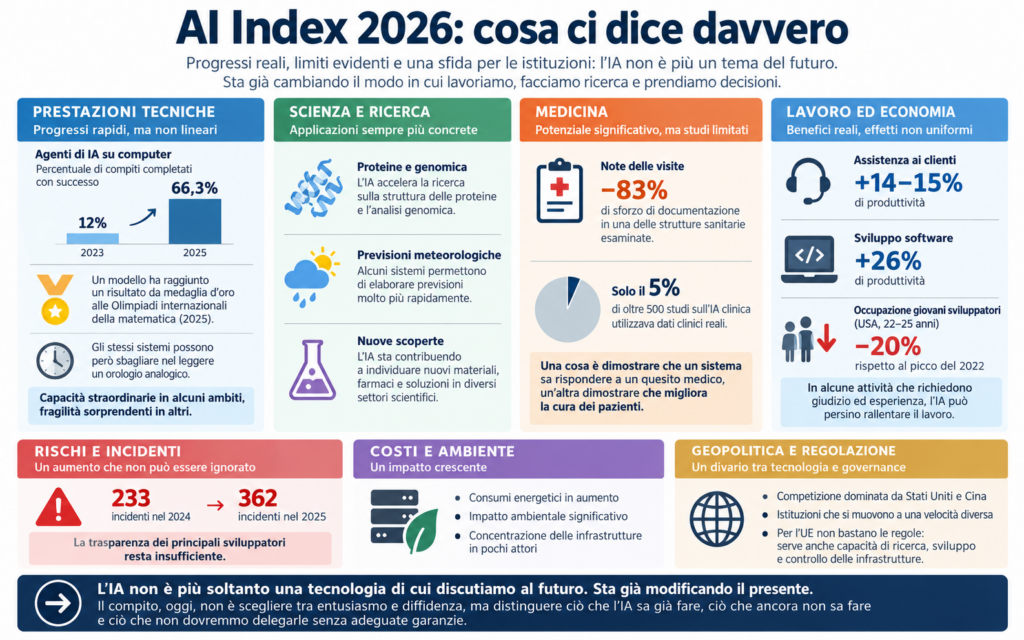
I miglioramenti tecnici sono impressionanti, anche se tutt’altro che lineari. Nei test in cui gli agenti di IA devono operare su un computer e portare a termine compiti concreti, la percentuale di successi è salita da circa il 12% al 66,3%. Resta un margine di errore enorme, ma il salto è evidente. Un modello ha raggiunto nel 2025 un risultato da medaglia d’oro alle Olimpiadi internazionali della matematica; eppure gli stessi sistemi possono sbagliare nel leggere un orologio analogico. È una contraddizione solo apparente. Le capacità dell’IA non crescono come quelle di una persona: possono essere straordinarie in un ambito e sorprendentemente fragili in un altro. Per questo confondere le prestazioni nei test con un’affidabilità generale sarebbe un errore.
Trovo ancora più interessante ciò che sta accadendo fuori dai laboratori informatici. L’IA è impiegata nella ricerca sulle proteine, nella genomica e nelle previsioni meteorologiche, dove alcuni sistemi permettono di elaborare previsioni molto più rapidamente. In medicina, strumenti che preparano le note delle visite hanno ridotto fino all’83% lo sforzo di documentazione in una delle strutture sanitarie esaminate. Non significa che un algoritmo possa sostituire un medico. Lo stesso rapporto ricorda che, in una rassegna di oltre 500 studi sull’IA clinica, solo il 5% utilizzava dati clinici reali. È una precisazione essenziale: una cosa è dimostrare che un sistema sa rispondere a un quesito medico, un’altra dimostrare che migliora la cura dei pazienti.
Anche sul lavoro cominciano a esserci misure concrete. Alcuni studi registrano incrementi di produttività del 14–15% nell’assistenza ai clienti e del 26% nello sviluppo software. I benefici, però, non sono uniformi; in determinate attività che richiedono giudizio ed esperienza, l’IA può persino rallentare il lavoro. E il rapporto segnala un dato che mi sembra impossibile ignorare: negli Stati Uniti, l’occupazione degli sviluppatori software tra i 22 e i 25 anni è diminuita di quasi il 20% rispetto al picco del 2022. Le cause non si possono ridurre alla sola IA. Resta però una domanda che riguarda anche le professioni giuridiche e l’università: se affidiamo alle macchine una parte crescente del lavoro normalmente svolto da chi comincia, come formeremo i professionisti esperti di domani?
Da giurista, è soprattutto il divario tra sviluppo tecnologico e capacità di governo a preoccuparmi. Gli incidenti documentati connessi all’IA sono passati da 233 nel 2024 a 362 nel 2025, mentre la trasparenza dei principali sviluppatori resta insufficiente. Si aggiungono le questioni ambientali, la concentrazione delle infrastrutture e una competizione tecnologica sempre più dominata da Stati Uniti e Cina. Per l’Unione europea, la sfida non può esaurirsi nella produzione di regole. Serve anche una capacità effettiva di ricerca, sviluppo e controllo delle infrastrutture. L’autonomia normativa conta poco se non è accompagnata da un’autonomia tecnologica almeno credibile.Questo non significa rinunciare alla tutela dei diritti; significa prendere sul serio le condizioni materiali che consentono di renderla effettiva.
Mi sembra, in definitiva, che la discussione pubblica continui troppo spesso a oscillare tra due estremi: da una parte l’idea che l’IA risolverà quasi tutto, dall’altra la convinzione che ogni suo errore ne dimostri l’inutilità. Nessuna delle due posizioni aiuta a capire ciò che sta accadendo. I progressi sono reali, i limiti anche, e gli effetti non saranno distribuiti equamente. Il compito, oggi, non è scegliere tra entusiasmo e diffidenza. È imparare a distinguere ciò che l’IA sa già fare, ciò che ancora non sa fare e ciò che non dovremmo delegarle senza adeguate garanzie.
Fonte principale: Stanford Institute for Human-Centered AI, AI Index Report 2026, in particolare i capitoli 2 (prestazioni tecniche), 3 (IA responsabile), 4 (economia), 5 (scienza), 6 (medicina) e 8 (politiche pubbliche). Testo scientifico del rapporto. Le percentuali citate si riferiscono a studi, test e campioni differenti e non sono direttamente confrontabili.
Artificial intelligence is already changing things. Including those we barely notice.
Whenever a new report on artificial intelligence comes out, I am less interested in which model has topped the rankings than in what has actually changed. Stanford’s 2026 AI Index offers some useful answers. It is hardly a celebration of the technology: alongside the advances, it documents failures, risks, costs and promises that still need to be tested. Yet one conclusion seems increasingly difficult to avoid: AI is no longer a technology we discuss mainly in the future tense.It is already changing how we work, conduct research and make decisions. Our institutions, meanwhile, seem to be moving at a different speed.
The technical advances are striking, though far from consistent. In tests where AI agents must operate a computer and complete practical tasks, success rates have risen from about 12% to 66.3%. The margin for failure remains considerable, but so does the progress. In 2025, a model achieved a gold-medal-level performance at the International Mathematical Olympiad, while these systems can still struggle to read an analogue clock. The contradiction is only apparent. AI capabilities do not develop in the same way as human abilities: a system may be exceptional at one task and remarkably fragile at another. Strong benchmark results should never be confused with general reliability.
What interests me even more is what is happening beyond computer science laboratories. AI is being used in protein research, genomics and weather forecasting, where some systems can produce forecasts much faster than traditional approaches. In medicine, tools that draft clinical notes have reduced documentation effort by as much as 83% in one of the healthcare settings examined. This does not mean an algorithm can replace a physician. The report itself notes that, in a review of more than 500 clinical AI studies, only 5% used real clinical data. That distinction matters: answering a medical question correctly is not the same as demonstrating better outcomes for patients.
There is also growing evidence of economic benefits. Some studies report productivity gains of 14–15% in customer support and 26% in software development. But those gains are uneven; on certain tasks requiring judgment and experience, AI may actually slow people down. And there is another finding I would not dismiss: in the United States, employment among software developers aged 22 to 25 has fallen by almost 20% from its 2022 peak. AI cannot simply be held responsible for the entire decline. Still, it raises a question for universities and the legal professions as well: if machines increasingly take on work traditionally given to beginners, how will the next generation become experienced professionals?
From a legal perspective, what concerns me most is the gap between technological development and our capacity to govern it. Documented AI incidents increased from 233 in 2024 to 362 in 2025, while transparency among leading developers remains inadequate. Add to this the environmental costs, the concentration of infrastructure and a technological competition increasingly dominated by the United States and China. For the European Union, the challenge cannot be confined to drafting rules. Europe also needs the capacity to research, develop and exercise meaningful control over the infrastructure on which these systems depend. Regulatory autonomy will have limited value without a credible degree of technological autonomy. This is not an argument for weakening the protection of rights. It is an argument for taking seriously the material conditions required to make that protection effective.
Too much of the public debate still seems trapped between two extremes: the expectation that AI will solve almost everything and the belief that every mistake proves it has little value. Neither position tells us much about what is actually happening. The progress is real, so are the limitations, and the benefits and costs will not be shared equally. The task now is not to choose between enthusiasm and suspicion. It is to distinguish what AI can already do, what it still cannot do, and what we should not delegate to it without adequate safeguards.
Main source: Stanford Institute for Human-Centered AI, AI Index Report 2026, especially chapters 2 (technical performance), 3 (responsible AI), 4 (economy), 5 (science), 6 (medicine), and 8 (policy and governance). Research report. The figures quoted come from different studies, benchmarks and samples and are not directly comparable.