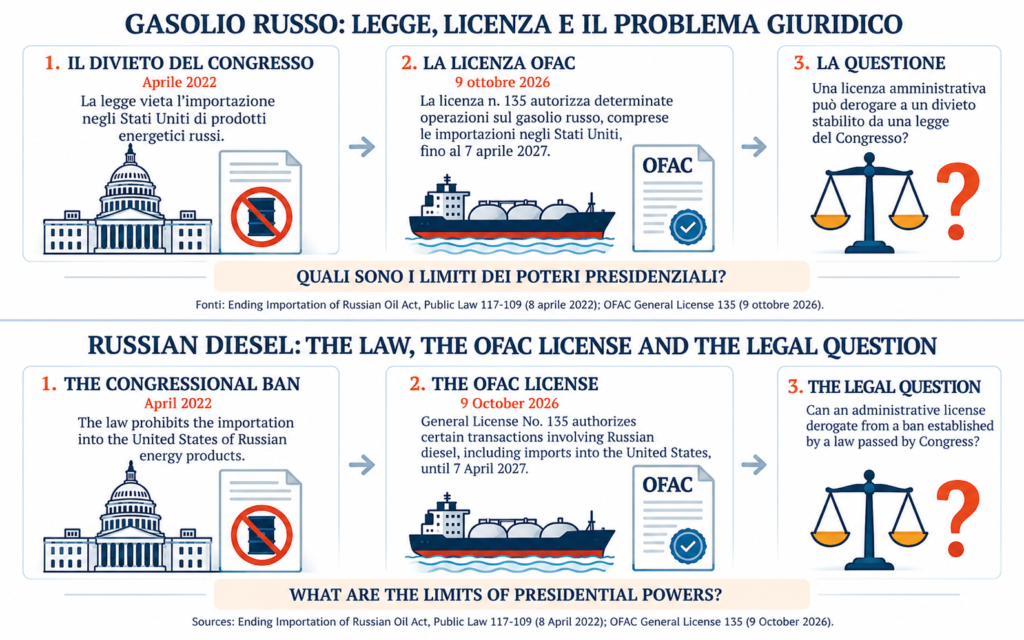
The Trump administration’s decision to allow Russian diesel imports for a limited period raises a question that goes beyond energy prices or the merits of easing economic pressure on Moscow. Can the executive branch use an administrative license to authorize conduct that Congress has prohibited by statute? The answer requires distinguishing the original executive order, the later congressional legislation, and the legal scope of the license issued in October 2026.
On 8 March 2022, President Biden issued Executive Order 14066, prohibiting imports into the United States of several categories of Russian-origin energy products, including petroleum, refined petroleum products, liquefied natural gas and coal. The order expressly allowed exceptions provided through regulations, orders, directives or licenses issued pursuant to it. On 8 April 2022, however, Congress enacted the Ending Importation of Russian Oil Act (Public Law 117-109). Section 2 establishes a statutory prohibition on the importation of Russian-origin goods classified under Chapter 27 of the US Harmonized Tariff Schedule, while referring to implementation actions under Executive Order 14066.
Congress also prescribed a specific route for terminating the prohibition. Under Section 3, the President must consult relevant congressional committees and certify, among other things, that Russia has agreed to a withdrawal and cessation of hostilities accepted by the Ukrainian government, poses no immediate military threat to NATO members, and recognizes Ukraine’s right to choose its own government. Termination takes effect 90 days after the certification, unless a joint resolution of disapproval is enacted. These provisions demonstrate that Congress did not leave the decision to end the prohibition entirely to presidential discretion.
On 9 October 2026, the Treasury Department’s Office of Foreign Assets Control issued General License No. 135. It authorizes, until 7 April 2027, transactions involving the sale, delivery, offloading or importation of Russian-origin diesel fuel, explicitly including imports into the United States. The license applies to transactions otherwise prohibited under 31 CFR Parts 587 and 589. It does not purport to amend or repeal Public Law 117-109 and does not set out a presidential certification under Section 3.
This produces a serious objection. If Congress has enacted a prohibition and specified the requirements for ending it, a general six-month license covering an entire class of prohibited goods may undermine those legislative safeguards. The concern is not that individual licenses are necessarily unlawful, but that regulatory licensing authority cannot automatically be equated with an unlimited power to suspend a statute. Seven senators from both parties took this position publicly on 11 October 2026, criticizing the decision and the absence of the congressional consultation and explanation they considered legally required.
There is, nevertheless, a material counterargument. Section 2 of the 2022 Act requires the prohibition to operate consistently with implementation actions under Executive Order 14066, and that order expressly contemplates licenses. The administration may therefore argue that Congress preserved a degree of administrative flexibility, and that Section 3 regulates the formal termination of the prohibition rather than every temporary exemption. The interpretive difficulty lies in determining when the breadth and duration of a license turn an implementation measure into a de facto suspension of the statutory rule. The mere existence of licensing authority does not necessarily settle that question.
Nor does the Lindsey O. Graham Sanctioning Russia and Iran Act of 2026 (Public Law 119-111, enacted on 18 September 2026) resolve it. That legislation introduces additional sanctions and tariffs but does not expressly repeal the 2022 import ban. Its Section 115 waiver authority is directed to measures under the relevant title of the 2026 Act; it cannot simply be treated as a blanket waiver of the earlier statute.
The sound conclusion is therefore narrower than a categorical assertion of illegality. OFAC’s license expressly covers imports that otherwise fall within the 2022 prohibition, while Congress has prescribed strict conditions for terminating that prohibition. Whether the license unlawfully circumvents those conditions turns on how the statutory reference to executive implementation measures is read and on the distinction between a permissible temporary exception and the substantive suspension of a congressional command. This is the constitutional importance of the episode: the boundary between flexibility in administering sanctions and the President’s duty to implement a foreign-policy constraint enacted by Congress.
Primary sources and documentation
- Ending Importation of Russian Oil Act, Public Law 117-109, Sections 2-3 (8 April 2022).
- Executive Order 14066 (8 March 2022).
- OFAC, General License No. 135 (9 October 2026), official text.
- Senate Foreign Relations Committee, bipartisan statement of 11 October 2026.
- Lindsey O. Graham Sanctioning Russia and Iran Act of 2026, Public Law 119-111.