Congress, the President, and the changing constitutional law of U.S. trade policy
Tariffs have returned to the centre of U.S. economic and foreign policy. They are increasingly used not only to protect domestic industries, but also to pursue broader objectives involving national security, economic security, strategic competition, supply chains, and relations with major trading partners.
Yet behind the political controversy lies a prior legal question that is sometimes overlooked: who actually has the authority to impose tariffs under the U.S. constitutional system?
The answer is more complex than the frequent reference to “presidential tariffs” might suggest.
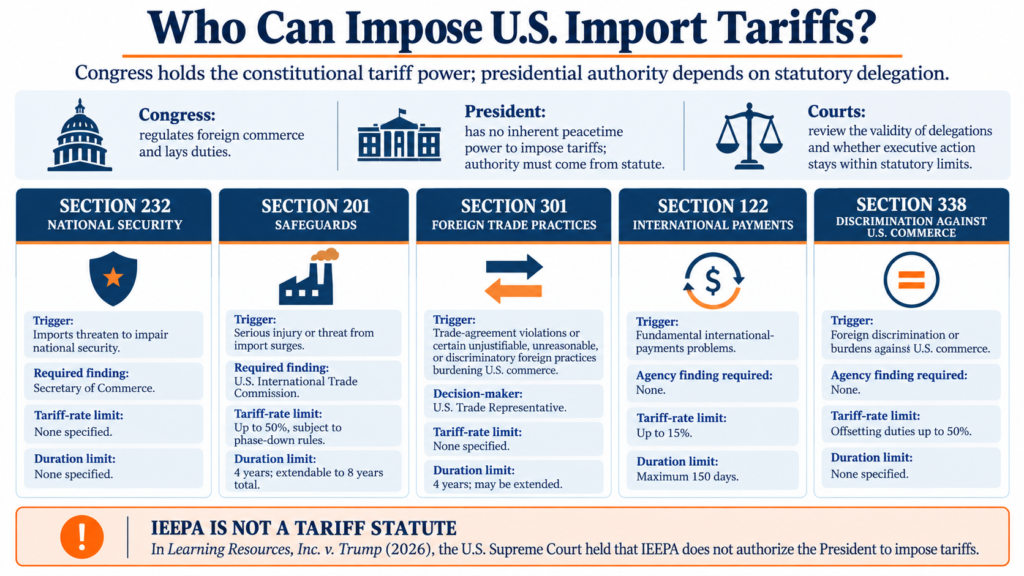
The constitutional power belongs primarily to Congress. The President may impose or modify tariffs only when Congress has delegated that authority through legislation and when the conditions established by the relevant statute are satisfied.
This institutional structure is examined in detail in the Congressional Research Service report Congressional and Presidential Authority to Impose Import Tariffs, updated on 19 March 2026. The report analyses Congress’s constitutional powers, the statutory authorities delegated to the executive branch, the role of judicial review, and the consequences of the Supreme Court’s recent intervention in the field.
Tariffs begin with Congress
The constitutional starting point is Article I.
The Constitution gives Congress the power to regulate commerce with foreign nations and the power to “lay and collect Taxes, Duties, Imposts and Excises.” In other words, the authority to establish import tariffs forms part of the legislative powers assigned to Congress.
The President does not possess an equivalent inherent constitutional authority to impose tariffs.
That point has recently acquired renewed importance. As the CRS report notes, U.S. courts have repeatedly distinguished the President’s substantial authority in foreign affairs from the power to regulate commerce through tariffs. The Supreme Court stated in 2026 that, whatever the scope of presidential authority may be in other contexts, the President has no inherent peacetime authority to impose tariffs.
This does not mean that the President lacks important tariff powers. On the contrary, modern U.S. trade law gives the executive branch very considerable room for manoeuvre.
But that authority is delegated authority.
Congress has enacted a series of statutes allowing the President, the U.S. Trade Representative, or other executive authorities to adopt tariffs when specified conditions are met. The legal issue is therefore not simply whether the President wishes to impose a tariff. It is whether a statute enacted by Congress authorizes the measure in question.
Delegation is the key to understanding modern U.S. tariff policy
The modern system is built on a tension that runs through much of U.S. public law.
Congress possesses the constitutional power, but Congress has delegated substantial portions of that power to the executive.
Historically, the Supreme Court has accepted relatively broad delegations in the tariff field. The foundational case is J.W. Hampton, Jr. & Co. v. United States, in which the Court accepted that Congress could authorize the President to adjust tariff rates so long as Congress supplied an “intelligible principle” governing the exercise of the delegated authority.
Later decisions continued that approach. In particular, the Supreme Court upheld the constitutionality of Section 232 of the Trade Expansion Act because presidential action depends upon statutory preconditions, including a finding that imports threaten to impair national security.
The result is a legal framework in which the President may exercise very significant authority, but that authority takes different forms depending on the statutory basis invoked.
The CRS report identifies five particularly important tariff authorities currently available under federal law: Section 232 of the Trade Expansion Act of 1962; Sections 201, 301 and 122 of the Trade Act of 1974; and Section 338 of the Tariff Act of 1930.
They should not be treated as interchangeable.
Each responds to a different legal problem.
Section 232: tariffs and national security
Section 232 of the Trade Expansion Act of 1962 is perhaps the clearest example of the growing interaction between trade law and national-security policy.
The provision authorizes the President to adjust imports when the Secretary of Commerce finds that particular goods are being imported “in such quantities or under such circumstances as to threaten to impair the national security.”
The procedure therefore begins with an investigation by the Department of Commerce.
The Secretary of Commerce must investigate the effects of the relevant imports on national security, consult with other parts of the government — including the Department of Defense — and submit findings and recommendations to the President.
If the Secretary makes the necessary national-security finding, the President decides whether to concur and, if so, determines the nature and duration of the action necessary to adjust imports.
The breadth of the provision is striking.
Section 232 does not prescribe a general maximum tariff rate, nor does it impose a fixed maximum duration on tariffs imposed under the provision. The President is also not legally required to follow the Secretary of Commerce’s specific recommendations.
This explains why Section 232 has become so important in contemporary U.S. trade policy. It provides a comparatively broad statutory foundation for measures connecting imports to national-security concerns.
Section 201: protection against serious injury from imports
Section 201 of the Trade Act of 1974 addresses a different problem.
It is a safeguard mechanism.
Rather than focusing on national security or allegedly unfair conduct by foreign governments, Section 201 concerns situations in which increased imports cause, or threaten to cause, serious injury to a domestic industry.
The institutional structure is also different.
The U.S. International Trade Commission plays the central role in investigating whether the statutory conditions are satisfied. Only after the required injury determination does the statutory framework permit presidential action.
Section 201 is therefore an example of a more tightly structured delegation: executive action is preceded by a specialised institutional determination concerning the economic effects of imports.
It illustrates an important point about U.S. tariff law more generally. Presidential tariff powers differ not only in purpose, but also in the extent to which Congress has imposed procedures, findings, time limits, or quantitative restrictions before executive action becomes legally available.
Section 301: foreign trade practices and unilateral enforcement
Section 301 of the Trade Act of 1974 serves another function.
It is designed to respond to foreign governmental measures, policies, or practices that affect U.S. trade.
The statute gives the U.S. Trade Representative an important enforcement role where U.S. rights under trade agreements are violated or where foreign practices are considered unjustifiable, unreasonable, or discriminatory and burden or restrict U.S. commerce.
Section 301 is therefore not primarily a safeguard mechanism and is not centred on national security. It is a mechanism for responding to foreign trade practices.
Its importance has grown because it provides a legal basis for unilateral U.S. trade measures, including additional duties, while still operating within a statutory framework established by Congress.
The difference in institutional design also has consequences for judicial review. The CRS report notes that actions taken by the U.S. Trade Representative under Section 301 are reviewed according to the standards of the Administrative Procedure Act, including whether agency action is arbitrary, capricious, an abuse of discretion, contrary to law, or unsupported by substantial evidence.
Section 122: emergency action, but with explicit limits
Section 122 of the Trade Act provides a narrower authority directed at fundamental international payments problems.
It is particularly interesting because it demonstrates how Congress can authorize emergency economic action while simultaneously imposing clear statutory limits.
Unlike Section 232, Section 122 contains express restrictions concerning both the magnitude and duration of the measure.
A temporary import surcharge may reach up to 15 per cent and may generally remain in force for no more than 150 days.
This becomes especially significant in light of the Supreme Court’s 2026 judgment concerning the International Emergency Economic Powers Act.
The contrast is revealing. Where Congress intended to permit the executive branch to impose temporary tariffs in response to international payments problems, it did so explicitly and imposed identifiable limits on the delegated authority.
Section 338: discrimination against U.S. commerce
Section 338 of the Tariff Act of 1930 offers yet another legal basis for additional tariffs.
It addresses situations in which foreign countries discriminate against U.S. commerce or impose burdens or disadvantages on U.S. trade.
The statute allows additional duties, subject to statutory limits, as a response to such discriminatory treatment.
Unlike Sections 232, 201 and 301, Section 338 does not contain the same type of express requirement for a preliminary investigation and finding by a designated federal agency.
Its inclusion alongside the more frequently discussed modern trade statutes is useful because it demonstrates the diversity of tariff powers accumulated in U.S. legislation over time.
There is no single “tariff statute.” There is instead a collection of legal authorities adopted for different purposes and conferring different degrees of executive discretion.
The Supreme Court draws a line: IEEPA is not a tariff statute
The most consequential recent development came in February 2026.
In Learning Resources, Inc. v. Trump, the Supreme Court held that the International Emergency Economic Powers Act of 1977 — IEEPA — does not authorize the President to impose tariffs.
The issue was of considerable constitutional significance.
IEEPA grants the President broad powers over economic transactions following the declaration of certain national emergencies. Among other things, it authorizes the President to “regulate” or “prohibit” imports.
But the statute does not expressly authorize tariffs.
The Court rejected the proposition that the general authority to regulate imports could be read as an independent power to impose customs duties. As the CRS report explains, the Court relied both on the statutory language and on the broader structure of federal trade legislation.
That conclusion matters well beyond the specific tariffs challenged in the case.
If a broadly worded emergency statute were sufficient to authorize tariffs, the executive branch could potentially bypass the numerous trade statutes in which Congress deliberately specified particular triggers, procedures, institutional findings, tariff ceilings, and time limits.
The Supreme Court’s decision therefore reinforces the principle that presidential power over tariffs must ultimately be traced back to Congress.
Emergency powers do not automatically become tariff powers.
Judicial review may now become more important
The scope of presidential tariff authority also depends on the intensity of judicial review.
Historically, the Federal Circuit has adopted a relatively deferential approach when reviewing presidential action in the trade field.
Under the standard developed in Maple Leaf Fish Co. v. United States, judicial intervention has traditionally been associated with situations involving a “clear misconstruction” of the governing statute, significant procedural violations, or action outside the authority delegated by Congress.
That approach may now come under greater scrutiny.
In Loper Bright Enterprises v. Raimondo, decided in 2024, the Supreme Court rejected the Chevron doctrine of judicial deference to reasonable agency interpretations of ambiguous federal statutes. Courts, the Supreme Court explained, must exercise their own independent judgment when determining the meaning of statutory provisions.
The relationship between Loper Bright and the traditionally deferential review of presidential tariff decisions has not yet been completely resolved.
But the question is important.
If courts scrutinise statutory delegations and their exercise more closely, disputes over tariffs may increasingly turn on the precise wording of the statute invoked by the executive branch.
The deeper issue is separation of powers
Tariffs are often discussed primarily as instruments of economic policy.
They may protect domestic production, respond to foreign trade practices, encourage industrial investment, alter supply chains, or serve national-security objectives.
But legally they also raise a fundamental question of separation of powers.
The U.S. constitutional system does not simply ask whether a tariff is economically justified or strategically useful. It asks which institution has the legal authority to impose it.
Congress holds the underlying constitutional power.
Congress may delegate portions of that power to the executive, and historically it has done so extensively. But the President acts within a legal framework created by legislation. The scope of executive authority therefore depends on the text, structure, conditions and limits of the particular statute being invoked.
The 2026 Supreme Court decision on IEEPA makes this institutional distinction especially visible.
The President may possess extensive powers in foreign affairs and during national emergencies. But those powers do not themselves produce an independent constitutional authority to tax imports.
That is why Sections 232, 201, 301, 122 and 338 matter.
They are not merely technical provisions of trade legislation. They mark the legal boundaries between congressional power and executive discretion.
And as tariffs assume an increasingly important role in U.S. economic security and foreign policy, those boundaries are likely to become as important as the tariffs themselves.