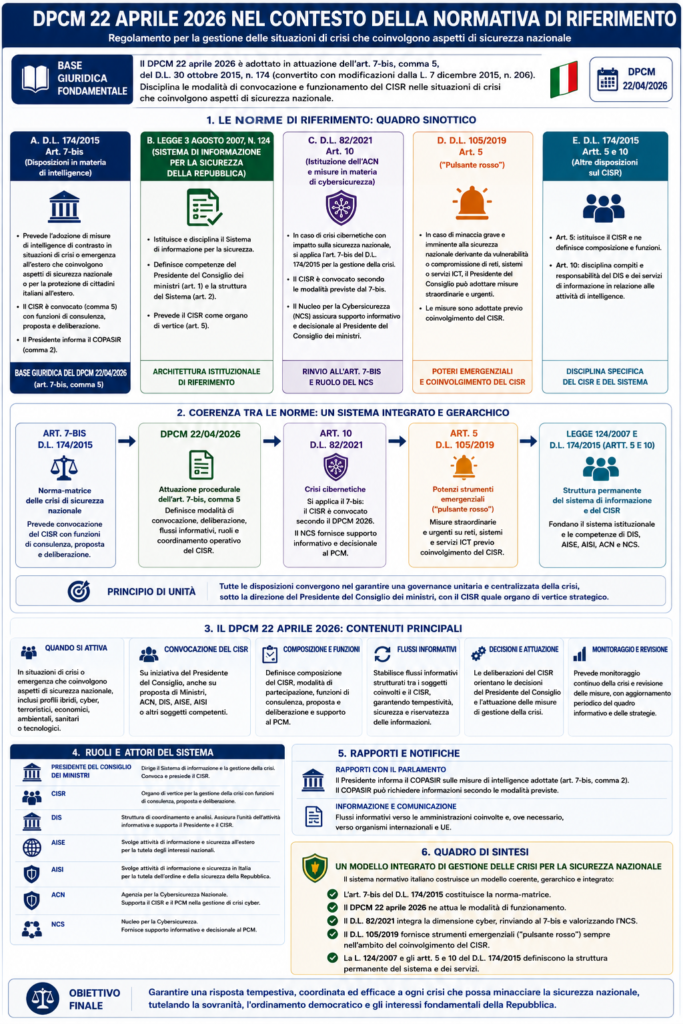
The Decree of the President of the Council of Ministers of 22 April 2026 establishes the implementing regulation for Article 7-bis, paragraph 5, of Decree-Law No. 174 of 30 October 2015, concerning the management of crisis situations involving aspects of national security. In practical terms, the decree reorganizes and clarifies how Italy’s highest governmental security coordination body, the Interministerial Committee for the Security of the Republic — CISR, must operate when a crisis has implications for national security.
The regulation starts from the premise that modern crises may affect not only military or intelligence matters, but also political, economic, industrial, scientific, environmental and cyber interests of the State. It therefore seeks to avoid uncertainty, overlaps or duplication among public authorities by giving the Prime Minister and the CISR a clearer coordination framework.
A central point of the decree is the definition of “crisis situations”. These are systemic crises involving national security, including hybrid-threat scenarios, whose management requires the Prime Minister to exercise powers of direction, guidance and coordination. The decree does not replace the ordinary competences of ministries, agencies or other interministerial bodies in emergencies that do not concern national security. Rather, it creates a specific framework for crises that rise to the level of national-security relevance.
The CISR may be convened by the Prime Minister to perform three main functions: consultation, proposal and deliberation. In crisis situations, it can propose general directives for coordinating the activities needed to manage and overcome the crisis; assess the relevant information picture and its evolution; decide measures for the coordinated acquisition and updating of data; and propose specific measures or decisions to be adopted by the Prime Minister or, where necessary, submitted to the Council of Ministers.
The decree also gives the CISR a strategic role. It must contribute to the preparation of a National Security Strategy, which identifies the fundamental interests to be protected, the strategic objectives to be pursued, and the policies and instruments for preventing and countering threats and risks. This strategy is adopted by the Prime Minister on a proposal from the CISR, after hearing the parliamentary intelligence oversight committee, COPASIR. It must be updated at least every three years.
Special attention is given to cyber crises. Where a crisis involves cybersecurity, the CISR’s composition is expanded to include the minister responsible for technological innovation and digital transition and the Director General of the National Cybersecurity Agency. This also applies in cases of serious and imminent risk to national security linked to vulnerabilities in networks, information systems and IT services.
The decree also regulates who may participate in CISR meetings during a crisis. Besides the ordinary members, the Prime Minister may invite ministers or authorities whose competences are affected, the Civil Protection authorities, the diplomatic and military advisers to the Prime Minister, the directors of AISE and AISI, and other civil or military authorities when their presence is necessary. In urgent cases, the Prime Minister may convene the CISR through simplified procedures or in a restricted composition.
A significant operational role is assigned to the technical CISR, a permanent collegial body chaired by the Director General of the DIS, the Department of Information for Security. The technical CISR prepares and supports the work of the political-level CISR. It gathers and analyses information, acquires relevant operational plans, monitors implementation of measures, supports exercises, and may propose positions to be taken by Italy in international organisations during crises. It may also establish technical working groups, including permanent ones, and the decree expressly refers to a permanent technical table for monitoring and countering hybrid threats.
The decree preserves the responsibilities of the administrations and bodies already competent in their respective sectors. Measures adopted for managing crises must be implemented by the appropriate ministries, public bodies, private actors where relevant, and interministerial bodies, according to existing law. These actors must ensure reciprocal information-sharing on initiatives taken and on the development of the crisis.
Finally, the decree repeals the previous DPCM of 5 May 2010 on the national organisation for crisis management, while preserving certain transitional arrangements until new structures or bodies are formally designated. It also provides that information exchange among the actors involved must take place continuously through an appropriate telecommunications infrastructure. The decree states that its implementation must not generate new or greater costs for public finance.
Overall, the 22 April 2026 DPCM strengthens the central coordination role of the Prime Minister and the CISR in national-security crises. It creates a more integrated system for assessment, decision-making, interministerial coordination, cyber and hybrid-threat response, and long-term strategic planning through the National Security Strategy.