From IEEPA emergency tariffs to a multi-statute architecture
The U.S. tariff landscape in 2026 looks markedly different from the system constructed during the first year of President Donald Trump’s second term. The change is not that tariffs have disappeared. Rather, the legal architecture supporting them has been substantially reorganised.
A useful starting point is the Congressional Research Service report Presidential 2025 Tariff Actions: Timeline and Status, updated on 12 January 2026. The CRS described an unusually broad set of tariff measures adopted after 20 January 2025 and identified three principal statutory frameworks: the International Emergency Economic Powers Act (IEEPA), Section 232 of the Trade Expansion Act of 1962, and, potentially, Section 301 of the Trade Act of 1974. The report covered presidential tariff measures, bilateral arrangements and foreign retaliation through 31 December 2025.
At the time the CRS report was published, however, the legality of the most innovative component of this system—the use of IEEPA to impose tariffs—was already before the Supreme Court. The CRS noted that federal courts had held that the President had exceeded his IEEPA authority in at least some of the challenged measures, while the tariffs remained temporarily in force pending Supreme Court review.
What followed in February 2026 fundamentally changed the legal framework.
The Supreme Court closes the IEEPA route
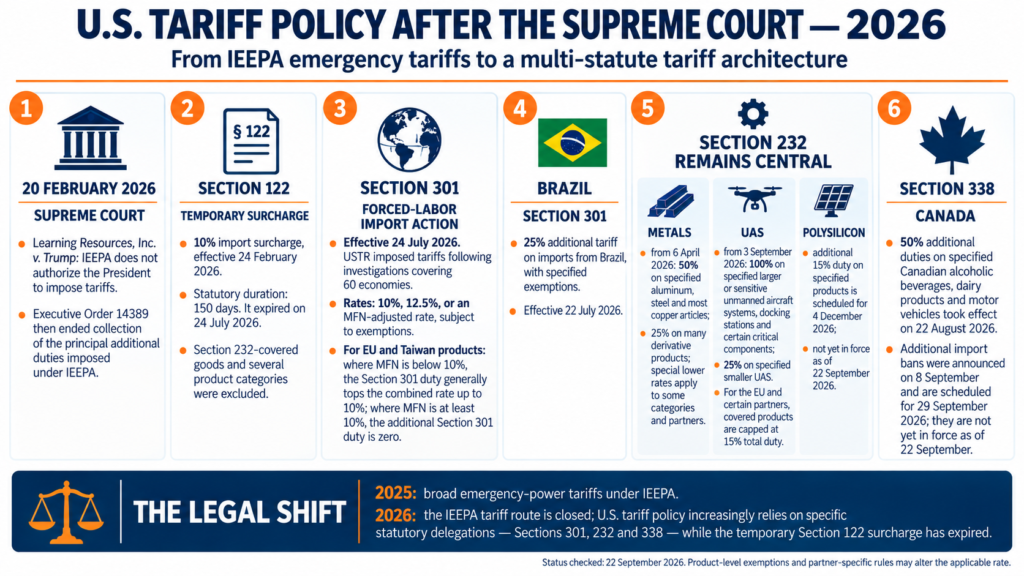
On 20 February 2026, the Supreme Court decided Learning Resources, Inc. v. Trump, together with Trump v. V.O.S. Selections, Inc. The Court’s holding was direct: IEEPA does not authorize the President to impose tariffs. It therefore affirmed the Federal Circuit judgment in V.O.S. Selections.
The constitutional and statutory reasoning is particularly important. Article I, Section 8 gives Congress the power to impose “Taxes, Duties, Imposts and Excises”, and the Court observed that the Executive does not possess an inherent peacetime power to impose tariffs. Presidential tariff authority must therefore derive from legislation enacted by Congress.
IEEPA authorises the President, following the declaration of a national emergency, to “regulate” specified international economic transactions and importation. But it contains no express reference to tariffs or duties. By contrast, Congress has expressly referred to duties when delegating tariff authority under other statutes. The Court consequently rejected the proposition that the general power to “regulate … importation” silently included an effectively unlimited tariff power.
The judgment was therefore narrower than a general restriction on presidential trade powers. It invalidated IEEPA as a tariff authority; it did not invalidate statutory delegations such as Sections 122, 232 or 301.
That distinction explains what happened next.
The immediate response: terminating IEEPA tariffs
On the same day as the judgment, President Trump issued Executive Order 14389, “Ending Certain Tariff Actions.”The order terminated the additional ad valorem duties imposed under the principal IEEPA measures, including the emergency tariffs concerning Canada, Mexico and China, the “reciprocal” tariff regime, and IEEPA measures concerning Brazil, India and other countries.
Crucially, the Executive Order expressly stated that it affected only duties imposed under IEEPA and did not affect tariffs imposed under other statutes, including Section 232 and Section 301.
The effect of Learning Resources was therefore not the dismantling of U.S. tariff policy. It forced the Administration to rely on statutes in which Congress had more specifically delegated tariff powers.
Section 122: an immediate but temporary bridge
Also on 20 February 2026, the President invoked Section 122 of the Trade Act of 1974 and imposed a temporary 10% import surcharge.
Unlike IEEPA, Section 122 expressly authorises import surcharges in response to specified international payments problems. The proclamation found that the United States was experiencing a “large and serious balance-of-payments deficit” and imposed the surcharge from 24 February 2026.
But Section 122 contains an important statutory limitation: presidential action may last no more than 150 days unless Congress extends it. The proclamation accordingly provided that the surcharge would remain in force until 24 July 2026. It also contained substantial product exemptions and provided that the surcharge would not be added to the portion of an import already subject to Section 232 tariffs.
Section 122 thus served as a temporary bridge rather than a permanent replacement for the IEEPA system.
The more durable reconstruction of tariff policy occurred elsewhere.
Section 301 emerges as a central post-IEEPA instrument
One of the most consequential developments in 2026 has been the expanded use of Section 301 of the Trade Act of 1974.
Section 301 is fundamentally different from IEEPA. It expressly authorises the U.S. Trade Representative to impose duties and other trade restrictions after investigating foreign acts, policies or practices that meet the statutory criteria.
On 12 March 2026, USTR initiated investigations concerning 60 economies over their alleged failure to impose and effectively enforce prohibitions on imports produced with forced labour. USTR subsequently determined that the practices under investigation were actionable under Section 301.
After two rounds of hearings, consultations with foreign governments and thousands of public submissions, USTR announced final action on 23 July 2026, with the new duties applicable from 24 July.
The tariff structure is not uniform.
For economies that had adopted, partially adopted or committed themselves to adopting an effective forced-labour import prohibition, the basic additional tariff is 10%. Other investigated economies are generally subject to a 12.5% tariff. Products already subject to Section 232 tariffs and a number of specifically identified products are exempt.
The treatment of the European Union is more nuanced. For covered EU products whose ordinary most-favoured-nation tariff is below 10%, the Section 301 duty brings the combined MFN-plus-Section-301 rate to 10%. If the existing MFN tariff is already at least 10%, the additional Section 301 duty is zero. The same mechanism applies to Taiwan, while Japan, Korea and Switzerland operate under a corresponding 12.5% threshold.
This is a significant structural change. Instead of using a broadly framed emergency statute as the basis for almost economy-wide tariffs, the Administration is now relying on a statute expressly authorising duties following a defined investigative procedure.
Brazil: from an IEEPA tariff to Section 301
Brazil provides a particularly clear example of this transition.
The January CRS report recorded a 40% IEEPA tariff on selected Brazilian products, alongside the broader reciprocal tariff measures. That IEEPA legal basis disappeared following Learning Resources and Executive Order 14389.
A separate Section 301 investigation, however, had already been initiated in July 2025.
Following that investigation, USTR announced on 15 July 2026 a new 25% tariff on Brazilian goods, subject to substantial product exemptions. The duty became applicable on 22 July 2026.
USTR based the action on findings concerning Brazilian measures relating to digital trade and electronic payment services, tariff preferences, anti-corruption enforcement, intellectual-property protection, ethanol market access and deforestation. Those descriptions should be understood as USTR’s statutory findings under Section 301, rather than independent judicial determinations concerning Brazilian conduct.
The distinction is legally important. The policy objective may overlap with earlier tariff measures, but the statutory mechanism is different.
Section 232 remains intact—and has expanded
The Supreme Court decision did not disturb Section 232 of the Trade Expansion Act of 1962.
The CRS report had already documented the extensive use of Section 232 in 2025 for steel and aluminium, automobiles and automobile parts, copper, timber and lumber, trucks and buses, while investigations were underway in sectors including semiconductors, pharmaceuticals, critical minerals, aircraft, drones, polysilicon, wind turbines and medical equipment.
The Administration expanded this sectoral architecture in 2026.
On 2 April 2026, the President restructured the Section 232 tariff regimes for steel, aluminium and copper. From 6 April, the general additional tariff became 50% for specified aluminium, steel and many copper products and 25% for a substantial category of derivative products, with lower rates and special treatment for certain products and trading partners.
Further modifications adopted in June introduced additional differentiated treatment. For specified goods from the European Union, Japan, Korea, Switzerland, Taiwan and several other partners, the ordinary tariff and the additional Section 232 duty are calibrated in certain categories so that the total rate is 15%.
The resulting system is considerably more complex than a simple across-the-board tariff. Product classification, metal content, country of origin and the existence of bilateral arrangements can all affect the applicable rate.
Drones become a new Section 232 sector
A particularly notable 2026 development concerns unmanned aircraft systems (UAS).
Following a Section 232 investigation, an August presidential proclamation imposed new tariffs effective 3 September 2026.
Specified larger UAS, UAS incorporating thermal imagers, docking stations and certain critical components are subject to a 100% additional tariff, while specified smaller UAS are generally subject to a 25% tariff. Further 25% duties on certain components are scheduled to begin in February 2027.
Again, however, the system contains significant country-specific qualifications. For qualifying products from the European Union, Japan, Korea, Taiwan, Switzerland and Liechtenstein, the total rate may not exceed 15%, subject to certification requirements concerning the origin of critical components and technology. The corresponding ceiling for qualifying UK products is 10%.
Polysilicon: another Section 232 regime is coming
The Administration has also completed a Section 232 process concerning polysilicon and its derivatives.
The August proclamation establishes a minimum import price mechanism and provides for an additional 15% tariff on specified polysilicon ingots and derivative products, beginning on 4 December 2026.
That distinction in dates is important: as of 22 September 2026, the new polysilicon tariff has been announced but is not yet in force.
For covered products from the EU, Japan, Korea, Taiwan, Switzerland and Liechtenstein, the combined ordinary duty and Section 232 tariff will generally be capped at 15%.
A rarely used provision returns: Section 338 and Canada
Another striking development is the revival of Section 338 of the Tariff Act of 1930.
Section 338 authorises the President, under specified conditions, to impose additional duties of up to 50% when a foreign country is found to discriminate against U.S. commerce.
On 20 July 2026, President Trump invoked Section 338 in three separate proclamations concerning Canadian measures affecting alcoholic beverages, dairy products and motor vehicles. The proclamations imposed additional duties of 50%on specified Canadian products. After a brief three-day suspension, those duties became effective on 22 August 2026.
The scope of some of those tariffs was subsequently modified with effect from 15 September.
The dispute has since escalated further. On 8 September 2026, the President issued proclamations providing for the exclusion from importation of certain Canadian alcoholic beverages, dairy goods and motor-vehicle products. Those bans are scheduled to become effective on 29 September 2026. As of 22 September, therefore, they have been announced but are not yet operative.
Here too, the Administration describes the Canadian measures as discriminatory within the meaning of Section 338. That characterization reflects the findings contained in the presidential proclamations and should be presented as such.
What does all this mean for the European Union?
For the EU, the post-Learning Resources system is more complicated than the 2025 concept of a single “reciprocal tariff.”
The IEEPA-based reciprocal tariff no longer supplies the legal basis for taxing EU imports. But this does not mean that EU exports have returned to the pre-2025 tariff regime.
Instead, different categories of EU goods may now fall within several parallel legal frameworks.
Under the July 2026 Section 301 forced-labour action, covered EU goods are generally subject to a system that brings the combined MFN and Section 301 rate to 10%, unless the pre-existing MFN rate is already 10% or higher.
Separately, Section 232 continues to apply to strategic sectors such as metals and UAS, often with specific arrangements limiting the combined tariff burden to 15% for qualifying EU products.
The applicable tariff therefore increasingly depends not simply on the country of origin but on the statutory authority invoked, the HTS classification of the product, existing MFN duties, sector-specific exemptions, country-specific arrangements and rules governing the interaction of overlapping measures.
The broader legal shift
The most important consequence of the Supreme Court’s February ruling is therefore not the end of U.S. tariffs. It is a change in their legal architecture.
The tariff regime of 2025 was distinctive because IEEPA was used to construct broad emergency-based measures capable of reaching almost all imports from particular countries—or, through the reciprocal tariff programme, imports from much of the world.
After Learning Resources, that pathway is closed.
The Administration has instead relied increasingly on several more specific congressional delegations:
Section 122 supplied a temporary 10% general surcharge but expired in July because of its statutory 150-day limit.
Section 301 now supports broad tariffs following investigations into foreign acts, policies and practices, including the July 2026 forced-labour measures and the separate action involving Brazil.
Section 232 remains the principal mechanism for national-security-based sectoral tariffs and continues to expand into strategic industries including metals, UAS and polysilicon.
Section 338, long largely dormant, has re-emerged as a potential instrument against foreign measures that the Administration determines discriminate against U.S. commerce.
The Supreme Court therefore constrained one exceptionally broad theory of executive tariff power without eliminating the substantial authority that Congress has delegated to the President and USTR under the trade statutes.
For lawyers and policymakers, the central question after Learning Resources is consequently more precise than before: not simply whether the Executive wishes to impose a tariff, but which statutory delegation authorises the measure, what findings activate that delegation, what procedures must be followed, and what substantive or temporal limits Congress has attached to it.
That is likely to be the defining legal issue surrounding U.S. tariff policy after 2026.