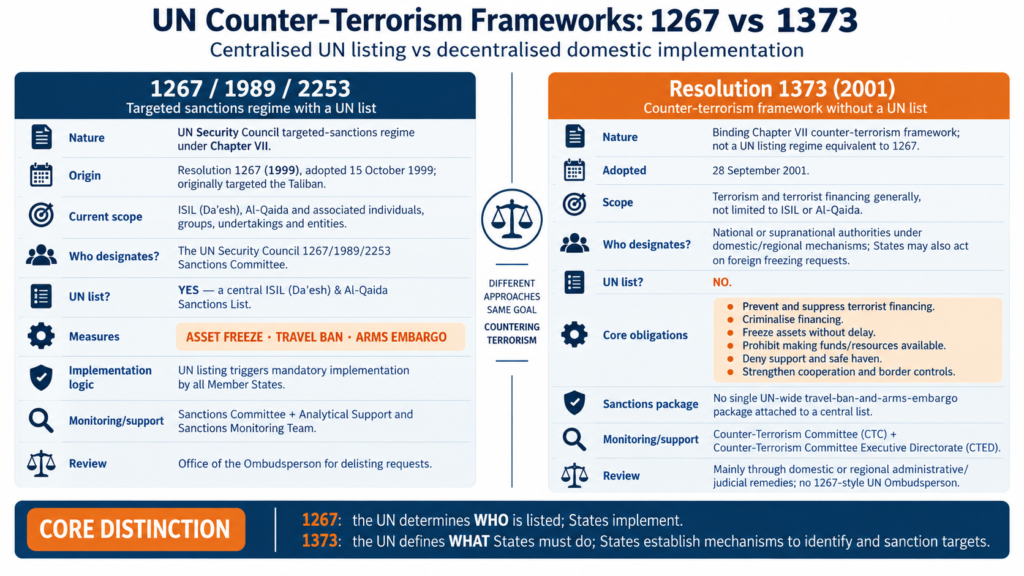
Security Council resolutions 1267 (1999) and 1373 (2001) are frequently treated as two components of the same international counter-terrorism architecture. That is correct at a functional level, particularly in relation to terrorist financing and asset freezing. Legally, however, the two frameworks operate through substantially different regulatory techniques. The essential distinction is that the 1267 framework constitutes a centralised United Nations targeted-sanctions regime based on an international list, whereas resolution 1373 establishes general and binding counter-terrorism obligations that States must implement through national or supranational legal mechanisms.
Both resolutions were adopted by the Security Council acting under Chapter VII of the Charter. Resolution 1267 was adopted on 15 October 1999 and initially imposed measures against the Taliban, including an asset freeze and restrictions on Taliban-controlled aircraft. Resolution 1373 was adopted unanimously on 28 September 2001, in the immediate aftermath of the attacks of 11 September, and expressly states that the Council was acting under Chapter VII. The binding force of Security Council decisions follows from Article 25 of the Charter, under which Member States agree to accept and carry out the Council’s decisions; Article 103 further provides that Charter obligations prevail in the event of conflict with obligations under another international agreement.
1. Resolution 1267: a centralised UN sanctions regime
The system originating in resolution 1267 has undergone substantial transformation. It initially targeted the Taliban. Subsequent resolutions extended and refined the measures; in 2011, resolutions 1988 and 1989 separated the Taliban sanctions regime from the Al-Qaida regime, and resolution 2253 (2015) expanded the latter to encompass ISIL (Da’esh). The contemporary framework is therefore formally known as the 1267/1989/2253 ISIL (Da’esh) and Al-Qaida sanctions regime.
Its defining feature is the existence of a United Nations sanctions list. Individuals, groups, undertakings and entities satisfying the relevant listing criteria are designated through the Security Council’s 1267/1989/2253 Sanctions Committee. Once included on the ISIL (Da’esh) and Al-Qaida Sanctions List, they are subject to measures that every UN Member State must implement.
Under the current framework reaffirmed by resolution 2734 (2024), the sanctions consist of an asset freeze, travel ban and arms embargo. The Security Council Committee itself describes these as the three measures applicable to persons and entities appearing on the list.
The legal trigger is therefore a designation made at the international level. States do not independently determine whether a person already appearing on the UN list should be subjected to the sanctions: they are required to give effect to the Security Council designation within their domestic legal orders. This produces a comparatively high degree of uniformity. A listed person is, in principle, subject to the same core sanctions obligations in every Member State.
The regime is institutionally supported by the Analytical Support and Sanctions Monitoring Team, while listing, delisting, exemptions and questions of implementation are dealt with by the Sanctions Committee. A particularly important procedural feature is the Office of the Ombudsperson, created by resolution 1904 (2009). It provides an independent and impartial procedure through which individuals and entities may seek removal from the ISIL (Da’esh) and Al-Qaida list. Its present mandate runs until 17 June 2027.
The measures are preventive rather than criminal in character. A criminal conviction is not a prerequisite for listing. The relevant issue is whether the listing criteria established by the Security Council are satisfied. This preventive character explains both the operational value of the regime and the importance attached to procedural safeguards, exemptions and delisting review.
2. Resolution 1373: a decentralised system of binding obligations
Resolution 1373 adopts a fundamentally different approach. It does not establish a United Nations list of terrorists and does not empower the Counter-Terrorism Committee to designate individual persons or entities.
Instead, the Security Council imposes general obligations upon all States. In particular, States must prevent and suppress terrorist financing; criminalise the intentional provision or collection of funds for terrorist acts; freeze without delay the funds and economic resources of persons who commit, attempt to commit, participate in or facilitate terrorist acts; and prohibit funds, financial assets, economic resources and related services from being made available to those persons and associated entities.
Resolution 1373 also extends well beyond asset freezing. It requires States, inter alia, to refrain from supporting persons involved in terrorist acts, suppress recruitment, eliminate the supply of weapons to terrorists, deny safe haven, strengthen border controls and enhance criminal, police and judicial cooperation.
The crucial structural difference is that the Security Council defines the obligation to act, but does not centrally identify every person against whom the obligation is to be applied. States must therefore create domestic — or, where appropriate, supranational — mechanisms capable of designating persons and entities and freezing their assets. CTED expressly notes that the asset-freezing mechanism required by resolution 1373 differs from the mechanism established under resolutions 1267, 1989 and 2253.
This distinction is also explicitly reflected in recent UN guidance, which differentiates between domestic sanctions resulting from the implementation of resolution 1373 and UN-administered targeted financial sanctions under the ISIL (Da’esh) and Al-Qaida sanctions regime. FATF terminology follows the same logic: a “designated person or entity” may be someone listed by the 1267 Committee or someone designated by a national or supranational jurisdiction pursuant to resolution 1373.
3. Different institutional functions: Sanctions Committee versus CTC
The institutional distinction is equally important.
The 1267/1989/2253 Committee is a sanctions committee. It designates persons and entities, administers the sanctions list, considers exemptions and delisting requests, supervises implementation and works with the Monitoring Team.
The Counter-Terrorism Committee (CTC) established by resolution 1373 performs a different function. It monitors how States implement the resolution. Its Executive Directorate, CTED, conducts expert assessments, implementation dialogue and country visits. The CTC does not maintain a global “1373 list” and does not function as an international designation authority.
Consequently, there is also no 1373 equivalent of the 1267 Ombudsperson. Review of designations adopted under domestic or supranational 1373 mechanisms is principally governed by the procedural and judicial guarantees of the relevant domestic or regional legal order.
4. Scope of the two systems
The 1267 regime is both more centralised and more specifically targeted. Its present personal scope is connected to ISIL (Da’esh), Al-Qaida and associated individuals, groups, undertakings and entities.
Resolution 1373 has a potentially broader substantive scope. Its obligations concern terrorist acts and terrorist financing generally and are not limited to persons associated with ISIL or Al-Qaida. A person may therefore be subject to a domestic asset freeze implementing resolution 1373 even though that person has never appeared on the 1267 list.
The converse is also possible: a person listed under the 1267 regime may simultaneously satisfy the criteria for a national designation adopted under a State’s 1373 implementation mechanism. The two systems are therefore complementary rather than mutually exclusive.
5. The difference in the sanctions themselves
The 1267 regime attaches a defined package of measures to the UN designation:
| 1267/1989/2253 | Resolution 1373 | |
|---|---|---|
| UN sanctions list | Yes | No |
| Who identifies the target? | Security Council Sanctions Committee | National or supranational authorities |
| Asset freeze | Yes | Yes |
| Travel ban attached to designation | Yes | No equivalent UN-wide individual travel-ban list |
| Arms embargo attached to designation | Yes | No equivalent UN-wide individual arms-embargo list |
| Broader counter-terrorism duties | Ancillary to the sanctions regime | Central element of the resolution |
| UN monitoring body | Sanctions Committee + Monitoring Team | CTC + CTED |
| UN individual delisting mechanism | Ombudsperson | No equivalent mechanism |
It would nevertheless be inaccurate to say that resolution 1373 contains no obligations concerning weapons or movement. Paragraph 2 requires States to eliminate the supply of weapons to terrorists and to take measures aimed at preventing terrorist movement through effective border controls. The difference is structural: these are general State obligations, rather than an individualised travel ban and arms embargo automatically attached to a central UN listing.
6. Centralised designation versus decentralised implementation
The distinction can therefore be reduced to one proposition:
Under the 1267 system, the United Nations determines who is listed and States implement the consequences. Under resolution 1373, the United Nations determines what States must do, while States or competent supranational authorities establish the mechanisms through which individual targets are identified and sanctioned.
This distinction affects not only the source of the designation but also procedural review, institutional supervision, the degree of international uniformity and the relationship between international and domestic legal orders.
The 1267 regime creates a relatively uniform transnational sanctions architecture because a single UN listing activates obligations in all Member States. Resolution 1373 instead creates what may be described as a decentralised network of national and regional counter-terrorism systems, subject to common Security Council obligations but implemented through different domestic procedures.
7. Legal conclusion
It is therefore preferable not to describe resolutions 1267 and 1373 simply as two parallel UN sanctions regimes.
The 1267/1989/2253 framework is a Security Council targeted-sanctions regime in the strict institutional sense: it possesses a UN sanctions list, an international designation mechanism, a sanctions committee, a monitoring structure and an international delisting procedure.
Resolution 1373 is a binding Chapter VII counter-terrorism framework with a broader normative function. It obliges States to establish criminal, administrative, financial and cooperative mechanisms against terrorism and, in particular, to maintain national or supranational systems for targeted financial sanctions. The Security Council therefore legislates the obligation, but the individual designation ordinarily occurs below the UN level.
The two frameworks consequently perform complementary functions: 1267 supplies a centralised global list and uniform sanctions against ISIL, Al-Qaida and associated actors; 1373 obliges States to construct a wider and more flexible counter-terrorism system capable of reaching terrorist actors beyond that list.