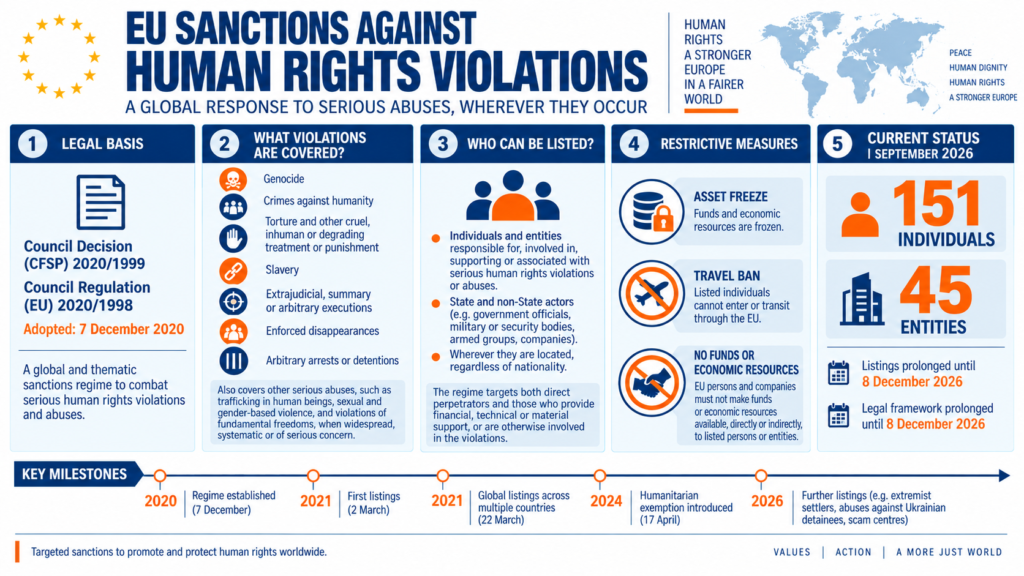
The European Union’s sanctions policy has gradually moved beyond the traditional model of restrictive measures directed at particular countries. One of the clearest expressions of this development is the EU Global Human Rights Sanctions Regime, established in December 2020 to enable the Union to target individuals and entities responsible for serious human rights violations and abuses wherever they occur.
The significance of the regime lies precisely in its global and thematic character. The Council does not need to establish a separate geographical sanctions framework every time serious violations arise in a particular country. State officials, military commanders, security bodies, private companies, armed groups and other non-State actors may all be designated under the same legal framework if the relevant criteria are met.
As of September 2026, restrictive measures under the regime apply to 151 individuals and 45 entities.
From country-based sanctions to a global regime
Before 2020, the EU could already impose restrictive measures in response to human rights violations, but these measures were generally embedded in geographically defined sanctions regimes. Human-rights-related listings continue to exist today within country-specific regimes concerning, among others, Belarus, Iran, Myanmar, Russia, Sudan, Syria and Venezuela.
The Global Human Rights Sanctions Regime introduced a different logic.
Instead of beginning with a particular State, it begins with the nature and seriousness of the conduct. The decisive question is whether an individual or entity is responsible for, involved in, supporting or associated with serious human rights violations or abuses falling within the scope of the regime.
The result is a genuinely horizontal sanctions instrument. The same legal framework can therefore be used against actors operating in very different geographical and political contexts.
This feature also explains why the regime is sometimes informally described as the EU’s “Magnitsky” sanctions mechanism. The comparison, however, should not obscure an important legal difference: the EU instrument is formally a Global Human Rights Sanctions Regime, and unlike the US Global Magnitsky framework it does not establish a corresponding general EU sanctions ground for serious corruption. The European Parliament has itself called in the past for corruption to be addressed through an additional EU sanctions framework.
The legal architecture
The regime was established on 7 December 2020 through two complementary instruments:
Council Decision (CFSP) 2020/1999, adopted on the basis of Article 29 TEU; and
Council Regulation (EU) 2020/1998, adopted on the basis of Article 215 TFEU.
The Decision defines the CFSP framework and the categories of conduct and persons that may be targeted. The Regulation gives effect within the EU legal order to the economic and financial restrictions, including asset freezes and the prohibition on making funds or economic resources available to listed persons and entities.
This two-stage architecture is characteristic of EU autonomous sanctions. Measures involving admission to Member State territory remain within the CFSP Decision, while economic restrictions requiring uniform application throughout the Union are implemented by Regulation.
The regime therefore operates at the intersection of the Union’s foreign policy powers and the directly applicable legal obligations imposed on economic operators within the internal legal order.
Which human rights violations are covered?
The legal framework does not cover every human rights violation automatically.
Article 1 of Decision 2020/1999 and Article 2 of Regulation 2020/1998 expressly identify a core group of particularly serious violations and abuses:
- genocide;
- crimes against humanity;
- torture and other cruel, inhuman or degrading treatment or punishment;
- slavery;
- extrajudicial, summary or arbitrary executions and killings;
- enforced disappearances; and
- arbitrary arrests or detentions.
The regime is nevertheless broader than this list.
Other human rights violations or abuses may also justify restrictive measures where they are widespread, systematic or otherwise of serious concern in relation to the objectives of the Common Foreign and Security Policy under Article 21 TEU.
The legislation expressly mentions, among other examples:
- trafficking in human beings;
- human rights abuses committed by migrant smugglers;
- sexual and gender-based violence;
- violations or abuses of freedom of peaceful assembly and association;
- violations or abuses of freedom of opinion and expression; and
- violations or abuses of freedom of religion or belief.
This distinction is important. Certain acts, such as torture or slavery, fall directly within the core categories identified by the legislation. Other violations require an additional assessment of their scale, systematic character or seriousness from the perspective of the Union’s CFSP objectives.
The Council consequently retains a significant degree of political assessment, but that discretion is exercised within legally defined listing criteria and remains subject to the requirements of EU law.
Who may be targeted?
The regime is not limited to public officials.
It can apply to both State and non-State actors, wherever they are located and irrespective of whether the violations occur within their own State, in another State or across borders.
The legislation also reaches beyond the person who directly commits the violation.
Persons and entities may be listed where they are responsible for serious human rights violations or abuses, provide financial, technical or material support for them, are otherwise involved in them, or are associated with persons or entities falling within the listing criteria.
This broader approach is particularly relevant in situations in which abuses depend upon institutional or economic networks. A violation may involve not only the person physically carrying it out but also military or security structures, detention authorities, private organisations, companies providing resources or logistical support, or organisations facilitating the conduct concerned.
The regime can therefore address both perpetrators and parts of the infrastructure that enables serious abuses.
What sanctions are imposed?
The restrictive measures are targeted rather than comprehensive.
Listed individuals are subject to a travel ban, preventing them from entering or transiting through EU Member States, subject to the exceptions contained in the legal framework.
Both individuals and entities are subject to an asset freeze.
Moreover, EU persons and economic operators are prohibited from making funds or economic resources available, directly or indirectly, to or for the benefit of listed persons or entities.
The practical consequences therefore extend considerably beyond the freezing of bank accounts. “Economic resources” under EU sanctions law encompasses assets capable of being used to obtain funds, goods or services. Compliance obligations consequently affect banks, companies and other EU operators that must ensure that they are not directly or indirectly making resources available to designated parties.
Humanitarian safeguards
As with other EU sanctions regimes, the Union has progressively developed mechanisms intended to prevent targeted financial restrictions from obstructing legitimate humanitarian activity.
In April 2024, the Council amended the Global Human Rights Sanctions Regime to introduce a specific humanitarian exemption from certain asset-freeze restrictions for categories of humanitarian actors. The reform was inspired by the approach adopted in UN Security Council Resolution 2664 (2022).
The exemption covers, under specified conditions, bodies such as UN programmes and agencies, organisations holding an EU Humanitarian Partnership Certificate, humanitarian organisations recognised by Member States and certain specialised national agencies.
For other humanitarian operators, derogation mechanisms remain available through the competent national authorities.
This development is legally significant because it illustrates the effort to reconcile two objectives that can otherwise come into tension: maintaining the effectiveness of targeted asset freezes while limiting unintended consequences for humanitarian assistance and basic human needs.
The first listings
The existence of the framework did not itself result automatically in designations.
The first listings were adopted on 2 March 2021, when the Council imposed restrictive measures on four Russian officials in connection with serious human rights violations, including arbitrary arrest and detention and repression of freedoms of peaceful assembly, association, opinion and expression in the context of the treatment of Alexei Navalny and related protests.
Only three weeks later, on 22 March 2021, the Council adopted a much broader package covering eleven individuals and four entities associated with violations in China, North Korea, Libya, Russia, South Sudan and Eritrea.
These early decisions immediately demonstrated the global character of the instrument. A single sanctions regime was being used in response to unrelated violations committed in several regions of the world.
A regime increasingly used across very different situations
Since 2021, the Council has progressively expanded the scope of the listings.
The regime has been used in response to violations and abuses involving Afghanistan, Haiti, Iran, Myanmar, North Korea, Russia and South Sudan. It has also been applied to individuals and entities linked to the Wagner Group, actors connected with the death of Alexei Navalny and abuses against Ukrainian detainees, extremist Israeli settlers responsible for serious abuses against Palestinians, persons obstructing humanitarian assistance to Gaza, Hamas and Palestinian Islamic Jihad in relation to sexual and gender-based violence during the attacks of October 2023, actors linked to the former al-Assad regime, and operators of scam centres in Southeast Asia.
The diversity of these situations shows why the horizontal character of the instrument matters. The common legal element is not geography, ideology or institutional affiliation. It is the alleged involvement in conduct meeting the human rights criteria established by the sanctions framework.
The significant expansion of 2026
The development of the regime continued during 2026.
On 28 May 2026, the Council imposed additional restrictive measures on three individuals and four entities described by the Council as extremist Israeli settlers and organisations supporting them. The Council linked the designations to serious and systematic abuses against Palestinians in the West Bank, including conduct affecting physical and mental integrity, property, private and family life, freedom of religion or belief and education.
On 13 July 2026, a further fifteen individuals and one entity were designated in relation to serious human rights violations against Ukrainian prisoners of war and civilian detainees in occupied Ukrainian territories and in Russia. According to the Council, the conduct included torture and other cruel, inhuman or degrading treatment.
The regime moved into another very different field on 30 July 2026, when seven persons and three entities were sanctioned in connection with scam centres operating in Southeast Asia. The Council referred to human trafficking, torture and other cruel, inhuman or degrading treatment involving individuals who were trafficked or deceived into compounds, detained and forced to participate in online fraud.
The latter listings are especially interesting from a legal perspective. They demonstrate that the Global Human Rights Sanctions Regime is not confined to conventional patterns of State repression. It can also be deployed against transnational criminal and commercial structures where their activities involve serious human rights abuses.
Where the regime stands in September 2026
According to the Council’s current figures, 151 individuals and 45 entities are now subject to restrictive measures under the EU Global Human Rights Sanctions Regime.
The legal framework was prolonged in December 2023 for three years, until 8 December 2026, while individual listings are reviewed periodically. In December 2025, the Council also prolonged the existing listings until 8 December 2026.
The distinction is worth noting. The continuation of the general sanctions regime and the maintenance of individual designations are related but legally distinct questions. Listings must remain justified by the applicable criteria and are subject to continuing review.
Sanctions are not criminal penalties
The nature of these measures also requires some precision.
An EU sanctions designation is not equivalent to a criminal conviction. Restrictive measures are instruments of the Common Foreign and Security Policy, designed to pursue external-policy objectives by imposing targeted economic and mobility restrictions.
The Council must nevertheless identify a sufficient factual and legal basis for each listing and provide reasons capable of supporting the designation. Listed persons and entities may challenge EU restrictive measures before the EU Courts.
This judicial dimension is important. The effectiveness of sanctions cannot be separated from the requirements of the rule of law, including effective judicial protection, respect for procedural rights and the need for listings to remain supported by sufficiently substantiated reasons.
The Global Human Rights Sanctions Regime therefore combines a considerable degree of foreign-policy discretion with legal constraints deriving from the EU constitutional order.
Global, but not universal in application
The word “global” describes the geographical scope of the legal competence, not an automatic response to every serious human rights violation worldwide.
The regime gives the Council the capacity to impose restrictive measures irrespective of where the underlying conduct occurs. It does not create an obligation to impose sanctions whenever the substantive criteria appear to be met.
Actual listings remain the result of CFSP decision-making.
This inevitably leaves room for questions concerning consistency, selectivity and political prioritisation. Those questions are not unique to this regime; they are inherent in the use of sanctions as instruments of foreign policy. What the 2020 framework changed was not the political character of sanctions decisions but the legal architecture available to the Union when it decides to act.
A structural change in EU sanctions policy
The deeper importance of the EU Global Human Rights Sanctions Regime therefore lies beyond the number of individuals currently listed.
It represents a shift from sanctions organised primarily around territorial crises toward sanctions organised around categories of prohibited conduct.
The cyber-sanctions regime follows a similar horizontal logic in relation to malicious cyber operations. The Global Human Rights Sanctions Regime does so in relation to serious violations and abuses of fundamental rights.
That change gives the Union substantially greater flexibility. New listings can be adopted without constructing an entirely new sanctions regime for each country concerned, while State and non-State actors can be addressed within the same legal framework.
At the same time, that flexibility places greater importance on the quality of the individual listing process. As the geographical and substantive reach of horizontal sanctions expands, questions concerning evidence, responsibility, association, proportionality, humanitarian effects and judicial review become increasingly central.
The EU Global Human Rights Sanctions Regime is consequently more than another list of designated individuals and entities. It is an important stage in the transformation of EU restrictive measures into instruments capable of addressing particular forms of conduct across borders.
Its development since 2020 — and especially the considerable diversification of its use in recent years — demonstrates how human rights protection has become an increasingly autonomous basis for EU sanctions policy.