The European Union has developed a distinct sanctions regime specifically directed against the proliferation and use of chemical weapons. Unlike geographically defined sanctions regimes, this framework is thematic: designation depends on conduct connected with chemical weapons rather than on nationality, territorial location or involvement in a particular conflict.
The regime was established in October 2018, against the background of renewed concern over the use of toxic chemical agents, including the Salisbury poisoning earlier that year. The European Council had stated in March 2018 that the use of chemical weapons — including the use of toxic chemicals as weapons under any circumstances — was completely unacceptable and constituted a threat to collective security. In June 2018, it called for a new EU restrictive-measures regime addressing both the use and proliferation of chemical weapons.
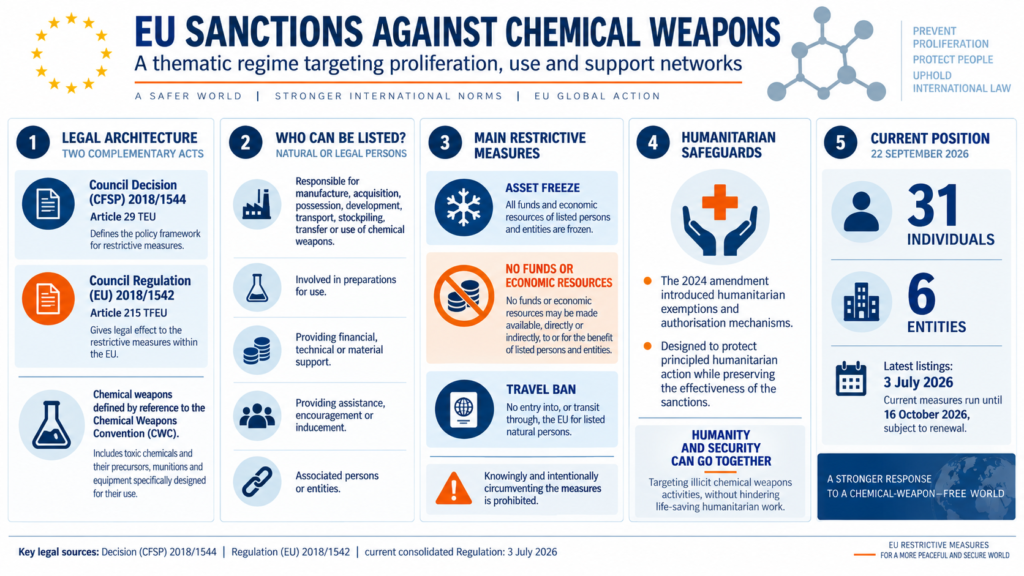
The resulting framework rests on two interconnected legal instruments: Council Decision (CFSP) 2018/1544, adopted under Article 29 TEU, and Council Regulation (EU) 2018/1542, adopted on the basis of Article 215 TFEU. This two-level structure reflects the normal architecture of EU sanctions. The CFSP Decision establishes the Union’s foreign-policy measures, including travel restrictions, while the Regulation gives binding and directly applicable effect within the EU legal order to the financial and economic restrictions.
The definition of “chemical weapons” is not autonomous. Both instruments refer to the definition contained in Article II of the Chemical Weapons Convention (CWC). The EU regime therefore operates in close conceptual alignment with the international legal framework established by the CWC, while providing the Union with its own mechanism for imposing individual restrictive measures.
The listing criteria are deliberately broad. The Council may designate natural or legal persons, entities or bodies responsible for, financially, technically or materially supporting, or otherwise involved in the manufacture, acquisition, possession, development, transport, stockpiling or transfer of chemical weapons. The regime also covers the use of chemical weapons and preparations for their use. In addition, persons and entities that assist, encourage or induce such activities, as well as persons or entities associated with them, may be listed.
This makes the regime capable of reaching well beyond the individual who physically employs a toxic agent. Scientists, military personnel, officials, laboratories, research institutions, companies, intermediaries and other actors may potentially fall within its scope where the applicable listing criteria are satisfied.
For designated persons and entities, the principal economic measure is an asset freeze. All funds and economic resources belonging to, owned, held or controlled by listed persons or entities must be frozen. EU operators are also prohibited from making funds or economic resources available, directly or indirectly, to them or for their benefit. The prohibition therefore extends beyond simple payments and can cover the provision of assets, goods or other resources capable of generating economic value.
Natural persons listed under the CFSP Decision are additionally subject to restrictions on entry into or transit through the territories of the Member States, subject to the exceptions provided for in the Decision, including obligations arising under international law and certain judicial or diplomatic circumstances.
The Regulation also contains an express anti-circumvention rule: knowingly and intentionally participating in activities whose object or effect is to circumvent the restrictive measures is prohibited. This is particularly significant for compliance purposes, since EU sanctions obligations are not confined to direct transactions with a designated person. Ownership, control, intermediaries, indirect provision of economic resources and the actual structure of a transaction must also be assessed.
The territorial and personal scope of the Regulation is similarly extensive. It applies within the territory of the Union, including its airspace; aboard aircraft and vessels under Member State jurisdiction; to nationals of Member States wherever they are located; to legal persons incorporated under the law of a Member State, including when operating outside the Union; and to legal persons or entities in respect of business carried out wholly or partly within the Union.
Implementation is decentralised but legally coordinated. Member States designate the competent national authorities responsible for administering authorisations and derogations and must establish penalties for violations of the Regulation that are effective, proportionate and dissuasive. The directly applicable nature of Regulation 2018/1542 therefore coexists with national responsibility for enforcement and penalties.
An important development came in July 2024, when the Council introduced humanitarian safeguards. Certain EU humanitarian partners may make funds or economic resources available where this is necessary exclusively for humanitarian purposes. For other humanitarian actors, competent national authorities may grant specific or general authorisations. The amendment seeks to reduce the risk that targeted sanctions unintentionally obstruct principled humanitarian action while preserving the effectiveness of the asset-freeze regime.
The sanctions list has progressively expanded. In May 2025, the Council added three entities belonging to the Russian Armed Forces following reports concerning the use of riot-control agents as a method of warfare in Ukraine. In July 2026, the Council listed six additional Russian individuals involved in the development of chemical weapons, notably epibatidine, in connection with the poisoning and death of Alexei Navalny.
As of 22 September 2026, the EU chemical-weapons sanctions regime therefore applies to 31 individuals and 6 entities. The measures include asset freezes, a prohibition on making funds or economic resources available to those listed, and — for listed natural persons — travel restrictions.
The current individual restrictive measures are in force until 16 October 2026. The Council may renew them and may amend the list of designated persons and entities whenever the relevant legal criteria are met.
The broader significance of the regime lies in its thematic character. It allows the Union to respond to chemical-weapons proliferation and use independently of the existence of a wider country-specific sanctions programme. In this sense, the regime complements the Chemical Weapons Convention and the work of the Organisation for the Prohibition of Chemical Weapons rather than replacing them. The CWC establishes the primary international legal prohibition and verification architecture; EU restrictive measures add a separate layer of targeted political and economic consequences for identified individuals and entities.
The regime illustrates a broader evolution of EU sanctions practice: restrictive measures are increasingly used not only in response to particular territorial crises but also to defend specific international norms. Chemical weapons, cyber-attacks, serious human-rights violations and other forms of conduct can consequently become the object of autonomous thematic sanctions frameworks. In the chemical-weapons field, the result is a mechanism designed to connect the prohibition established by international law with targeted consequences within the EU legal order.