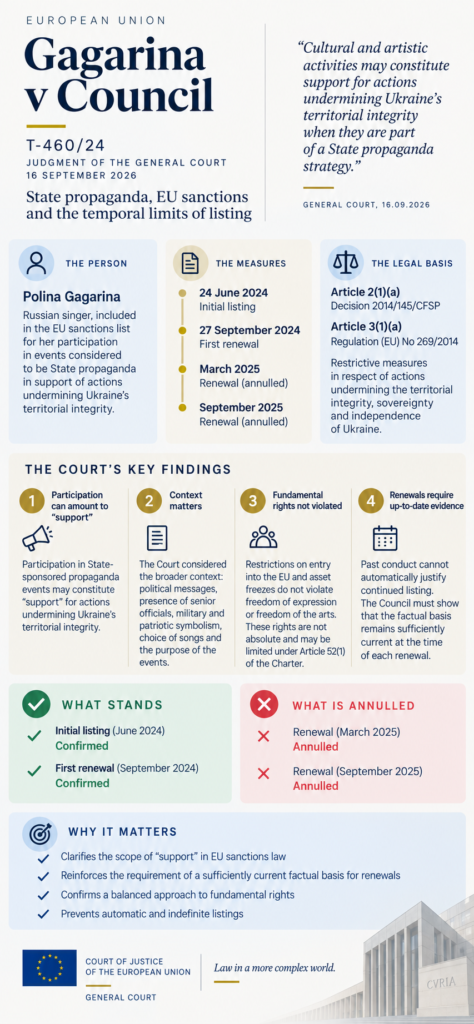
On 16 September 2026, the General Court delivered its judgment in Gagarina v Council (T-460/24), concerning the inclusion of Russian singer Polina Gagarina on the EU sanctions list relating to actions undermining the territorial integrity, sovereignty and independence of Ukraine.
The judgment is significant for two reasons. First, it confirms that participation in State-sponsored propaganda events may amount to “support” for actions undermining Ukraine’s territorial integrity within the meaning of Article 2(1)(a) of Decision 2014/145/CFSP and Article 3(1)(a) of Regulation No 269/2014. Second, it draws a clear line between the evidence required for an initial listing and that required for subsequent renewals.
The General Court accepted that Gagarina’s participation in several public events between 2022 and 2024 could not be treated as politically neutral artistic activity. It relied on the broader context in which those performances took place: events marking the annexation of Crimea, performances before soldiers involved in the war, political speeches by senior Russian officials, patriotic and military symbolism, and the overall communicative purpose of the events. Taken together, those factors were sufficient to establish participation in State propaganda activities and, consequently, support for actions undermining Ukraine’s territorial integrity.
The Court also confirmed that restrictive measures of this kind do not necessarily violate freedom of expression or freedom of the arts under Articles 11 and 13 of the Charter. Those freedoms are not absolute and may be restricted, provided the conditions laid down in Article 52(1) of the Charter are satisfied. In this case, the Court considered the measures proportionate in light of the objectives pursued by the EU sanctions regime.
The most important part of the judgment, however, concerns the 2025 renewals. The Council continued to rely on the assertion that Gagarina “regularly” performed at State propaganda events, but the evidence did not establish comparable conduct after March 2024. The General Court therefore held that past conduct could not, by itself, justify indefinite maintenance on the sanctions list.
The March 2025 and September 2025 measures were accordingly annulled.
The judgment thus combines a relatively broad understanding of “support” with a demanding requirement of temporal relevance. Participation in cultural or artistic activities may justify sanctions where those activities are embedded in a broader propaganda strategy. But when the Council renews an individual listing, it must still demonstrate that the factual basis remains sufficiently current to show that the relevant listing criterion continues to be satisfied.
In that respect, Gagarina reinforces a central principle of EU sanctions law: restrictive measures are preventive, but they cannot become automatic. Their continuation must remain supported by a sufficiently specific, precise and up-to-date factual basis.