I had been waiting for this one. Case C-67/25 had been languishing on the Court’s docket for months, and for anyone keeping an eye on how the EU enforces its information sanctions against Russia — genuinely enforces them, not just on paper — the preliminary reference out of Germany posed the kind of question that forces a choice. Not about the validity of the broadcasting ban. That had been settled. The real question was different, more uncomfortable: does the prohibition under Article 2f(1) of Regulation (EU) No 833/2014 reach private individuals who run non-commercial websites? Or is there, somewhere at the edges of the regime, a pocket of tolerance for the small-scale relay?
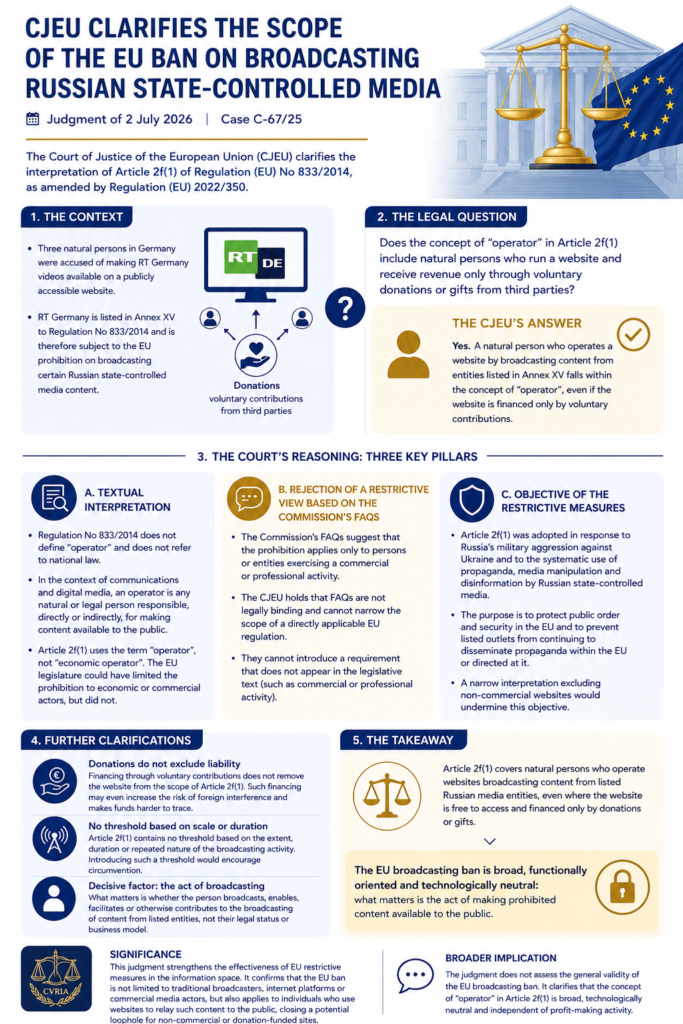
On 2 July 2026, the Court of Justice of the European Union delivered its judgment in Case C-67/25, concerning the interpretation of Article 2f(1) of Regulation (EU) No 833/2014, as amended by Regulation (EU) 2022/350.
The facts. Three people in Germany. A website. Videos lifted from RT Germany — an outfit listed in Annex XV to Regulation No 833/2014, banned from broadcasting in the EU since Regulation (EU) 2022/350 entered into force. No subscription model. No ads. Revenue: donations, gifts, whatever visitors felt like contributing. That is it. A shoestring operation, the sort of thing you could run from a kitchen table, and precisely the sort of thing that exposes whether a regulatory framework has teeth or only gums.
The German court wanted to know: is this person an “operator” within the meaning of Article 2f(1)?
Yes. Unequivocally.
I expected the answer. What I did not entirely expect — or at any rate, what I find worth pausing on — is the vigour of the reasoning. Something has shifted. We are in the middle of a discernible hardening in the enforcement posture of EU sanctions, and this judgment is a data point, not an outlier. The tightening is no longer confined to the broadening of designation lists or the layering of new sectoral measures. It has migrated into the Court’s own interpretive apparatus. That is a qualitative change, and it matters.
Now, the textual argument. No definition. Regulation No 833/2014 uses the word “operator” and leaves it undefined. No cross-reference to national law. Nothing. So the Court worked with ordinary meaning — and in communications and digital media, an operator is whoever makes content available to the public, directly or indirectly. Straightforward enough. But then comes the move that, in my view, does the real heavy lifting. Article 2f(1) says “operator”. Not “economic operator”. Anyone who has spent time inside EU legislative texts will recognise immediately that this is a loaded silence. The legislature knows both terms. It deploys them with (sometimes exasperating) precision. If it had wanted to confine the ban to commercial actors, it had the exact word for it. It reached for the broader term instead. Deliberate? Obviously. And the Court says so.
Then there is the matter of the Commission’s FAQs. These had suggested — with the kind of quiet self-assurance that soft-law instruments tend to exude — that the prohibition applied to persons exercising a “commercial or professional activity”. The Court dispensed with this in about two paragraphs. FAQs are not law. They are guidance. They cannot smuggle into the regulation a condition that the legislature never put there. I would add, perhaps more bluntly: a restrictive measure adopted under Article 215 TFEU draws its binding force from the regulation itself. The Commission’s after-the-fact interpretive glosses are interesting reading. They are not a source of law. Soft law does not get to redraw the perimeter of a hard prohibition, quietly and through the back door.
Purpose. This is where the argument snaps shut. Article 2f(1) exists because Russia’s war against Ukraine was accompanied — and in part prepared — by a sustained, industrialised campaign of propaganda, disinformation, and media manipulation, channelled through state-controlled outlets. The ban aims to sever those channels. All of them. Now, if non-commercial websites were carved out, circumvention would be trivially easy. Do not register a company. Do not sell advertising. Accept only donations. Done — you are outside the prohibition. The absurdity is self-evident. The effectiveness of an EU sanctions measure would hinge on whether the person violating it had the good sense to avoid commercialising the violation. The Court, wisely, refused to go there.
On donations — the only revenue stream of the website at issue — the judgment takes a turn I find particularly sharp. The Court does not simply say that voluntary contributions fail to immunise the operator. It goes further. Donation-based funding, the Court observed, can obscure the actual provenance of the money and may amplify the risk of foreign interference in content dissemination. Read that again. Donations are not a mitigating factor. They are, if anything, an aggravating circumstance — because the very opacity they introduce is one of the things the sanctions regime exists to combat. Quietly devastating.
And then came the part that genuinely caught me off guard.
No threshold. Article 2f(1), the Court held, sets no minimum level of activity. No requirement that the broadcasting be repeated, systematic, or sustained. No de minimis. The reasoning is elegant on its own terms: a threshold would be an invitation to fragment. Prohibited content gets sliced into isolated, seemingly trivial publications — each one below the line, the aggregate achieving exactly what the regulation prohibits. I follow the logic. It is consistent with the anti-circumvention instinct that permeates the entire judgment. But — and I do not think this is a small “but” — the implication is stark. A single repost. One video, shared once, on a website no one visits. In principle, that is enough. Enough to qualify as an operator. Enough, in a case like this one, to trigger criminal proceedings.
Think about that for a moment.
This is where the hardening of the regime becomes tangible, almost palpable. The concept of “operator”, as the Court now reads it, is technologically neutral. Indifferent to profit motive. Detached from any notion of commercial activity. Unqualified by scale. Functional, in the purest sense: what triggers the prohibition is the act, not the actor. Making prohibited content available is what matters. Everything else — legal status, business model, audience size, revenue — is noise.
There is, I should say, a great deal to admire here. The gap the Court closed was real. It was exploitable with no resources and no ingenuity. The broadcasting ban now reaches well beyond professional media and platforms, extending to individuals who operate websites — however amateurish, however marginal — to relay content from listed Russian state-controlled outlets. As a matter of sanctions policy, the logic is watertight.
And yet.
Precisely because the interpretive aperture is now this wide — no commercial requirement, no scale requirement, no organisational nexus — the ruling opens terrain that the Court itself did not fully map. The general validity of the broadcasting ban was not at issue; earlier proceedings took care of that. But where the concept of “operator” is this elastic and no threshold applies, enforcement will demand a degree of prosecutorial restraint that the judgment itself does not mandate. Not every act of sharing is an act of propaganda. Not every repost is a relay. The line between the two is real, but it is thin, and it will not always be drawn by the person who crosses it.
Whether the breadth of the concept proves proportionate in every future case is, I suspect, a question the Court left open on purpose. Sanctions law has a structural temptation: to build regimes so tight that nothing escapes, and then to discover — sometimes too late — that the structure cannot distinguish between what it was meant to catch and what it was not. That reckoning, for Article 2f(1), has not yet arrived. But it will.