The euro area’s inflation shock of 2022–2023 was not simply a story about prices rising too fast. It was a stress test for monetary policy in an age of geopolitical fragmentation, energy insecurity, and recurring supply disruptions.
Three recent papers prepared for the European Parliament’s ECON Committee examine precisely this issue. They converge on one central point: central banks should not react mechanically to every rise in inflation. The appropriate monetary policy response depends on the origin, composition, persistence, and transmission of the shock. But the papers differ in how they assess the present risks and how quickly the ECB should react.
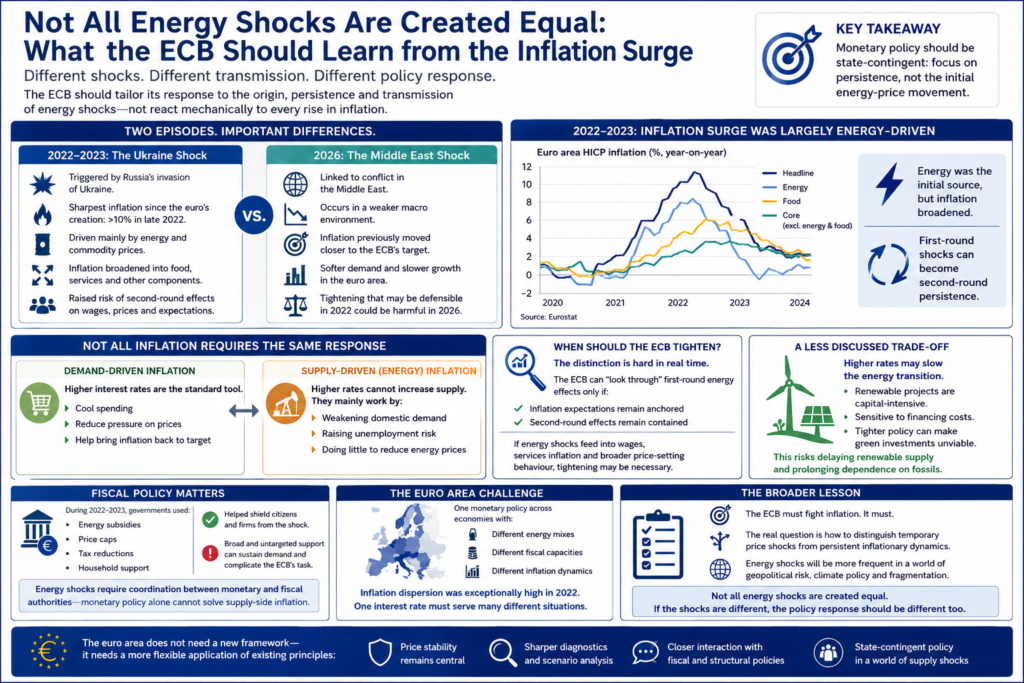
The report Not All Energy Shocks Are Created Equal stresses that the 2022–2023 inflation surge and the renewed inflationary pressures of 2026 should not be treated as identical episodes. At first sight, they look similar. Both involve geopolitical conflict, higher energy prices, and renewed concern about inflation. But the similarities should not obscure important differences.
The 2022–2023 surge was the sharpest since the creation of the euro. Headline inflation exceeded 10% in late 2022, driven initially by energy and commodity prices rather than by excessive domestic demand. Energy was the initial source of the shock, but inflation later broadened into food, services, and other components. This raised the classic central-bank concern: a temporary relative-price shock might become persistent inflation through wages, price-setting behaviour, and expectations.
The 2026 episode is different. It occurs in a weaker macroeconomic environment, with softer demand and inflation having previously moved closer to the ECB’s target. That matters. A monetary tightening that may be defensible when demand is strong can be harmful when growth is weak and the shock originates in global energy markets.
There is also a compositional difference. The 2022–2023 crisis was mainly a European gas shock. Gas prices affected electricity generation, industrial production costs, and household energy bills across the euro area. By contrast, the current shock is, so far, more concentrated in global oil markets, while European gas markets remain more stable than during the Ukraine-related energy crisis. This is one reason why the DIW paper argues that the current shock may be less likely to generate broad-based and persistent inflationary pressures than the 2022–2023 episode.
But this does not mean the risks are negligible. The DIW paper also stresses that inflation expectations may be more fragile than current data suggest. Households and firms still remember the recent inflation surge. Highly visible prices, especially fuel and energy prices, can affect expectations disproportionately. In periods of geopolitical uncertainty, even a temporary energy shock can become more dangerous if it alters wage-setting and price-setting behaviour.
This is where the papers diverge. The OFCE paper cautions against an excessively mechanical tightening response to supply-driven inflation. Higher ECB rates cannot reopen shipping routes, increase gas supply, or reduce geopolitical risk. They mainly work by weakening domestic demand. The DIW paper, by contrast, gives more weight to the risk of doing too little too late. Its model simulations suggest that the welfare costs of responding too cautiously to renewed inflationary pressures may exceed the costs of a somewhat stronger monetary policy response.
This disagreement is useful because it clarifies the real policy dilemma. The question is not whether the ECB should fight inflation. It must. The question is when an energy-price shock ceases to be a temporary relative-price movement and becomes a threat to medium-term price stability.
When inflation is demand-driven, higher interest rates are the standard tool. They cool spending, reduce pressure on prices, and help bring inflation back to target. But when inflation is supply-driven, especially by energy prices, the trade-off is more complex. Tightening monetary policy may reduce second-round effects, but it may also deepen the output loss caused by the shock itself.
That does not mean the ECB should ignore energy shocks. A central bank can “look through” the first-round effects of an energy shock only if inflation expectations remain anchored and second-round effects remain contained. Once energy-price increases feed into wages, services inflation, and broader price-setting behaviour, monetary tightening may become necessary.
The difficulty is that this distinction is hard to make in real time. Energy prices affect not only headline inflation but also production costs across the economy. Even “core” inflation, which excludes energy and food, can still reflect energy shocks indirectly. The boundary between first-round and second-round effects is therefore blurred.
The reports also highlight a less discussed problem: higher interest rates may slow the energy transition. Renewable-energy projects are highly capital-intensive. Wind farms, solar installations, grids, storage capacity, and related infrastructure require large upfront investment and are sensitive to financing costs. If monetary tightening raises nominal borrowing costs, some green projects may become financially unviable. In that case, tight monetary policy could delay the expansion of renewable energy supply and prolong dependence on fossil fuels.
The ECB’s response to the 2022–2023 crisis should be assessed in this light. The ECB initially proceeded cautiously, partly because the shock appeared supply-driven and partly because the euro area was still emerging from the pandemic. Once inflation broadened, however, the ECB moved rapidly, launching the fastest tightening cycle in its history. This was not simply a policy mistake or a policy success. It was a difficult balancing act: the ECB had to avoid reacting too early to a relative-price shock, while also preventing inflation from becoming entrenched.
The lesson for the present is not that the ECB should always wait. Nor is it that it should always tighten quickly. The lesson is that monetary policy should be state-contingent. It should focus less on the initial energy-price movement and more on persistence: wages, services inflation, underlying inflation indicators, inflation expectations, consumption dynamics, and the risk that temporary price increases become embedded in the economy.
This also gives central-bank communication a more important role. In a highly uncertain environment, the ECB should avoid over-committing to a fixed policy path. But it must clearly communicate its reaction function: it will not mechanically tighten in response to every energy-price movement, but it will act if there is evidence that inflation persistence or expectations are becoming inconsistent with price stability.
Fiscal policy is equally central. During the 2022–2023 crisis, euro area governments adopted energy subsidies, price caps, tax reductions, and household-support measures. Some helped shield citizens and firms from the immediate shock. But broad and untargeted support can also sustain demand, distort price signals, and complicate the ECB’s task. Energy shocks therefore require coordination between monetary and fiscal authorities, not because central-bank independence should be weakened, but because monetary policy alone cannot solve supply-side inflation.
This is particularly relevant for the euro area, where a single monetary policy operates across economies with different energy mixes, fiscal capacities, and inflation dynamics. Inflation dispersion across member states was exceptionally high during the 2022 episode. This makes the ECB’s task structurally harder: one interest rate must serve countries facing different inflationary pressures.
The broader conclusion is institutional rather than merely technical. The euro area does not necessarily need a completely new monetary policy framework. But it does need a more flexible application of existing principles. The ECB’s commitment to price stability remains central. Yet price stability in a world of recurrent supply shocks requires sharper diagnostics, better scenario analysis, more attention to distributional effects, and closer interaction with fiscal and structural policies.
Energy shocks will not disappear. Geopolitical conflict, climate policy, supply-chain fragmentation, and the energy transition are likely to make them more frequent. The central question is therefore not whether the ECB should fight inflation. It must. The real question is how to distinguish temporary price shocks from persistent inflationary dynamics.
That is why the title of the report matters. Not all energy shocks are created equal. And if the shocks are different, the policy response should be different too.