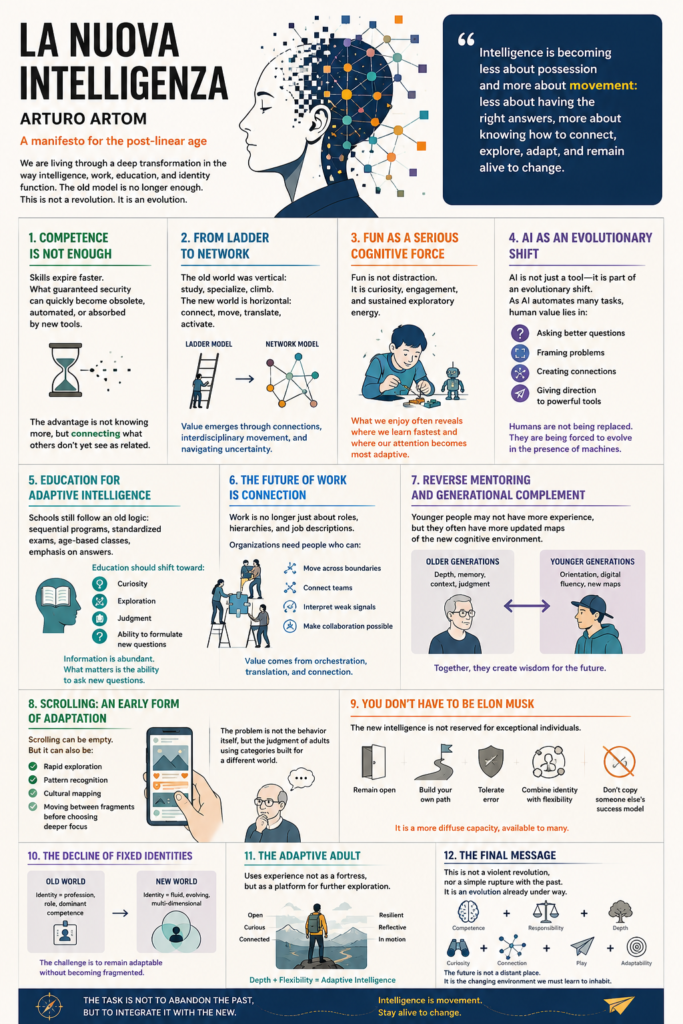
Arturo Artom’s La nuova intelligenza argues that we are living through a deep transformation in the way intelligence, work, education, and personal identity function. The book’s central thesis is that the old twentieth-century model—based on stable skills, duty, linear careers, and fixed identities—is no longer sufficient in an environment shaped by artificial intelligence, digital networks, geopolitical instability, and rapid technological change.
The book does not claim that competence has become useless. Rather, it argues that competence is no longer sovereign. Skills now expire faster than before. What once guaranteed professional security can quickly become obsolete, automated, or absorbed by new tools. In this context, the decisive advantage is not merely knowing more than others, but connecting ideas, people, technologies, and contexts that others do not yet see as related.
A key concept in the book is the shift from a “ladder” model to a “network” model. In the old world, progress was imagined as vertical: study, specialize, work hard, climb step by step. Today, value often emerges horizontally, through unexpected connections, interdisciplinary movement, and the ability to navigate uncertainty. Success belongs less to those who simply execute well and more to those who can orchestrate systems, translate between different worlds, and activate meaningful relationships.
Artom also challenges the traditional cult of duty. Duty, discipline, and seriousness were essential virtues in a stable environment, but they do not necessarily generate innovation. In unstable systems, simply doing what is expected may no longer be enough. The book introduces “fun” not as entertainment or distraction, but as a serious cognitive force: a sign of curiosity, engagement, and sustained exploratory energy. What we enjoy often reveals where we learn fastest and where our attention becomes most adaptive.
Artificial intelligence is presented not merely as a tool that automates tasks, but as part of an evolutionary shift. The author suggests that humans are not simply being replaced by machines; they are being forced to evolve in the presence of machines. As AI takes over many technical or procedural functions, human value increasingly lies in asking better questions, framing problems, creating connections, and giving direction to increasingly powerful tools.
This has major implications for education. The book criticizes schools for continuing to operate according to an older logic: sequential programs, standardized exams, age-based classes, and an emphasis on accumulating answers. But in a world where information is abundant and AI can perform many technical tasks, education should shift toward curiosity, exploration, judgment, and the ability to formulate new questions. The school of the future, in Artom’s view, should train adaptive intelligence rather than merely reward repetition.
The same transformation affects work. The workplace can no longer be understood only through roles, hierarchies, and job descriptions. Increasingly, organizations need people who can move across boundaries, connect teams, interpret weak signals, and make collaboration possible. The book gives particular importance to reverse mentoring: younger people may not possess more experience, but they often have more updated maps of the new cognitive environment. Older generations bring depth and memory; younger generations bring orientation within emerging systems.
One of the book’s most interesting arguments is its reinterpretation of behaviors often dismissed as superficial, such as scrolling. Artom does not deny that digital habits can become empty or excessive. But he suggests that, in some cases, scrolling may reflect an early form of adaptation to an information-rich environment: rapid exploration, pattern recognition, cultural mapping, and the ability to move between fragments before choosing what to examine more deeply. The problem, he argues, is that adults often judge new cognitive behaviors with categories built for a different world.
The book also rejects the idea that everyone must become an extraordinary entrepreneur or a figure like Elon Musk. The “new intelligence” is not reserved for exceptional individuals. It is a more diffuse capacity: remaining open, building one’s own path, tolerating error, combining identity with flexibility, and refusing to confuse someone else’s success model with one’s own vocation.
A further consequence is the decline of fixed identities. In the past, people often defined themselves through a profession, a stable role, or a dominant competence. Today, identity becomes more fluid, not necessarily weaker. The challenge is to remain adaptable without becoming fragmented. Artom’s ideal figure is the “adaptive adult”: someone who uses experience not as a fortress, but as a platform for further exploration.
The book’s final message is deliberately non-apocalyptic. This is not a violent revolution, nor a simple rupture with the past. It is an evolution already under way. The task is not to abandon competence, responsibility, or depth, but to integrate them with curiosity, connection, play, and adaptability. The future is not a distant place we are moving toward; it is the changing environment we must learn to inhabit.
In this sense, La nuova intelligenza is a manifesto for a post-linear age. Its most important insight is that intelligence is becoming less about possession and more about movement: less about having the right answers, more about knowing how to connect, explore, adapt, and remain alive to change.