The chronology must distinguish between General Assembly recommendations, non-mandatory Security Council measures, and binding sanctions adopted under Chapter VII of the UN Charter.
South Africa
- 6 November 1962 – General Assembly resolution 1761 (XVII). This was the first major UN measure recommending sanctions-type action against South Africa: severance of diplomatic relations, closure of ports, boycott of South African goods, cessation of exports including arms and ammunition, and restrictions on air traffic. As a General Assembly resolution, these measures were not legally binding.
- 7 August 1963 – Security Council resolution 181 (1963). The Council “solemnly calls upon all States” to cease the sale and shipment of arms, ammunition and military vehicles to South Africa. This was not yet a mandatory embargo. Resolution 418 (1977) itself later referred to the earlier regime as a “voluntary arms embargo”.
- 4 December 1963 – resolution 182 (1963). The Council extended the appeal to equipment and materials for the manufacture and maintenance of arms and ammunition. The embargo remained non-mandatory.
- 18 June 1964 – resolution 191 (1964). The Council reaffirmed the earlier calls.
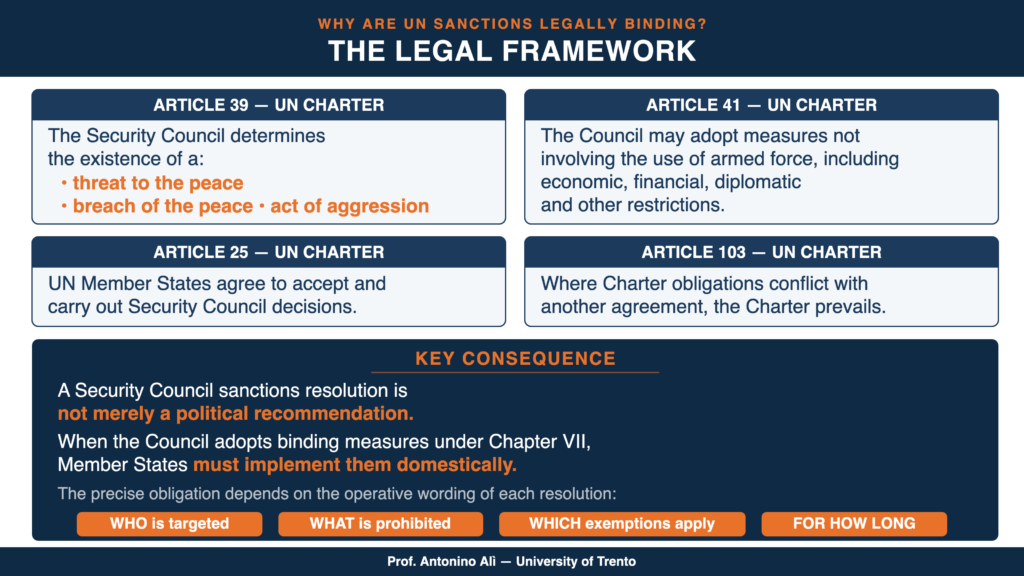
- 4 November 1977 – Security Council resolution 418 (1977). This was the decisive step. Acting expressly under Chapter VII, the Council determined that South Africa’s acquisition of arms constituted a threat to international peace and security and decided that all States must cease supplying arms and related materiel. From this date, the arms embargo was mandatory.
Thus, if “first UN sanctions” is used broadly, the relevant date for South Africa is 6 November 1962. If the reference is to the first Security Council arms embargo, it is 7 August 1963. If the reference is to the first binding Security Council sanction against South Africa, it is 4 November 1977.
Southern Rhodesia
- 12 November 1965 – Security Council resolution 216 (1965). The Council condemned the unilateral declaration of independence and called upon States not to recognize the regime. This was not yet a binding economic sanctions regime.
- 20 November 1965 – resolution 217 (1965). The Council called upon all States not to recognize the illegal authority, to refrain from supplying arms, and to do their utmost to break economic relations, including an embargo on oil and petroleum products. These were sanctions-type measures but not yet the mandatory Article 41 regime.
- 9 April 1966 – resolution 221 (1966). The Council determined that the situation concerning oil supplies constituted a threat to the peace, called upon States to divert vessels carrying oil for Rhodesia, and authorized the United Kingdom to prevent such vessels from reaching Beira, using force if necessary. This was an important coercive step but not yet the general mandatory economic sanctions regime.
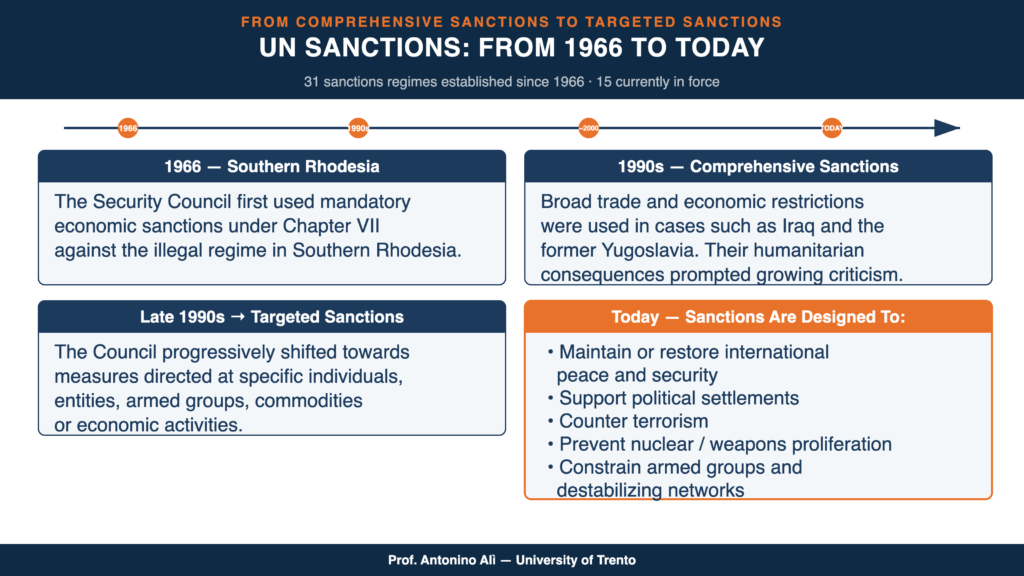
- 16 December 1966 – resolution 232 (1966). This was the turning point. The Council acted expressly “in accordance with Articles 39 and 41 of the United Nations Charter”, determined the existence of a threat to the peace, and decid andatory economic sanctions.
- 29 May 1968 – resolution 253 (1968). The sanctions became substantially comprehensive, covering a far broader range of trade and financial relations and adding travel and transport restrictions. A sanctions committee was also established to monitor implementation.
Resolution 232 of 16 December 1966 is generally regarded as the first instance in United Nations history of mandatory economic sanctions imposed by the Security Council under Article 41.