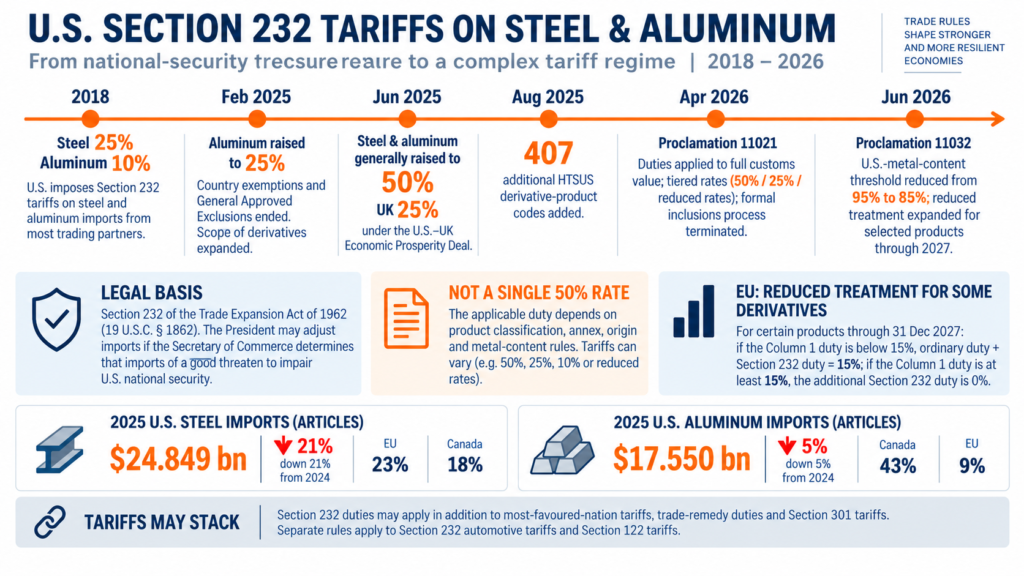
The United States’ tariffs on steel and aluminum under Section 232 of the Trade Expansion Act of 1962 have evolved into one of the most significant examples of the growing interaction between trade policy, industrial policy and national security.
What began in 2018 as a relatively straightforward system of additional duties on imported steel and aluminum has progressively developed into a much more complex regulatory framework, differentiated by product category, country of origin, metal content and, increasingly, the contribution of imported products to domestic U.S. production.
A recent Congressional Research Service report, Section 232 Tariffs on Steel and Aluminum, updated on 17 September 2026, provides a useful overview of this evolution.
The legal basis: national security rather than ordinary trade protection
Section 232 of the Trade Expansion Act of 1962, codified at 19 U.S.C. § 1862, authorizes the President to adjust imports when the Secretary of Commerce determines that a product is being imported “in such quantities or under such circumstances” as to threaten to impair U.S. national security.
This is important from a legal perspective. Section 232 tariffs are not conventional anti-dumping or countervailing duties, nor are they classic safeguard measures. Their statutory justification rests on a national-security assessment.
President Donald Trump first invoked this authority in March 2018, imposing an additional tariff of 25% on steel and 10% on aluminum imports from most trading partners. The measures were subsequently extended to certain derivative products.
The Biden Administration largely preserved the Section 232 architecture and, in 2023, raised tariffs on Russian aluminum imports to 200% in response to Russia’s war against Ukraine.
The transformation of the regime after 2025
The second Trump Administration substantially expanded the system.
In February 2025, the aluminum tariff was increased to 25%, country exemptions were eliminated and the system of General Approved Exclusions was terminated. The scope of products potentially subject to Section 232 duties was also broadened.
The Administration additionally introduced a mechanism allowing U.S. stakeholders to request the inclusion of further derivative products within the tariff regime.
In June 2025, the principal tariff rate for steel and aluminum was increased to 50%. The United Kingdom initially retained more favourable treatment, with a 25% rate under the U.S.–UK Economic Prosperity Deal.
The expansion did not stop there. In August 2025, more than 400 additional product codes were brought within the scope of the steel and aluminum tariff regime.
The result was a significant extension of Section 232 beyond basic steel and aluminum products into downstream manufacturing supply chains.
The 2026 restructuring
The system was substantially reorganised again in 2026.
Proclamation 11021 of 2 April 2026 introduced one particularly important change: for many covered products, Section 232 duties began to apply to the full customs value of the imported article rather than merely to the value of its steel, aluminum or copper content.
The proclamation also introduced differentiated tariff categories. Depending on the product concerned, the applicable Section 232 rate may be 50%, 25%, 10%, or a temporarily reduced rate.
This is why describing the current regime simply as a “50% tariff on steel and aluminum” can be misleading. The applicable duty now depends on the precise tariff classification of the product, the relevant annex to the presidential proclamations, its origin and, in some circumstances, the origin and proportion of the metal incorporated into the product.
The system is therefore increasingly regulatory rather than merely tariff-based.
The EU receives differentiated treatment for certain products
The European Union occupies a particularly interesting position within this framework.
Under Proclamation 11032 of 1 June 2026, certain steel and aluminum derivative products originating in the European Union, as well as in several other partner jurisdictions, benefit from a temporarily reduced tariff structure through the end of 2027.
For the products covered by this arrangement, if the ordinary U.S. Column 1 tariff is below 15%, the combined ordinary tariff and Section 232 duty is brought to 15%.
If the normal Column 1 tariff is already 15% or higher, no additional Section 232 duty is imposed.
The same proclamation also reduced from 95% to 85% the proportion of U.S.-sourced metal required for certain products to qualify for preferential treatment.
The EU regime therefore illustrates the increasingly differentiated nature of U.S. tariff policy: the headline Section 232 tariff may be 50%, but that rate does not apply uniformly to every product or every trading partner.
What happened to U.S. imports?
The CRS figures show a substantial change in trade flows.
In 2025, the United States imported approximately $24.8 billion in steel articles, compared with about $31.6 billion in 2024 — a decline of roughly 21%.
Aluminum imports decreased more moderately, from approximately $18.6 billion in 2024 to $17.5 billion in 2025, a fall of about 5%.
These figures exclude derivative articles.
The geographical distribution is also noteworthy.
For steel, the European Union represented approximately 23% of U.S. imports by value in 2025, compared with 18% for Canada, 10% for South Korea and 9% each for Mexico and Brazil.
For aluminum, Canada remained the dominant supplier, accounting for approximately 43% of U.S. imports. The European Union accounted for around 9%, roughly the same share as the United Arab Emirates.
These figures do not establish by themselves the economic effects of the tariffs. They do, however, show that the Section 232 regime operates across trade flows of considerable magnitude.
Tariffs can accumulate
Another important feature is the relationship between Section 232 and other U.S. tariff instruments.
Section 232 duties may apply in addition to ordinary most-favoured-nation tariffs, trade-remedy duties and Section 301 tariffs.
The CRS therefore describes a system in which different tariff authorities may overlap rather than operate as mutually exclusive alternatives.
There are, however, exceptions. Products subject to the separate Section 232 automotive tariff regime are generally excluded from the steel and aluminum tariffs, while products already covered by Section 232 are not subject to the temporary global tariff imposed under Section 122 of the Trade Act of 1974.
For exporters, the practical question is consequently no longer simply whether a product is “subject to Section 232”, but how Section 232 interacts with the entire tariff treatment applicable to the particular import.
From trade protection to industrial policy
Perhaps the most interesting development is the increasingly explicit use of Section 232 to influence the location and structure of production.
This became particularly evident in July 2026, when President Trump authorised an investment-incentive programme for companies committing to build, expand or refurbish U.S. facilities producing primary aluminum.
Approved companies may be permitted to import a quantity of primary aluminum corresponding to the projected annual output of their U.S. investment project at half the Section 232 tariff rate otherwise applicable. The programme therefore links preferential tariff treatment directly to investment and production commitments in the United States.
This development reinforces a broader trend already visible in the 2025 and 2026 measures: Section 232 is increasingly being used not simply to restrict imports, but to modify incentives throughout industrial supply chains.
A national-security instrument with broader economic functions
The evolution of Section 232 raises a broader legal and institutional question.
Formally, the measures remain national-security import adjustments adopted under the Trade Expansion Act of 1962. They should therefore be distinguished from economic sanctions directed against foreign states or individuals.
Functionally, however, the regime now pursues several interconnected objectives: protecting domestic productive capacity, restructuring supply chains, encouraging the use of U.S.-produced metals, attracting industrial investment and creating leverage in trade negotiations.
The boundary between trade policy, economic security and industrial policy has consequently become increasingly difficult to draw.
The CRS report also highlights an important constitutional and institutional dimension. Because Section 232 represents a delegation of trade authority from Congress to the executive branch, its increasingly extensive use has generated debate within Congress over the appropriate balance between presidential discretion and congressional control of trade policy. Some Members favour maintaining or expanding executive flexibility; others have advocated greater congressional oversight, more targeted measures or renewed exemptions.
The significance of Section 232 therefore extends well beyond steel and aluminum.
It illustrates a broader transformation in international economic relations: trade instruments originally designed for exceptional circumstances are increasingly being integrated into national-security strategies and long-term industrial policy.
In that sense, the most important feature of the current Section 232 regime may not be whether the applicable tariff is 15%, 25% or 50%. It is the emergence of a regulatory architecture in which market access, national security, domestic production and geopolitical strategy are becoming progressively interconnected.