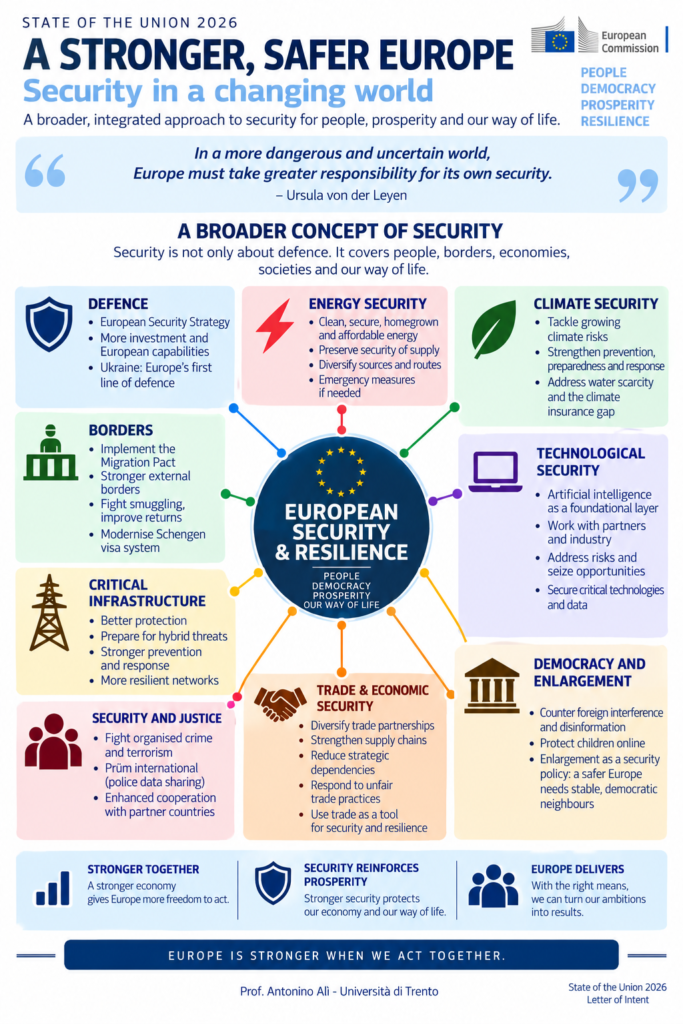
The document does not treat security as a self-contained policy field. Instead, security functions as a cross-cutting category connecting defence, borders, critical infrastructure, energy, democratic resilience, artificial intelligence, enlargement and economic policy.
1. European security and defence
The clearest passage states that, in a more dangerous and uncertain world, Europe must take greater responsibility for its own security. Higher defence spending should be converted into stronger European capabilities. The Commission also announces a European Security Strategy intended to set out how Europe should prepare for future threats.
2. Ukraine, Russia and sanctions
Ukraine is described as “Europe’s first line of defence”. European security is therefore linked to continued support for Ukraine, deeper defence cooperation, Ukraine’s path towards EU membership and sustained pressure on Russia, including stronger sanctions enforcement.
3. Internal security, borders and hybrid threats
Security also concerns pressure at the borders, attacks on critical infrastructure and hybrid threats. The priorities include:
- better protection of European borders;
- implementation of the Migration and Asylum Pact;
- cooperation with partner countries, action against smuggling and more effective returns;
- modernisation of the Schengen visa framework;
- stronger cooperation against organised crime and terrorism;
- protection of critical infrastructure;
- a stronger response to hybrid threats.
4. Enlargement as a security policy
Enlargement is expressly framed as a security issue: a safer Europe requires stable and democratic neighbours. Enlargement is therefore presented not merely as an integration or stabilisation policy, but as an instrument of European security.
5. Democratic security
The protection of the democratic space is included within the broader security agenda, notably through resilience against foreign interference and disinformation. Security thus acquires an institutional and informational dimension: protecting democratic processes and the European information environment.
6. Economic, energy and infrastructure security
Security is linked to security of energy supply, clean, secure, home-grown and affordable energy, and the protection of offshore energy installations. The document also links economic strength to Europe’s freedom of action: a stronger economy gives Europe greater room for manoeuvre, while stronger security protects the economy and the European way of life.
7. Artificial intelligence, climate and security
Artificial intelligence is described as a “foundational layer” for both the economy and security. The document stresses the need to maximise its benefits while addressing its risks. Climate change is also framed as a security issue because extreme events, water scarcity and related vulnerabilities affect society, the economy and preparedness.
8. Announced initiatives for 2027
Under Security and defence, the new initiatives listed are:
- European Security Strategy;
- Offshore security and safety for energy installations and operations;
- International data exchange for police cooperation (Prüm international);
- European Instrument for Strategic Enablers.
Legal and institutional reading
The underlying concept of security is integrated and multi-level. External defence, internal security, democratic resilience, economic and energy security, critical infrastructure protection and border management are presented as components of a single European agenda.
Legally, however, the document is a political letter of intent and does not itself alter the distribution of competences under the Treaties. Its main significance is therefore political and institutional: security is increasingly constructed as a transversal objective of Union action, even though the relevant legal bases and decision-making regimes remain differentiated across policy fields.
In the 2025 and 2026 State of the Union, trade is increasingly presented not only as an instrument of growth, but also as a component of European economic security.
In 2025, von der Leyen made the link explicit: trade helps Europe strengthen supply chains, open markets and reduce dependencies; “ultimately”, she argued, this enhances Europe’s economic security. The emphasis was therefore on diversification, partnerships and resilient supply chains in a deteriorating global trading environment.
The 2026 Letter of Intent develops the same logic in more operational terms. The Commission stresses diversification in key sectors, stronger European supply chains and the capacity to respond when third countries create unfair trading conditions, including through new instruments. Trade policy thus becomes part of a broader strategy aimed at reducing vulnerability and increasing Europe’s freedom to act.
The underlying shift is significant: trade is no longer framed only through market access and liberalisation. It is increasingly used to manage strategic dependencies, resilience and geopolitical risk. In this sense, economic security does not replace trade policy; it changes the strategic function attributed to it.