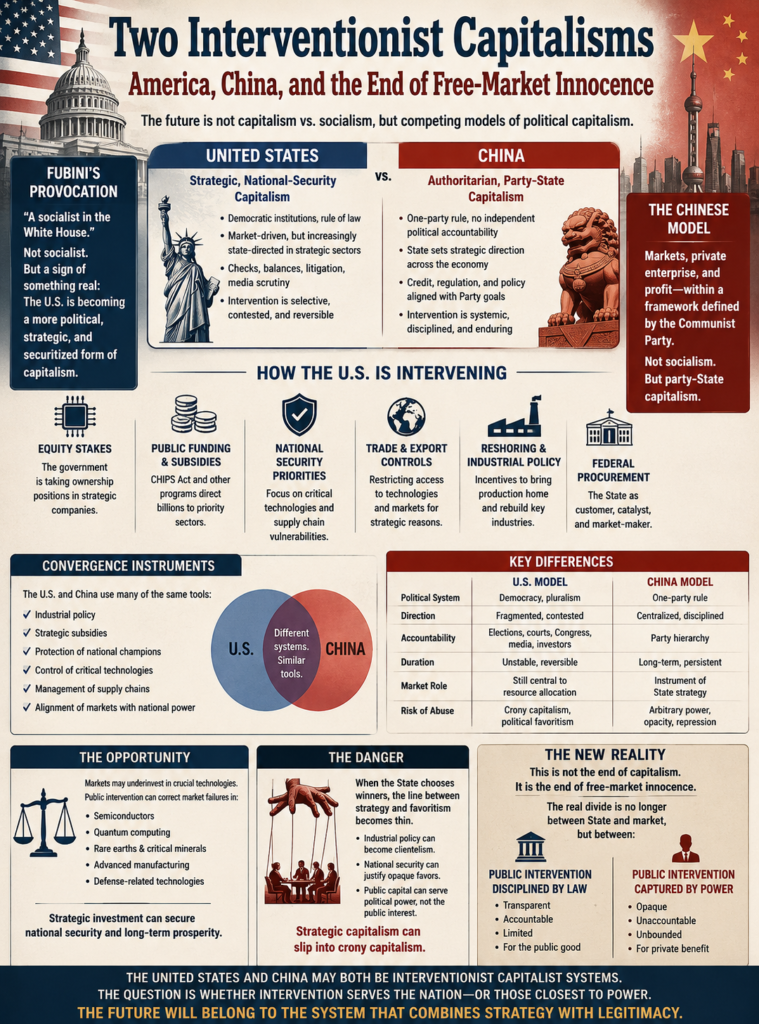
Federico Fubini’s article on Donald Trump’s economic interventionism captures a crucial shift in contemporary capitalism. The phrase “a socialist in the White House” is rhetorically effective, but analytically imprecise. What is emerging in the United States is not socialism. It is a more political, strategic, and securitized form of capitalism.
The most striking cases concern critical technologies. According to Fubini, the Trump administration has used funds originally made available under the CHIPS and Science Act to take equity positions in companies operating in quantum computing, semiconductors, rare earths, strategic minerals, and other sectors regarded as essential for national security and technological primacy. The point is not simply that the federal government is subsidizing private industry. It is that Washington is increasingly entering the ownership structure of firms deemed strategically important.
That is a major departure from the older American self-image of free-market capitalism. The United States has, of course, never had a purely laissez-faire economy. Defense procurement, public research, infrastructure spending, tax incentives, agricultural support, financial rescues, export controls, and industrial policy have long been part of the American economic model. But something different is now becoming more visible: the State is no longer only regulator, customer, or subsidizer. In selected strategic sectors, it is becoming shareholder, allocator, protector, and market-maker.
This raises the obvious question: is America copying China?
The answer is yes, but only partially.
China has built one of the most sophisticated models of political capitalism in modern history. It combines markets, private enterprise, global trade, technological ambition, and intense competition with pervasive State and party control. Chinese firms may seek profits, list on stock exchanges, attract foreign investment, and compete globally. But the Chinese Communist Party defines the strategic horizon. It directs credit, protects national champions, disciplines private actors, and subordinates market freedom to geopolitical, technological, and security objectives.
China is therefore not socialist in the classical sense of collective ownership of the means of production. It is better understood as a form of State capitalism, or party-State capitalism. Capital accumulation, profit, private enterprise, and global competitiveness remain central. But they operate inside a political framework in which the State is not merely an external regulator. It is the architect of the system.
The American model remains very different. The United States still has independent courts, private capital markets, congressional oversight, federalism, electoral competition, shareholder litigation, investigative journalism, and a much stronger ideology of private property. Its interventionism is more fragmented, contested, and reversible than China’s. Washington does not operate through a single party-State apparatus capable of imposing long-term industrial discipline across the entire economy.
And yet, the convergence is real. In semiconductors, artificial intelligence, quantum computing, defense technologies, batteries, rare earths, critical minerals, and advanced manufacturing, the United States is increasingly treating the market as an instrument of national power. Tariffs, export controls, investment screening, reshoring incentives, public subsidies, federal procurement, and now equity stakes all point in the same direction: the market is no longer imagined as a neutral space. It is a strategic battlefield.
This is the deeper meaning of the comparison with China. The United States continues to criticize China for non-market practices, industrial subsidies, and State-directed distortions. But in order to compete with China, Washington is increasingly adopting instruments that belong to the same broad family: industrial policy, selective protectionism, public direction of private capital, and strategic control over supply chains.
The difference lies in institutional form and political risk. China’s interventionism is systemic, authoritarian, and permanent. America’s interventionism is selective, legally constrained, politically unstable, and mediated by private markets. China’s capitalism is directed by the party-State. America’s emerging capitalism is directed by a combination of national security agencies, congressional funding, presidential pressure, corporate lobbying, and financial markets.
That does not make the American shift insignificant. On the contrary, it may represent one of the most important transformations of U.S. capitalism since the neoliberal turn of the late twentieth century. The old distinction between “free-market America” and “State-led China” is becoming less persuasive. A better distinction is between two types of interventionist capitalism: one authoritarian and party-commanded; the other democratic, legalistic, financialized, and increasingly securitized.
The central question is not whether Trump is a socialist. He is not. The central question is whether American capitalism can become interventionist without becoming arbitrary.
There are good reasons for public intervention. Markets alone may underinvest in technologies that are crucial for national security but commercially uncertain. Quantum computing, semiconductors, rare earth processing, defense-related AI, and advanced manufacturing all involve long time horizons, high capital costs, fragile supply chains, and geopolitical vulnerability. In those areas, a purely laissez-faire approach may be strategically naïve.
But there is also a serious danger. Once the State starts choosing firms, taking equity, steering procurement, pressuring private companies, and rewarding national champions, the boundary between public strategy and political favoritism becomes fragile. Industrial policy can become clientelism. National security can become a justification for opaque allocation of public resources. Strategic capitalism can become crony capitalism.
This is where Fubini’s provocation is most useful. The problem is not that Trump has become a socialist. The problem is that his economic policy may accelerate the transformation of American capitalism into a politically managed market, where access to federal power increasingly shapes corporate value.
China has shown that capitalism can be deeply interventionist without ceasing to be capitalist. The United States now appears to be drawing a difficult conclusion from that fact: in a strategic competition with State-directed capitalism, liberal capitalism may not be able to remain purely liberal.
The result is not the end of capitalism. It is the end of free-market innocence.
The future global economy may not be defined by a conflict between capitalism and socialism, but by a conflict among different capitalisms: liberal capitalism, State capitalism, national-security capitalism, green industrial capitalism, and authoritarian political capitalism.
In that landscape, the decisive issue will not be whether the State intervenes. It will. The decisive issue will be how it intervenes, under which legal constraints, with what transparency, and for whose benefit.
The United States and China may both be interventionist capitalist systems. But they are not the same system. China represents an organic, authoritarian, party-led capitalism. The United States is moving toward a strategic, national-security-driven capitalism still partially constrained by law, markets, and political pluralism.
The question, therefore, is not whether America is becoming socialist. It is whether America can use the State to defend its technological future without allowing the State to become an instrument of political favoritism.
The paradox of the new global economy is that the United States accuses China of distorting the market, while increasingly learning to distort the market itself. The real divide is no longer between State and market, but between public intervention disciplined by law and public intervention captured by power.