
 Leggi in Italiano
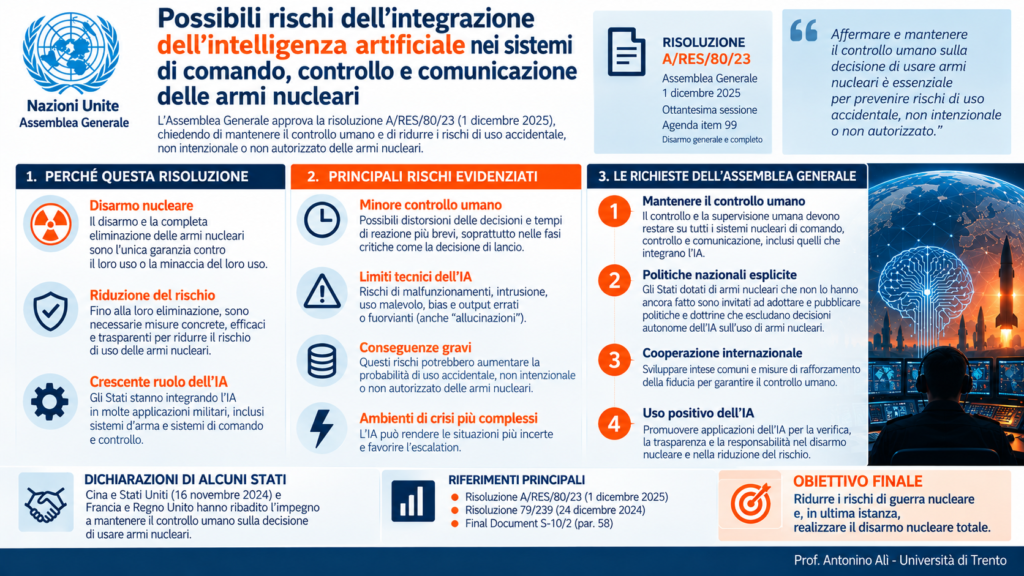
On 1 December 2025, the United Nations General Assembly adopted resolution 80/23 on the “Possible risks of the integration of artificial intelligence into command, control and communications systems of nuclear weapons.” The title precisely delineates the problem: the integration of artificial intelligence into nuclear command, control and communications systems, the so-called NC3 (Nuclear Command, Control and Communications). We are at the heart of the deterrence architecture, in a domain that requires a distinct reflection from the more general one on the military use of AI and autonomous weapons. The question running through the document deserves attention: how much can we automate the processes of analysis and decision-making while continuing to guarantee effective human control over the use of nuclear weapons?
The General Assembly addresses the question from the perspective of disarmament and nuclear risk reduction. It reaffirms that nuclear disarmament and the complete elimination of nuclear weapons constitute the only absolute guarantee against their use or the threat of their use. As long as these weapons exist, however, concrete, effective, and transparent measures will be needed to reduce the risks. Nuclear risk reduction thus accompanies the objective of disarmament, without replacing it. The problem of artificial intelligence lies precisely in the space — far from easy to govern — between the persistence of deterrence and the pursuit of disarmament.
The resolution takes note of the progressive integration of AI into a growing number of military applications: weapons, weapon systems, and operational support tools. From this observation, it does not derive an exclusion of artificial intelligence from the nuclear sector. Instead, it focuses attention on the consequences of automation when it enters the decision-making processes connected to nuclear command and control systems. And it is here that a seemingly obvious technological advantage — speed — can become a problem.
AI enables the collection, processing, and interpretation of information about a possible threat much more rapidly. In the nuclear context, however, speed does not necessarily coincide with greater safety. The resolution expressly observes that AI-driven decision-making systems could reduce human control and oversight, alter the environment in which decisions are made, and compress the time available for action and response. The risk is particularly evident at the most sensitive junctures, beginning with the launch decision: a shorter time window could increase the possibility of an accidental, unintentional, or unauthorised use of a nuclear weapon.
This is one of the most significant passages in the document. Deterrence presupposes the capacity to react, but also the capacity to interpret information, distinguish an actual attack from a false alarm, assess the adversary’s intentions, and decide whether and how to respond. Artificial intelligence can strengthen some of these capacities and, at the same time, accelerate the process to the point of narrowing the space for political judgement. The problem of the “machine that decides” is therefore only one part of the question. The human decision-maker might formally retain the final word, but find themselves exercising it under informational and temporal conditions so dependent on automation as to leave very little room for autonomous assessment.
To this risk are added others, linked to the technical characteristics of the systems. The resolution mentions malfunctions, exploitation of vulnerabilities, intrusions, cognitive and automation biases present in training data or in algorithmic design, as well as the possibility of generating “hallucinations” and erroneous, inaccurate, or misleading results. In nuclear systems, the General Assembly warns, the effects could be catastrophic. Assessing AI reliability solely on the basis of the statistical probability of error would therefore be insufficient: what that error can cause also matters. An extremely improbable event can be strategically unacceptable if among its possible consequences is the use of a nuclear weapon.
In the operative part, the resolution directly addresses human control. The General Assembly “demands” that, until the complete elimination of nuclear weapons, human control and oversight be maintained over NC3 systems, including those in which artificial intelligence technologies are integrated. The formulation deserves careful consideration: the call for human control expressly concerns the command, control, and communications infrastructure. It therefore extends to the entire technological and decisional chain that can contribute to the use of the weapon, beyond the weapon in the strict sense.
The following paragraph further specifies this approach. Nuclear-weapon states that have not yet done so are invited to adopt and make public national policies and doctrines explicitly stating that NC3 systems with AI components will remain subject to human control and oversight. Above all, such policies should affirm that these systems will not be able to “autonomously initiate decisions on the use of nuclear weapons.” An important distinction thus emerges between algorithmic decision support and decisional autonomy.
Gathering information, identifying patterns in data, evaluating scenarios, verifying informational elements, or assisting those who must decide are functions that, at least in principle, can be entrusted to AI. The threshold that the resolution seeks to preserve concerns autonomous initiative in the decision to use a nuclear weapon. The document thus attempts to delineate a functional limit, without introducing a general prohibition on artificial intelligence in nuclear systems: some activities can be assisted or automated, while the decision on the use of the weapon must remain subject to effective human control.
What remains to be understood, however, is what precisely should be meant by “human control and oversight.” The presence of a person in the decision-making chain, by itself, says little about their concrete ability to control the process. If they have only seconds to react, do not adequately understand how the system works, receive information filtered by opaque algorithms, or tend to systematically rely on the results produced by the machine, their control risks being merely nominal. It is on this point that the scope of the principle enunciated by the resolution will be measured.
The international debate will probably need to focus increasingly on the conditions that make human control “effective” or “meaningful.” Having sufficient time to decide, understanding the information received, being able to verify the system’s results and interrupt the process, knowing to whom responsibility is attributed: these are all elements that could assume a central role. Affirming the principle is a first step; establishing when it is truly respected poses far more difficult questions.
The resolution also records an initial convergence among some nuclear powers. It recalls the declaration of 16 November 2024 in which China and the United States affirmed the need to maintain human control over the decision to use nuclear weapons. It also notes the position of France and the United Kingdom, favourable to maintaining human control and involvement in critical actions relating to the formation and execution of sovereign decisions. These declarations are not sufficient to delineate a specifically defined international rule. They may, however, contribute to building a common language and, potentially, to the maturation of a shared norm of behaviour.
In this perspective, the third operative paragraph should be read, which underlines the urgency of developing, within competent multilateral and regional mechanisms, “common understandings,” confidence-building measures, and other appropriate measures to ensure the permanence of human control over nuclear systems. This opens the possibility that AI applied to deterrence may progressively enter the field of arms control. At least in an initial phase, it seems more realistic to envisage unilateral declarations, political agreements, transparency and confidence-building measures, hotlines, exchanges of information on doctrines, and reciprocal commitments to maintain certain functions under human control, rather than a grand treaty dedicated to artificial intelligence and nuclear weapons.
There is also an aspect of the document that deserves not to be overlooked. The General Assembly also recognises the opportunities offered by AI to strengthen verification, irreversibility, transparency, and accountability in nuclear disarmament, and invites the promotion of research and innovation in this area. The same technology that can destabilise deterrence — by accelerating decisions, producing erroneous information, or weakening human control — can contribute to stability when it improves treaty verification, enables the analysis of large quantities of data, helps to identify violations, or strengthens monitoring and transparency tools.
The assessment of artificial intelligence thus depends on the functions attributed to it and the degree of autonomy recognised in the systems. Asking whether it is abstractly compatible with nuclear deterrence risks leaving precisely this point unresolved. Resolution 80/23 seems to suggest a criterion that could gain increasing importance: the closer a technological function comes to the decision on the use of a nuclear weapon, the more robust the guarantees of human control must be.
The technological transformation could indeed affect the very logic of strategic stability, beyond the instruments used for decision-making. For decades, at the centre of reflection has been the need to prevent a political crisis from intentionally escalating into nuclear war. With artificial intelligence, it will also be necessary to prevent the interactions between automated systems, false signals, cyberattacks, the compression of decision-making timelines, and automation bias from triggering an escalation that none of the actors had initially intended to initiate.
The General Assembly resolution marks, in this sense, the beginning of the construction of an international discipline yet to be defined. It leaves open a question that will probably occupy a central place in the relationship between artificial intelligence, international security, and arms control: if deterrence continues to depend on the human capacity to assess, interpret, and decide, to what extent can we automate its systems without changing the very nature of the nuclear decision?