
 Leggi in italiano
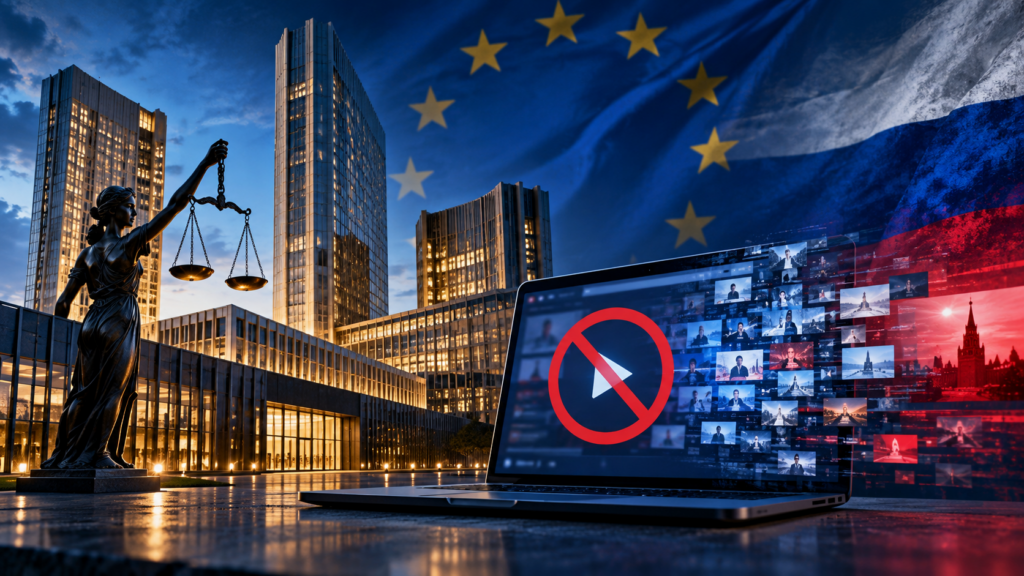
I had been waiting for this judgment for some time. The request for a preliminary ruling from Germany, in Case C-67/25, raised a seemingly narrow question, but one with important implications for the effective enforcement of EU sanctions against Russian propaganda.
Can someone who runs a website and distributes Russia Today content breach EU sanctions even if they are not engaged in commercial activity and the website is freely accessible?
In its judgment of 2 July 2026, the Court of Justice answered yes.
The case arose from criminal proceedings brought in Germany against three individuals who had made videos from RT Germany available through a website. The website was freely accessible and financed through voluntary contributions from users.
Since March 2022, the European Union has prohibited the broadcasting of content from certain Russian media outlets subject to restrictive measures. The central provision is Article 2f of Regulation (EU) No 833/2014, which applies to “operators” that broadcast, enable, facilitate or otherwise contribute to the dissemination of content from the entities listed in Annex XV.
The difficulty lay in the meaning of the word “operator”. Did it refer exclusively to those engaged in economic or professional activities, or could it also cover a private individual running a website without any commercial purpose?
The Court adopted the latter interpretation. Its reasoning begins with the wording of the provision, including a comparison of the different language versions of the Regulation. The EU legislature chose the term “operator”, not “economic operator”. Where it intended to restrict the scope of other provisions to economic activities, it did so expressly.
There is, however, another part of the judgment that I find particularly significant.
In its FAQs on the implementation of sanctions, the European Commission had linked the concept of an operator to the pursuit of commercial or professional activities. The Court pointed out that these FAQs are guidance documents without binding legal force. They cannot introduce conditions that the Regulation itself does not impose.
This is hardly a minor point. Commission guidance is used every day by public authorities, businesses and legal practitioners seeking to interpret a complex and constantly evolving regulatory framework. The judgment serves as a reminder that such guidance cannot alter the meaning of rules adopted by the EU legislature.
The Court also clarified that neither the scale nor the duration of the dissemination is decisive for the application of the prohibition.
Of course, the case continues to raise sensitive questions concerning freedom of expression and information. But it is important to avoid a misunderstanding that frequently arises in public debate: prohibiting the dissemination of content from specific sanctioned media outlets is not the same as imposing a general ban on reporting about Russia, discussing the positions of the Russian authorities or engaging in journalism.
What is at issue here is a specific restrictive measure directed against entities identified under EU law, and the possibility of circumventing its effects through alternative channels of dissemination.
The judgment does not determine the criminal liability of the individuals involved. That remains a matter for the German court. It does, however, clarify an essential element in the legal assessment of their conduct.
In my view, the significance of this judgment extends beyond the particular case. It illustrates how the effectiveness of sanctions also depends on the interpretation of the legal categories used in EU regulations. And it confirms that, when we move from the adoption of restrictive measures to their practical enforcement, questions that initially appear to be merely terminological can prove decisive.