
 Leggi in italiano
The Graham Act, Trump’s decision of 9 October 2026, and the politics of sanctions exemptions
9 October 2026 — Legal and policy analysis
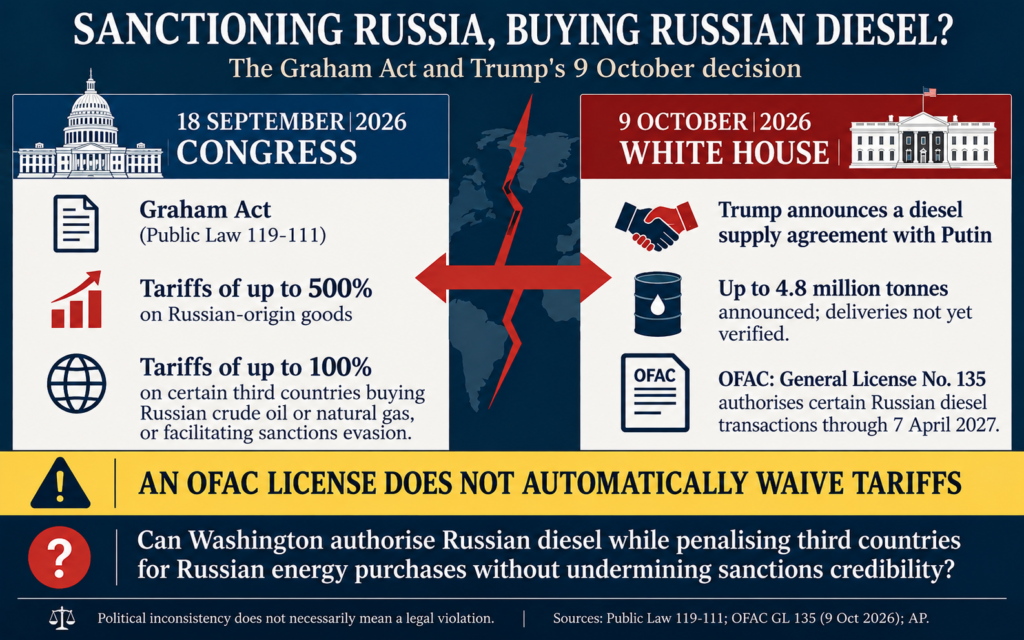
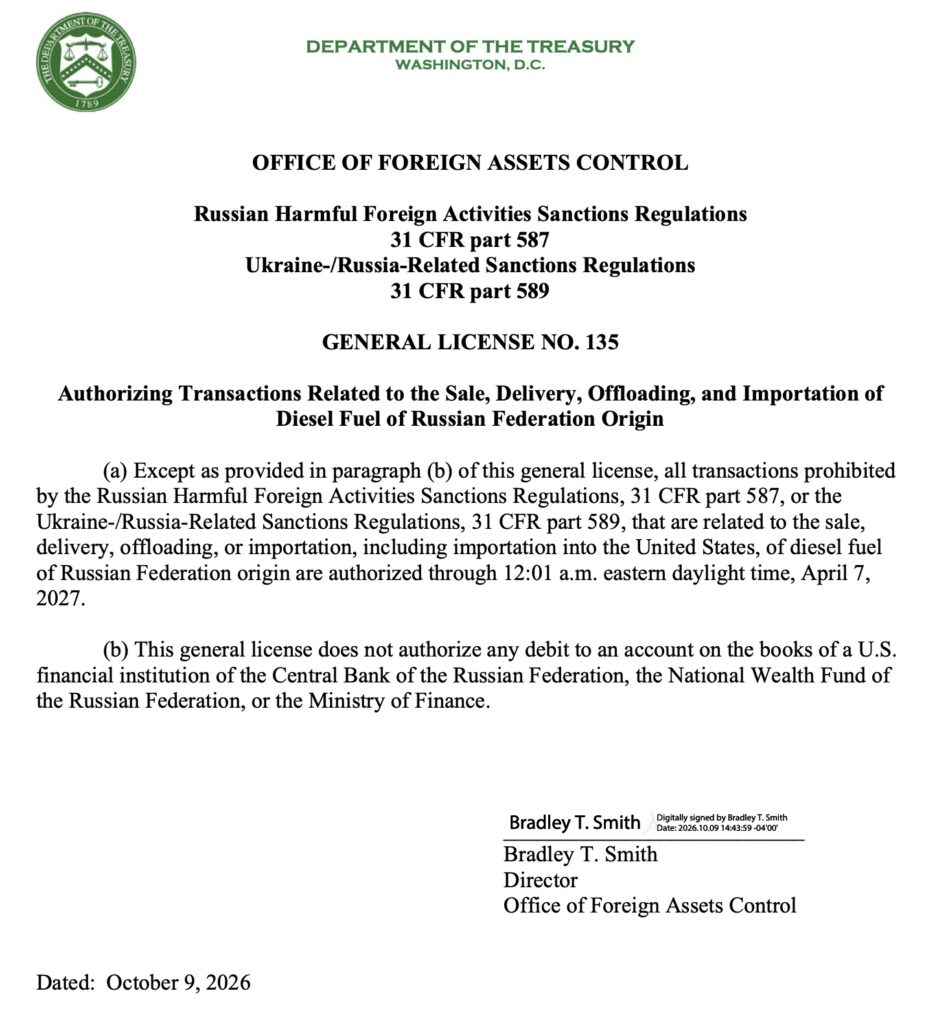
Barely three weeks after the enactment of one of the most far-reaching US sanctions statutes directed at Russia, President Donald Trump announced an understanding with Vladimir Putin to increase the supply of Russian diesel to the American and global markets. This was more than a change in presidential rhetoric. On 9 October 2026, the same day as the announcement, the Treasury Department’s Office of Foreign Assets Control (OFAC) issued General License No. 135, authorising specified transactions concerning the sale, delivery, offloading, and importation — including importation into the United States — of Russian-origin diesel until 7 April 2027.[1] The decision exposes the central tension in contemporary American sanctions practice: Congress seeks to restrict the energy revenues available to Moscow, while the executive reserves the capacity to reopen selected commercial channels when domestic economic priorities demand it.
That tension should not be reduced to an easy allegation of hypocrisy, and it is worth explaining why. Nor does the President’s announcement establish, without more, a breach of the Lindsey O. Graham Sanctioning Russia and Iran Act of 2026. Different restrictions have different legal bases, targets, and conditions of application. The more difficult issue, as I see it, lies elsewhere. What happens to the authority and predictability of secondary sanctions when the state imposing them demands that other countries alter their economic relations with Russia, yet itself authorises Russian energy transactions in pursuit of its immediate economic interests? The question is not simply whether the exception is lawful. It is whether a sanctions regime can remain credible when the grounds for an exception are not articulated in a manner capable of being tested against the stated strategic objective.
The Graham Act and the incorporation of tariffs into sanctions policy
Enacted on 18 September 2026 as Public Law 119-111 (H.R. 5334), the Graham Act combines restrictions affecting Russian state-linked persons, financial institutions, transfers of funds, investment, sovereign debt, and energy-related transactions. Its most distinctive innovation is the deliberate integration of customs duties into the sanctions architecture.[2] Section 112 directs the President, within thirty days of enactment, to increase duties on goods imported from the Russian Federation, expressly including petroleum products, to rates of up to 500 per cent ad valorem. “Up to” is not equivalent to a mandatory rate of 500 per cent: the provision states a ceiling, and its implementation requires further determinations. Section 113 separately provides for duties of up to 100 per cent on goods imported from defined classes of third countries, identified principally by their purchases of Russian-origin crude oil or natural gas or their facilitation of evasion of Russian oil sanctions. The statute also provides for subsequent reviews, methodology and reporting requirements, and specified exceptions. The timetable matters: 9 October precedes the thirty-day deadline of 18 October 2026 for the initial tariff measures.
A distinction that seems to me crucial must be preserved. Diesel is a refined petroleum product and falls within the broad language of section 112 concerning goods imported directly from Russia. The principal purchaser criteria in section 113, by contrast, refer to crude oil and natural gas. The statute expressly identifies Harmonized System headings 2709 and 2711 when determining imports for those purposes; it does not treat diesel purchases as categorically equivalent. An American purchase of Russian diesel and a third country’s purchase of Russian crude are therefore not identical legal situations. The asymmetry is better understood at the level of the sanctions system as a whole: the United States seeks to condition access to its market on the energy relationships maintained by other countries with Russia while retaining mechanisms that permit Russian energy to serve American market needs.[2]
The resulting friction strikes me as unmistakable. On one account, Russian energy trade is a strategic problem because it potentially sustains the resources available to the Russian state. On another, additional Russian energy supplies are a means of stabilising prices. These aims are not inherently incompatible. Their coexistence becomes problematic where the administration offers no publicly intelligible test for deciding when market stability justifies relaxing pressure on Russian revenue. The apparent severity of the statutory text does not, by itself, tell us how much economic pressure the United States will ultimately impose.
The Putin call, the OFAC licence, and the limits of presidential discretion
According to Trump’s public statement, Russia would supply more than 300,000 tonnes of diesel immediately, a further 500,000 tonnes in November, another million thereafter, and as many as three million additional tonnes subject to Russian refining capacity. Those are announced volumes, not evidence that all shipments have already taken place. The announcement does not establish the contractual prices, commercial counterparties, ultimate destinations, or the net benefit to the Russian Treasury.[3]
General License No. 135, by contrast, is an identifiable and operative administrative instrument. It authorises until 12:01 a.m. Eastern daylight time on 7 April 2027 transactions otherwise prohibited by the Russian Harmful Foreign Activities Sanctions Regulations (31 CFR part 587) or the Ukraine-/Russia-Related Sanctions Regulations (31 CFR part 589), provided they concern the sale, delivery, offloading, or importation of Russian-origin diesel. It does not authorise debits to specified accounts of the Russian Central Bank, National Wealth Fund, or Ministry of Finance held at US financial institutions.[1] Both its relatively broad formulation and its duration matter. The administration has not merely cleared one individually identified shipment: it has created a time-limited authorisation for a category of commercial activity.
Three legal layers must be distinguished, and the order in which they are addressed matters. The first consists of restrictions predating the Graham Act, including Executive Order 14066 of 8 March 2022, which prohibited, among other things, the importation into the United States of Russian-origin petroleum fuels and related products, subject to applicable authorisations.[4] The second is the OFAC licence, which operates by reference to the sanctions regulations it expressly identifies. The third consists of the Graham Act’s independent tariff provisions. General License No. 135 does not purport to suspend duties under section 112 and should not, without further evidence, be equated with a presidential waiver under section 115. Permission to perform a transaction and the customs treatment of the resulting import are related but distinct questions.
This is also a question of institutional competence. Section 114(h) of the Graham Act preserves the Treasury Secretary’s authority to extend or issue general licences. Section 115 separately empowers the President to waive statutory sanctions, restrictions, or duties, subject to prior submission to Congress of a written national-interest certification and an explanatory report. Section 117 draws a particularly revealing distinction: termination of measures against Russia is subject to more demanding substantive conditions, including a peace agreement acceptable to Ukraine and an end to hostilities, as well as congressional review.[2] The legislation thus distinguishes temporary accommodation from the permanent dismantling of the sanctions regime. General License No. 135 alone does not show that a section 115 waiver was invoked or that any congressional reporting obligation was breached. It does, however, demonstrate how the practical reach of a severe legislative framework may depend on choices made by the administration about exemptions and authorisations.
A serious counterargument: additional supply need not mean greater Russian revenue
The strongest defence of the decision — and it deserves a fair hearing — begins with the history of Western energy sanctions. They have never uniformly sought to eliminate Russian oil exports from global markets. The G7 price-cap mechanism, developed from 2022, explicitly aimed to keep Russian oil flowing while constraining the price Moscow could obtain for it.[5] Limiting revenue, not simply suppressing the physical volume of exports, was the central idea. An expansion in supply could, in some conditions, prevent a wider price increase from delivering windfall income to the Russian producer. It would therefore be too simple to assume that every additional shipment undermines the sanctions objective.
The difficulty is that the agreement announced on 9 October has not, on the evidence currently available, been presented as subject to a publicly specified price ceiling, independent verification of proceeds, or conditions intended to limit Russian state revenue. General License No. 135 itself states no maximum price for the diesel sold under its terms. Without information about prices, intermediaries, margins, and the wider energy-market consequences, one cannot conclude that the deal will necessarily increase Russian fiscal receipts; one cannot responsibly call it neutral either. What is missing is a publicly testable connection between the benefit sought for American consumers and the continued objective of reducing resources available to Moscow.
Lower diesel prices are a legitimate and intelligible domestic policy concern, particularly during a period of international energy disruption. Yet the credibility of sanctions cannot be measured only by how effectively their domestic costs are mitigated. Sanctions also send signals to the targeted state, third-country traders, and allied governments. If Russian energy transactions are treated as strategically unacceptable when undertaken by others, but economically indispensable when they serve the United States, the justification risks shifting away from Russia’s conduct and towards the identity of the buyer. That shift does not necessarily make the measure unlawful. It makes demands for cooperation harder to defend as the consistent application of a general strategic principle.
Secondary sanctions and international law: coercion through market access
The use of customs duties as an instrument of sanctions magnifies this tension. Primary sanctions regulate conduct falling within the sanctioning state’s jurisdiction; secondary sanctions seek to influence the economic behaviour of foreign actors even where the usual territorial or personal connection to the United States is absent. Section 113 presents a particular configuration. Its duties are levied on goods entering US territory, but their trigger lies in the exporting country’s economic relations with Russia. Their application is territorial; their intended influence reaches beyond US borders. Rather than describing this simply as extraterritorial jurisdiction, it is more accurate to identify the coercive use of access to the American market.
Under World Trade Organization law, country-specific duties imposed because of a state’s energy relations with Russia may raise questions under the most-favoured-nation obligation and tariff bindings in Articles I and II of GATT 1994. The United States may invoke the national-security exception in Article XXI. Such an invocation, however, does not automatically place every trade measure beyond legal scrutiny. In Russia — Measures Concerning Traffic in Transit(DS512), the panel accepted that certain objective conditions for reliance on Article XXI were reviewable, while recognising a substantial measure of governmental discretion in the identification of essential security interests.[6] That ruling does not establish that the Graham Act tariffs are inconsistent with GATT obligations. It does caution against treating the political designation of a tariff as a security measure as a complete legal answer.
Nor should the extraterritorial dimension be overstated. General international law does not contain a blanket prohibition on economic measures that influence another state’s choices; the legal classification of unilateral sanctions as prohibited economic coercion remains contested and context-dependent. A distinct question nevertheless concerns institutional credibility. A secondary sanction asks a third country to bear economic costs in the service of a strategic objective formulated in Washington. If Washington relieves itself of comparable costs without showing why the exemption is compatible with that objective, the burdens of cooperation appear asymmetrically distributed. The effect may be diplomatic rather than immediately judicial: third countries and allies may become less willing to participate in a regime whose implementation they regard as selective.
The Graham Act also reveals a tension within the American constitutional allocation of authority. Congress has attempted to harden economic pressure on Moscow and raise the costs of maintaining specified relationships with Russia. The executive retains substantial influence over the practical boundaries of authorised conduct, through licences, administrative determinations, and, where the statutory criteria are met, waivers subject to congressional notification requirements. The gap between legislative severity and administrative flexibility is not necessarily a legal defect. It is an institutional design choice. It becomes difficult to defend when exceptions are so consequential that they reshape the policy’s central message without sufficiently transparent reasons.
A contradiction the law can permit but cannot resolve
It would be an exaggeration — and I want to be clear about this — to present the Trump–Putin call and the OFAC licence as the collapse of US sanctions against Russia. The Graham Act remains in force; its provisions reach far beyond diesel transactions; the licence has a defined expiry date; and the shipments’ actual execution and economic effects are not yet established. Yet it would be equally mistaken to dismiss the episode as an ordinary technical exception. Less than a month after signing a statute intended to intensify pressure on Moscow, the administration authorised a significant category of Russian energy transactions, invoking domestic fuel-price concerns. The fact that this may be legally permissible does not eliminate the problem. It brings its institutional dimension into sharper focus.
The strength of sanctions cannot be inferred solely from the breadth of statutory prohibitions or the maximum tariffs Congress makes available. It also depends on implementation that is predictable, exemptions that are intelligible, and a demonstrable relationship between costs imposed and objectives pursued. If Washington conditions third countries’ access to the US market on their energy relations with Russia while authorising Russian products to enter its own market to ease prices, the regime risks appearing less like a coherent security policy and more like selective economic power. That, rather than an unproven claim of automatic statutory illegality, is the question that 9 October 2026 poses: can a sanctions system remain legally flexible without becoming politically arbitrary?
Sources and references
[1] US Department of the Treasury, OFAC, General License No. 135, Authorizing Transactions Related to the Sale, Delivery, Offloading, and Importation of Diesel Fuel of Russian Federation Origin, 9 October 2026, https://ofac.treasury.gov/media/937216/download?inline= .
[2] Lindsey O. Graham Sanctioning Russia and Iran Act of 2026, Pub. L. 119-111, 18 September 2026, especially §§ 112–117 and 114(h), https://www.govinfo.gov/content/pkg/PLAW-119publ111/html/PLAW-119publ111.htm .
[3] Michelle L. Price and Collin Binkley, “Trump says US to get diesel from Russia, relaxing pressure on Moscow to ease prices before midterms”, Associated Press, 9 October 2026, https://apnews.com/article/trump-russia-diesel-midterms-12baccc7aade559bf329079b0548c9da ; Barak Ravid, “Trump says he reached a diesel supply deal with Putin”, Axios, 9 October 2026, https://www.axios.com/2026/10/09/trump-putin-diesel-agreement-ukraine-war .
[4] Executive Order 14066, 8 March 2022; OFAC, FAQ 1010, updated 27 June 2025, https://ofac.treasury.gov/faqs/1010 .
[5] US Department of the Treasury, “Fact Sheet: Limiting Kremlin Revenues and Stabilizing Global Energy Supply with a Price Cap on Russian Oil”, 2 December 2022, https://home.treasury.gov/news/press-releases/jy1141 .
[6] WTO, Russia — Measures Concerning Traffic in Transit, WT/DS512/R, panel report adopted 26 April 2019, https://www.wto.org/english/tratop_e/dispu_e/cases_e/ds512_e.htm ; GATT 1994, Arts I, II, and XXI.
Methodological note (9 October 2026): this article relies on official instruments and public reporting available on the date indicated. Announced volumes are not verified deliveries. Transaction prices, contractual terms, ultimate destinations, effects on Russian public revenue, and any additional tariff instruments or congressional communications have not been independently established here.