
 Leggi in Italiano
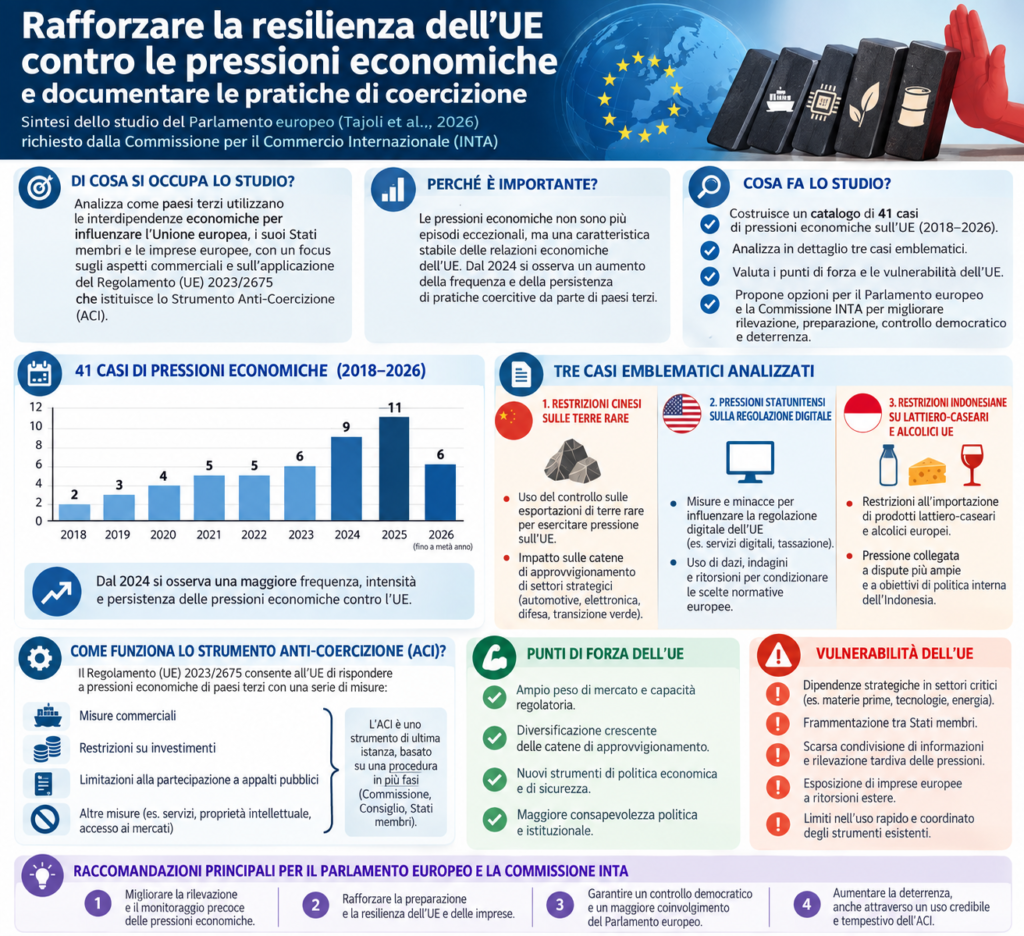
Economic coercion is becoming a permanent feature of international relations. A useful starting point is a study published by the European Parliament in September 2026, which examines 41 episodes of economic pressure on the European Union between 2018 and 2026. What stands out is their persistence: many of these pressures overlap and extend over time. For the EU, exposure risks becoming an almost permanent condition.
China and the United States account for the largest share of the cases analysed. Yet it would be reductive to treat economic coercion as a prerogative of great powers. Even a smaller state can exert considerable pressure if it controls a raw material, a market, a piece of infrastructure or a link in the value chain for which alternatives are hard to find. Overall economic weight matters, but so does the position occupied in a specific dependency relationship.
This is precisely where economic efficiency comes into tension with security.
A trade relationship can work perfectly well under ordinary conditions and prove vulnerable when access to a market, a technology or a resource is used to condition a political choice. Dependence then takes on a strategic meaning: what makes an exchange convenient can also make it difficult to resist the counterpart’s pressure.
The EU’s Anti-Coercion Instrument was created to address this problem. Its availability, however, leaves open the question of how to make it effective. The study points to very concrete conditions: recognising pressures in a timely manner, obtaining information from companies, coordinating Member States and making a credible European response possible. It is on these steps that the legal instrument’s capacity to influence the behaviour of third countries will be measured.
For this reason, the goal of “reducing dependencies” calls for some qualification. In many sectors, eliminating them would be economically impossible or extremely costly. What is needed, rather, is to reduce their coercive value: diversifying where possible, gaining a better understanding of one’s own vulnerabilities, and putting in place alternatives that make it harder to turn an economic tie into a political lever. Interdependence remains; what one seeks to limit is the possibility of exploiting it to restrict European freedom of decision.
In this shift of focus — from the convenience of trade to the conditions that make it possible to preserve trade without being held hostage — lies one of the most significant changes in European trade policy: its gradual entry into the field of economic security.