
 Leggi in italiano
Today, while preparing a university lecture on intelligence collection in digital networks, I had a rather interesting exchange with ChatGPT. It made me reflect on how artificial intelligence interprets information, particularly when national security is involved.
I was working on Edward Snowden’s 2013 revelations and wanted to use some of the famous National Security Agency (NSA) slides illustrating American electronic surveillance programmes. Many people will probably remember them: PowerPoint presentations featuring rather crude diagrams, arrows, clouds, technology company logos and, of course, the words TOP SECRET prominently displayed.
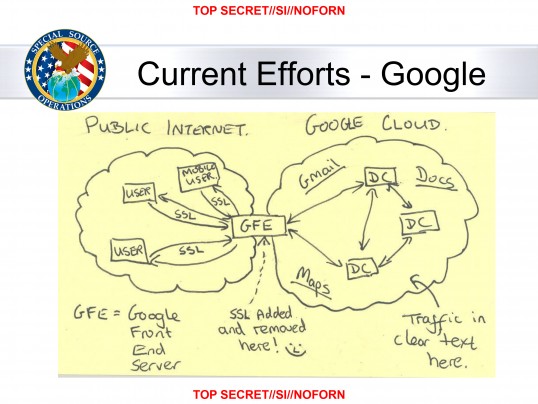
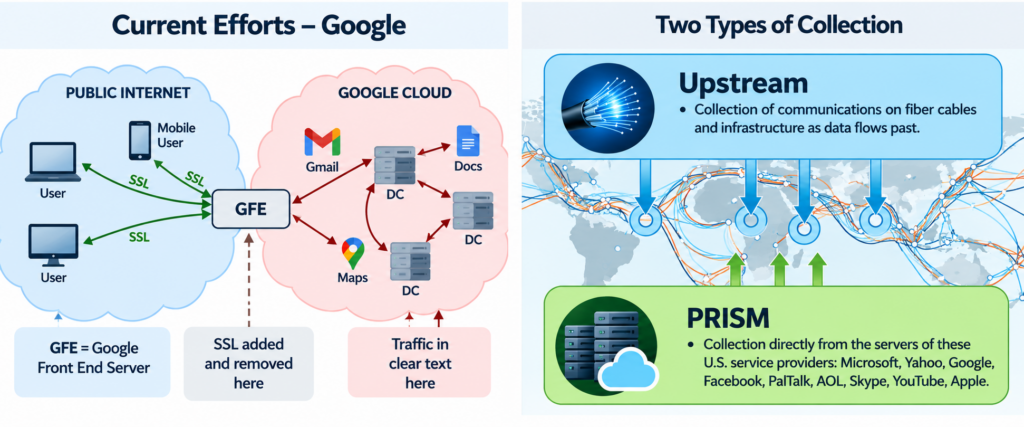
The first image I showed ChatGPT was entitled Current Efforts – Google. It uses an almost childish drawing to illustrate the difference between encrypted communications from users to Google’s servers and the traffic that, at the time, could circulate without the same protection within Google’s own infrastructure. It is one of the images associated with the revelations about the MUSCULAR programme, through which the NSA and Britain’s Government Communications Headquarters (GCHQ) collected information by intercepting connections between Google and Yahoo data centres.
The slide was published by The Washington Post on 30 October 2013. Since then, it has appeared in articles, books, conferences and university lectures.
I asked ChatGPT to turn it into a modern infographic while preserving its content. The initial response surprised me: it could not do so because the image might violate security rules.
I replied that this was a slide known throughout the world, made public through the Snowden revelations more than thirteen years ago. ChatGPT then accepted the request and produced a new version that was considerably easier to read. I subsequently asked whether it had actually verified what I had told it. It consulted the sources, located the original Washington Post article and acknowledged that its initial refusal had not been justified merely by the presence of a security classification marking.
It also pointed out something that was legally correct: the public disclosure of a classified document does not necessarily amount to its formal declassification. A document may be accessible to anyone while formally retaining its original classification. This is a distinction I am familiar with and consider important, particularly when studying systems for protecting national security information.
I therefore thanked ChatGPT for its initial caution. I prefer a system that questions the nature of a document to one that completely ignores the issue. But an interesting question remains: the system had initially recognised the TOP SECRET marking without reconstructing the historical and documentary context in which that same image has been publicly available for more than a decade.
The experiment continued with a second, equally famous slide entitled FAA702 Operations – Two Types of Collection. This is the one distinguishing between the two collection methods known as Upstream and PRISM, accompanied by the instruction You Should Use Both. This image had also been published by The Washington Post, on 10 July 2013. This time, ChatGPT immediately produced a modern version, preserving the distinction between collecting communications as they pass through network infrastructure and obtaining data through service providers.
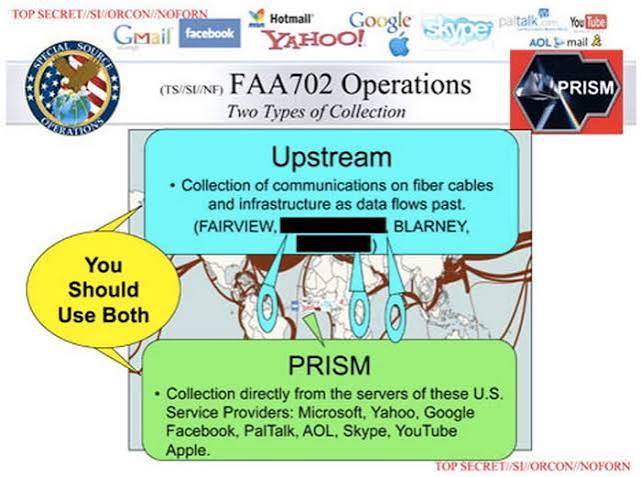
There is another aspect worth considering. Intelligence slides are not necessarily complete or impartial technical descriptions. They are documents produced for operational purposes, using the language and simplifications characteristic of that environment. The famous description of PRISM as collecting data directly from the servers of technology companies, for example, has given rise to considerable interpretative controversy. The companies denied that the programme involved generalised and indiscriminate access to their systems. PRISM operated within the framework of acquisition procedures established under Section 702 of the Foreign Intelligence Surveillance Act. Reconstructing the legal and technical reality therefore requires reading the slide alongside other available sources.
This is also important when we use artificial intelligence to modernise historical documents. An elegant infographic can make a phenomenon easier to understand, but it can also give an appearance of precision and certainty to a representation that originally contained simplifications, ambiguities or incomplete information.
By the end of the conversation, I had encountered two different responses from the same artificial intelligence system. Initially, it had treated a publicly available document with excessive caution because of its apparent security classification. Subsequently, after receiving contextual information and consulting the sources, it had managed to distinguish between the document’s original status, its public circulation and the possibility of using it for educational purposes.
This seems to me a concrete example of a problem that is likely to become increasingly important. Artificial intelligence can apply a general rule correctly and still reach the wrong conclusion in a particular case when it fails to consider decisive historical, legal and factual circumstances. The ability to reconsider an answer in light of new information is therefore valuable, but it presupposes that someone can recognise the problem and raise the right objection.
There is also a certain irony in all this. I was preparing a lecture on how intelligence agencies collect, select, classify and interpret information. My conversation with ChatGPT unexpectedly provided another illustration of how important it is to distinguish information from its interpretation, classification from public availability, and the application of a rule from an understanding of its context.
I think I will tell my students about this episode. The two NSA slides remain excellent teaching materials for understanding the evolution of electronic surveillance. The conversation with ChatGPT, however, offers an opportunity to discuss another, equally relevant question: what happens when we entrust an automated system not only with processing information, but also with making the initial assessment of what we are allowed to know, use and discuss?