
 Leggi in Italiano
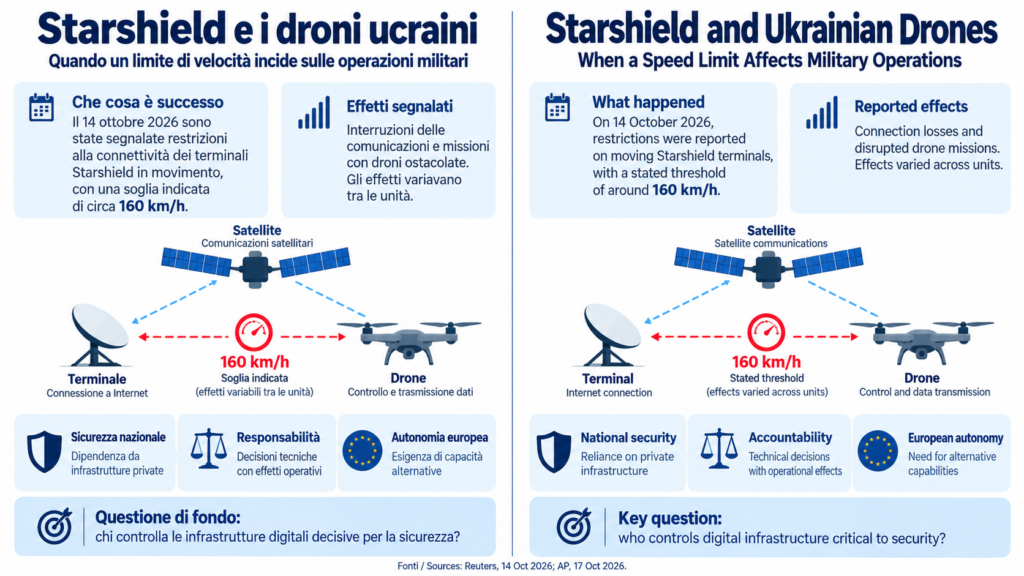
The restrictions imposed on Starlink services in Ukraine deserve some attention, not least because they illustrate how dependent modern military capabilities have become on infrastructure that states do not directly control. The issue concerns drone speed, but not quite in the way one might expect. According to sources within Ukraine’s Ministry of Defence, during the night of 13–14 October, SpaceX introduced restrictions affecting Starshield terminals, the military version of its Starlink satellite communications system, when moving at speeds exceeding approximately 160 km/h. This does not mean that a drone is physically unable to fly faster. It means that its satellite connection may be interrupted beyond that threshold.
Why does this matter? Some Russian jet-powered drones can exceed 400 km/h. Ukrainian interceptor drones therefore need to operate at high speeds while maintaining the connections required to receive information and, where necessary, allow remote control. If that connection is interrupted, the aircraft may remain mechanically capable of flying but lose the ability to complete its mission. This is precisely the problem Zelensky has raised. On 17 October, he also reported that tests conducted with Starlink terminals installed in vehicles travelling through EU countries showed that the service continued operating at speeds exceeding 180 km/h. According to the Ukrainian president, this demonstrates that the restrictions specifically affect Ukraine. These statements, however, should not be confused with independent technical verification. Differences between the services and terminals used in the tests still need to be clarified, as does who decided to impose these restrictions and why.
Particularly interesting about this case is something that goes well beyond Ukraine. We tend to think of technological dependence primarily in terms of procurement: acquiring components, obtaining access to certain technologies and maintaining equipment. This case reveals a different problem. A state may own a weapon system, have the personnel to operate it and possess all the necessary technical capabilities, only to discover that an essential function depends on the terms under which an external provider supplies a service. Those terms can change without anyone physically interfering with the weapon itself. To me, this is a particularly concrete example of why we need to reconsider the relationship between strategic autonomy, national security and control over technological infrastructure. Ownership of military equipment does not, by itself, necessarily guarantee full control over the operational capabilities that equipment is supposed to provide.