
 Leggi in Italiano
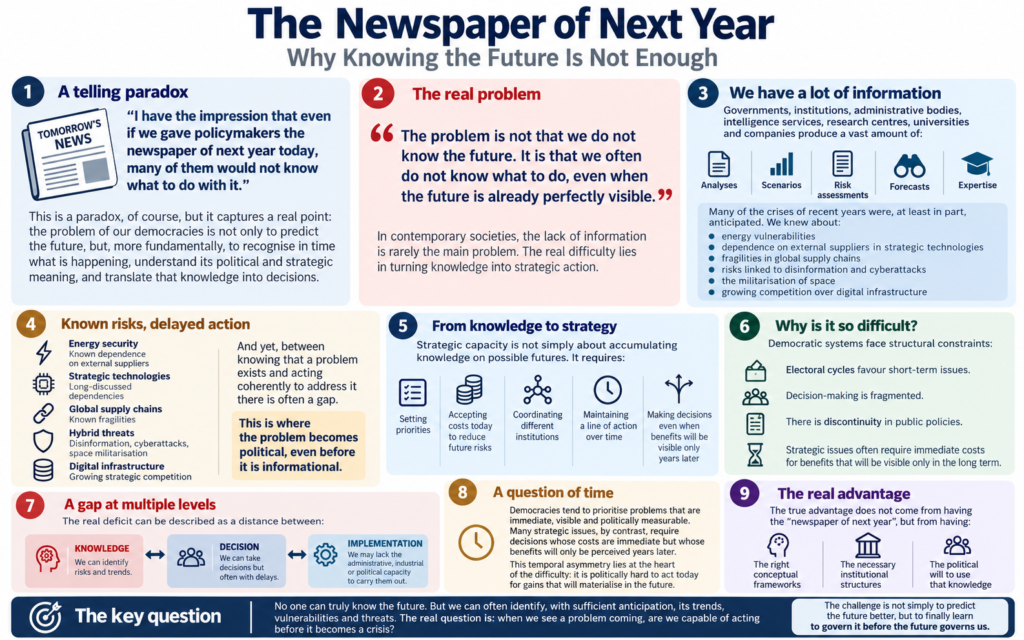
“I have the impression that, even if we handed political decision-makers today the newspaper from next year, many of them would not know what to do with it.”
The remark is deliberately paradoxical, but it captures a real problem: the challenge facing our democracies is not simply that of predicting the future. More fundamentally, it is the ability to recognise in time what is already happening, to attribute to it the appropriate political and strategic significance, and, above all, to translate that knowledge into decisions.
We could put the point even more starkly: “The problem is not that we do not know the future. It is that we often do not know what to do even when the future is already perfectly visible.”
This second formulation, in my view, goes to the heart of the matter.
In contemporary societies, scarcity of information is rarely the main problem.
Governments, European institutions, administrative bodies, intelligence services, research centres, universities and businesses produce an enormous volume of analyses, scenarios, risk assessments and forecasts.
Many of the crises that have appeared sudden in recent years had, at least in part, been anticipated.
Europe’s energy vulnerabilities were known; dependence on external suppliers in strategic technological sectors had long been debated; the fragility of global supply chains was well understood; and the risks associated with disinformation, cyberattacks, the militarisation of space and growing competition over digital infrastructures had all been identified.
And yet, between knowing that a problem exists and acting coherently to address it, a gap often opens up.
It is at this point that the problem becomes political before it is informational.
Strategic capacity does not simply consist in accumulating knowledge about possible futures. It consists in the ability to establish priorities, accept present costs in order to reduce future risks, coordinate different institutions, sustain a course of action over time, and take decisions even when their benefits will become visible only many years later.
In other words, the real advantage does not come from possessing the “newspaper from next year”, but from having the conceptual categories, institutional structures and political will required to make use of it.
This is probably one of the structural problems of contemporary Europe. The European Union possesses an extraordinary capacity for analysis, regulation and technical elaboration, yet it encounters greater difficulty when it must convert that knowledge into strategic decision-making, particularly in areas where security, foreign policy, defence, technology and divergent national interests intersect. The fragmentation of competences, the need to build compromise among twenty-seven Member States, differing perceptions of threats, and the often short time horizon of national politics all make it difficult to move from anticipation to action.
In Italy, this problem is even more visible.
The political and administrative system often tends to react to emergencies rather than anticipate them.
The pressure of electoral cycles, fragmented decision-making, discontinuity in public policies and an institutional culture not always oriented towards long-term planning encourage a model of government focused primarily on immediate urgency. The result is that issues known for years are treated as sudden emergencies as soon as they cross a critical threshold.
The paradox of the “newspaper from next year” therefore highlights an essential distinction between prediction and strategy. Prediction means formulating hypotheses about what may happen. Strategy, by contrast, requires a choice: deciding what to do today in light of what may happen tomorrow. It is precisely this second operation that is politically more difficult, because it inevitably entails costs, trade-offs and distributive conflicts.
Consider energy security. Recognising that excessive dependence on a single supplier creates vulnerability is relatively simple. Reducing that dependence, however, requires investment, infrastructure changes, diversification of supply and the acceptance of short-term economic costs. The same applies to European defence: for decades, there has been discussion of the need to strengthen common capabilities, interoperability and strategic autonomy. But translating that awareness into coherent policy requires budgetary choices, industrial restructuring and a degree of political integration that states are often reluctant to accept.
The same pattern reappears in the technological sphere. Europe has long understood that semiconductors, cloud computing, artificial intelligence, digital infrastructure and data have acquired a strategic dimension. The issue, therefore, is not merely to recognise this transformation, but to decide how much to invest, which dependencies to accept, which to reduce, and which capabilities should remain under European control.
From this perspective, the real deficit may be described as a gap between knowledge, decision and execution. We may understand a risk very well and still fail to put in place the policies needed to address it. We may take a decision but lack the administrative or industrial instruments required to implement it. We may even possess both knowledge and capabilities, yet lack the political continuity necessary to pursue an objective over time.
The issue, then, does not concern only the quality of our forecasting systems. It concerns the ability of democratic institutions to govern time. Democracies inevitably tend to privilege problems that are immediate, visible and politically measurable. Many major strategic challenges, by contrast, require decisions whose benefits will be perceived only years later, while their costs must be borne immediately. A significant part of the difficulty lies precisely in this temporal asymmetry.
For this reason, the problem is not simply to build better intelligence, forecasting or foresight systems. It is to build institutions capable of transforming anticipated knowledge into anticipatory action.
Ultimately, the “newspaper from next year” is only a metaphor. No one can truly know the future. But very often we can identify its trends, vulnerabilities and threats sufficiently early. The real question therefore becomes another: when we can see a problem approaching, are we capable of acting before it becomes a crisis?
And this may be the most important strategic question facing Europe today: not simply learning to predict the future better, but finally learning to govern it before the future governs us.