
 Leggi in Italiano
Some stories are so unusual that, if they were fictional, they would seem almost impossible to believe. Vivian Maier’s story is one of them. A woman who spent decades working as a nanny, leading a rather secluded life, and who, in the meantime, took something like 150,000 photographs, without almost anyone realizing just how talented she was. Today she is regarded as one of the most fascinating figures in twentieth-century street photography, yet her talent only gained widespread recognition after her death.
I find her story fascinating, not least because the way her photographs came to light sounds like something out of a movie.
In 2007, in Chicago, a young man named John Maloof bought a box containing thousands of old photographic negatives at an auction for about $380. He was looking for historical images for a book about one of the city’s neighborhoods. At first glance, the negatives didn’t seem particularly useful for his project, so he put them aside. Some time later, however, he began looking at them more carefully and realized that he had come across something quite extraordinary.
The photographs were beautiful. Portraits of strangers, people encountered on the street, children, elderly people, workers, scenes from everyday life in Chicago and New York. Images that were often humorous, sometimes melancholy, composed with a remarkable eye for detail and an extraordinary ability to capture precisely the right moment.
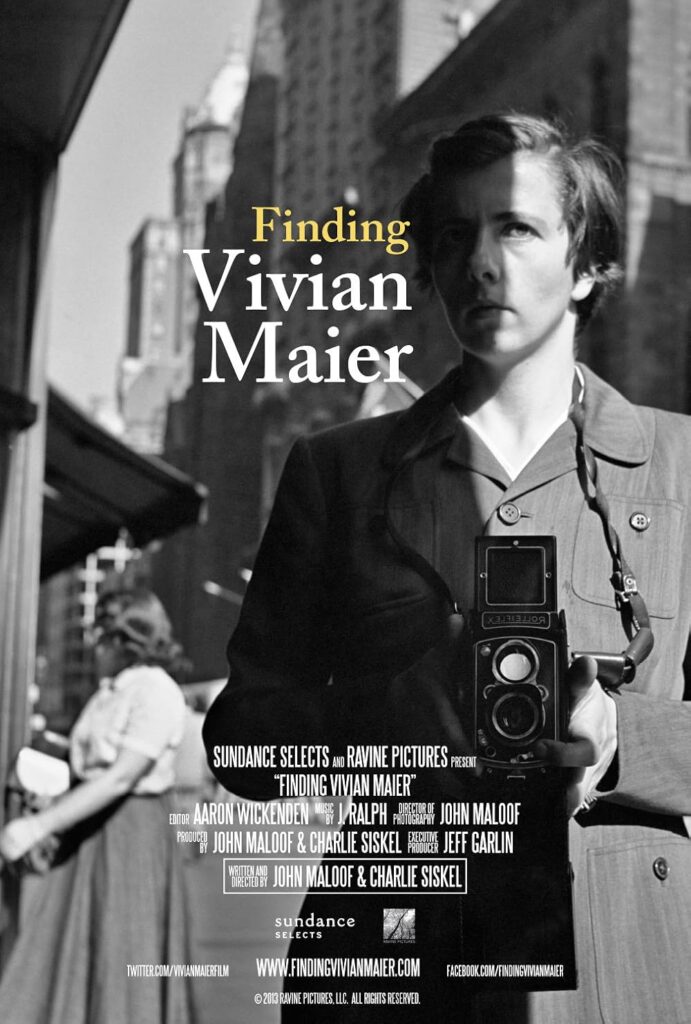
Maloof tried to find out who had taken them. The name was Vivian Maier, but he could find virtually nothing about her on the internet. He began digitizing the negatives and posting some of the photographs online. The response was enthusiastic. This marked the beginning of an investigation that would eventually become Finding Vivian Maier, a documentary released in 2013 and directed by Maloof himself together with Charlie Siskel.
And this is where the story becomes even more interesting.
Vivian Maier was born in New York in 1926, spent part of her childhood in France, and returned to the United States as an adult. For most of her life, she worked as a nanny for American families, mainly in Chicago. She never married, had no children, and led a rather private life. People who knew her describe a tall woman with a strong personality and a somewhat unusual way of dressing: large hats, heavy coats, men’s shoes. Someone who would hardly have gone unnoticed.
Above all, there was one thing she was almost never without: her camera.
She mainly used a Rolleiflex, a beautiful medium-format camera with two lenses mounted one above the other, one for taking the photograph and the other for viewing the scene. It used the 6×6 format, producing square negatives considerably larger than those of ordinary 35 mm cameras. The standard lens generally had a focal length of 75 or 80 mm, which, taking into account the size of the negative, corresponds roughly to a 40 mm lens on a 35 mm camera, or slightly longer in the case of the 80 mm lens.
I find this focal length particularly interesting because it offers a very natural perspective, wide enough to include a person within their surroundings without the more obvious distortions associated with stronger wide-angle lenses. An ideal choice for the kind of photography we now call street photography.
The Rolleiflex had another important characteristic. You didn’t normally take photographs by raising the camera to your eye, as you would with an SLR or a modern mirrorless camera. Instead, you looked down into a waist-level viewfinder, holding the camera around chest or waist height. This allowed you to observe and photograph people relatively discreetly, without attracting too much attention.
I can imagine Vivian walking through the streets of Chicago with her Rolleiflex, perhaps accompanied by the children she was looking after. She stops in front of a shop window, notices a passerby, waits for two people to cross paths, or for an expression to last just long enough to become a photograph.
Her ability to capture these moments is truly remarkable. Some of her images recall Henri Cartier-Bresson, others bring to mind Robert Frank or Diane Arbus. And yet, as you look through her work, you gradually begin to recognize a distinctive style, a particular way of observing the world.
What surprises me is the sheer number of photographs she took. Vivian photographed constantly. She kept negatives, rolls of film, prints, home movies, audio recordings, newspapers, and all kinds of documents. She accumulated everything in boxes and suitcases until entire rooms and storage units were filled with her belongings. Many rolls of film were never even developed. She probably couldn’t afford to have them processed, at least during certain periods of her life.
I wonder what it must have been like to keep taking photographs without ever seeing the results of a substantial part of your work. Today we take a picture and immediately look at it on a screen. Vivian could keep a roll of film for years without ever having seen the images it contained.
The documentary attempts to reconstruct this unusual personality through interviews with people who knew her. Maloof tracks down the families she worked for and speaks to many of the children she looked after, now grown adults.
What emerges is a complex, sometimes contradictory character. Some remember her fondly, as an eccentric, curious woman who took them exploring the city and introduced them to places they would otherwise never have visited. Others describe someone difficult, intensely private, sometimes authoritarian and even violent.
Vivian hardly ever allowed anyone into her room. She jealously guarded her boxes, negatives, and personal belongings. On some occasions, she changed the spelling of her surname or introduced herself differently. Once, when someone asked what she did for a living, she replied that she was something of a spy.
That remark made me smile, partly because there was a certain truth to it. Vivian spent her life observing and documenting other people’s lives while doing everything she could to keep her own out of sight.
In her later years, her financial situation deteriorated. Some of the children she had raised, now adults, helped look after her and contributed to the cost of an apartment. Meanwhile, the belongings she had accumulated in various storage units were auctioned off because she could no longer afford the fees. This is precisely how her negatives ended up in the hands of Maloof and other buyers.
Perhaps the most extraordinary part of the story concerns the timing of the discovery.
When Maloof bought the first negatives in 2007, Vivian was still alive. He knew nothing about her and was unable to track her down. In 2009, he searched for her name online once again and finally found something: an obituary.
Vivian Maier had died on April 21, 2009, at the age of 83.
Maloof finally discovered who had taken the photographs just when there was no longer any possibility of meeting her. From that moment on, he began piecing together her life, traveling to France, searching for documents, and interviewing anyone who might know something about her.
Meanwhile, her photographs began circulating, exhibitions were organized, and books were published. The photography world suddenly discovered an extraordinary artist who had remained unknown throughout her lifetime.
Watching Finding Vivian Maier, however, I found myself wondering about something that the documentary itself leaves unresolved: Would Vivian have wanted her photographs to be shown to the public?
We cannot know for certain. She had spent her entire life protecting her privacy and carefully guarding her work. There are some indications that she had considered having certain photographs printed or made public, but we don’t really know what her intentions were.
The question is interesting for another reason as well. Many of the photographs we admire today were selected and printed after her death. In some cases, they came from negatives that Vivian herself had never even developed. We therefore have no way of knowing which images she would have chosen, which she might have rejected, or how she would have wanted them printed.
Maloof undoubtedly played a crucial role in recovering and bringing this enormous archive to public attention. Without his intervention, a substantial part of Vivian Maier’s work might have been lost. At the same time, it is difficult not to wonder about the role that someone who discovers and manages an archive inevitably plays in shaping the artistic reputation of a person who can no longer have a say in the matter.
Of all Vivian’s photographs, I find her self-portraits particularly beautiful. She often photographed herself reflected in shop windows, mirrors, and metallic surfaces, or through the shadow she cast on a wall. Sometimes her figure is clearly recognizable; at other times, all we see is a silhouette holding a Rolleiflex.
These images feel remarkably modern, even though they were taken decades before selfies became commonplace. There is, however, a difference that strikes me: Vivian doesn’t seem particularly interested in putting herself on display. Her presence becomes almost another element of the composition, alongside the buildings, passersby, and reflections of the city.
I like to think that these self-portraits somehow reflect her personality: a woman who allows herself to be glimpsed without revealing too much.
By the end of the documentary, you have the feeling of having discovered an extraordinary photographer while still knowing remarkably little about the person she really was. There are countless testimonies and even more photographs, yet Vivian Maier remains, in many respects, a mystery.
There is something deeply unusual about the thought that she spent much of her life photographing strangers, keeping their images in boxes that nobody ever looked at, and that today, decades later, millions of people can see those faces, those streets, and those fleeting moments of everyday life.
Perhaps this is what fascinates me most about her story. Vivian took photographs because she evidently felt the need to do so. Public recognition, fame, and the art market came later, when she was no longer there.
And I find it curious that someone capable of observing the world and other people’s lives with such extraordinary attention should have left us with so few certainties about her own.
Finding Vivian Maier (2013), directed by John Maloof and Charlie Siskel, is worth watching for this reason alone: the pleasure of discovering, photograph by photograph, the extraordinary vision of a woman whom the world came to know far too late.