
 Leggi in Italiano
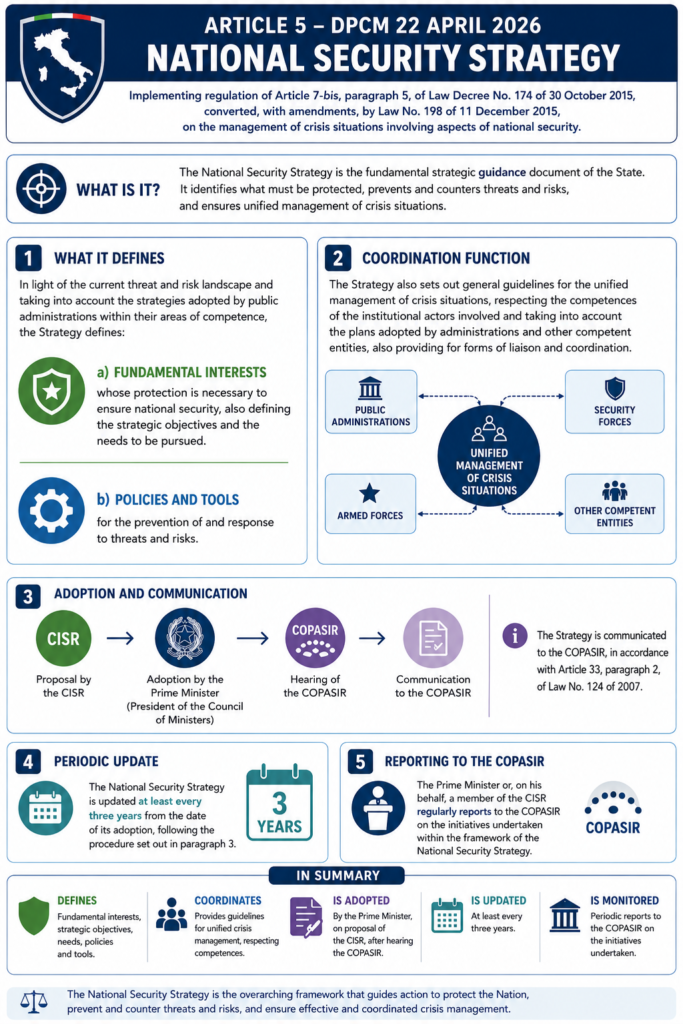
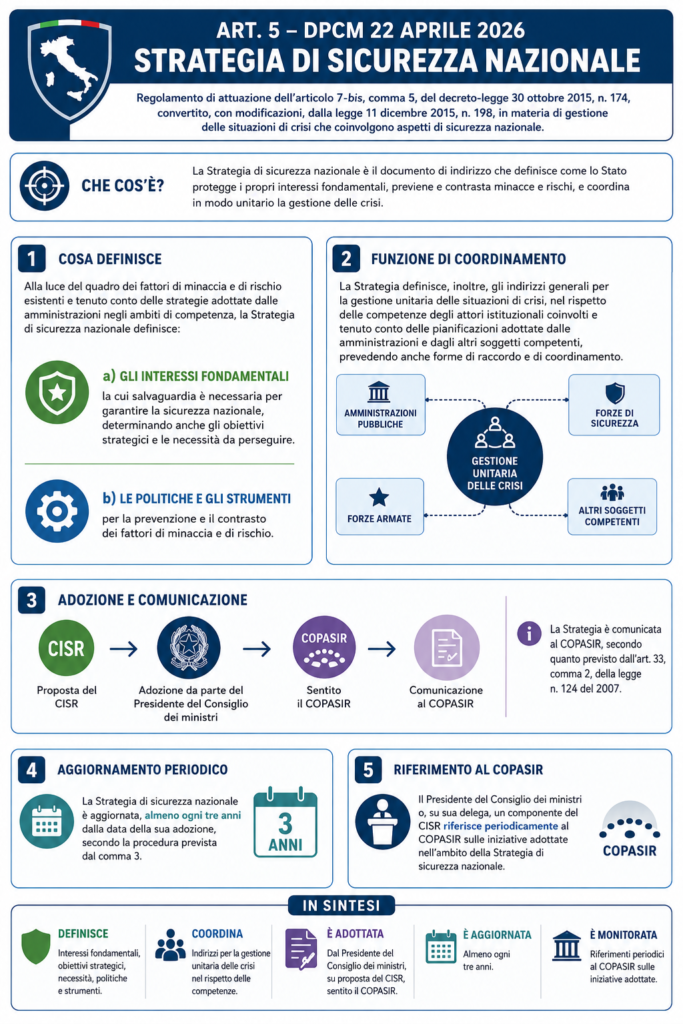
The adoption of an Italian National Security Strategy, defined by Article 5 of the Prime Ministerial Decree of 22 April 2026, marks a development I consider significant for the Italian security system. For the first time, Italy has a central framework for identifying, protecting, and advancing the State’s fundamental security interests — a high-level strategic guidance document designed to address the full spectrum of threats and risks affecting national security, while ensuring coherence across governmental action.
At its core, the Strategy identifies the fundamental interests whose protection is to guarantee national security. These interests are translated into strategic objectives and operational priorities. In parallel, the Strategy outlines the policies and instruments required to prevent, mitigate, and counter threats and risks, thereby linking political direction with practical implementation tools.
Beyond its definitional function — and this is what I find most consequential in practice — the Strategy plays a critical coordination role. It establishes general guidelines for the unified management of crisis situations, ensuring that responses are coherent and integrated across institutional actors. This coordination function operates without altering the formal distribution of competences; rather, it aligns existing administrative plans and sectoral strategies, and promotes mechanisms of inter-institutional liaison and cooperation among public administrations, security forces, armed forces, and other competent entities.
From an institutional perspective, the Strategy reflects the governance architecture of the Italian security system. It is adopted by the President of the Council of Ministers (Prime Minister) upon proposal of the Interministerial Committee for the Security of the Republic (CISR), after consultation with the Parliamentary Committee for the Security of the Republic (COPASIR). This procedure underscores the dual nature of the Strategy as both an executive act of strategic direction and an instrument subject to parliamentary oversight. The Strategy is not static. It is subject to periodic updating at least every three years, ensuring its continued relevance in light of evolving threat landscapes and geopolitical dynamics. This temporal requirement reflects the inherently adaptive nature of national security policy. Finally, the framework incorporates mechanisms of democratic accountability. The Prime Minister, or a delegated member of the CISR, is required to report regularly to the COPASIR on the initiatives undertaken within the scope of the Strategy. This reporting obligation reinforces parliamentary scrutiny over the executive’s action in the sensitive domain of national security.
In sum, the Italian National Security Strategy functions as the overarching instrument that defines priorities, coordinates institutional action, and ensures both adaptability and accountability in the protection of national security. Whether it will become an effective tool or remain largely declaratory will depend on implementation — a question I intend to follow closely.