

 Leggi in Italiano
I spent some time looking at a chart published by Epoch AI, estimating the computing capacity of major AI data centres in the first quarter of 2030. At first glance, it looks like a ranking of facilities with unfamiliar names and rather abstract figures. But it tells a more consequential story: where a resource that will increasingly shape research, economic activity and political power is being concentrated.
The projected scale is striking. Stargate New Mexico, intended for OpenAI, reaches approximately 5.1 million H100-equivalents; Shackelford, Texas, about 4.6 million. They are followed by Microsoft Fairwater in Wisconsin at around 4.5 million, Meta Hyperion in Louisiana at 4.1 million, and QTS Cedar Rapids in Iowa at 3.7 million. Further down are other Google and Stargate facilities, along with some projects outside the United States, including Stargate UAE in Abu Dhabi, estimated at roughly 2 million H100-equivalents. These are projections of future capacity, not descriptions of sites already operating at that scale.
It is worth being precise about what is measured. H100e does not mean that five million NVIDIA H100 GPUs will be physically installed in a building. It is a standardised measure: Epoch AI expresses the theoretical processing performance of different AI accelerators in terms of the NVIDIA H100, using 8-bit operations as the benchmark. The actual hardware mix will probably be diverse: newer generations of NVIDIA GPUs, Google’s own TPUs, Amazon’s Trainium chips and other specialised processors, whose real-world performance is not perfectly interchangeable. In many cases, Epoch AI estimates compute from projected electrical capacity, observable cooling infrastructure, permits and assumptions about future hardware. These figures should therefore not be mistaken for the capacity available to any single model-training run.
What interests me most, however, is the industrial and geographical structure behind the ranking. Almost all the leading names are American, but the labels can be misleading. A facility called OpenAI Stargate may contain chips owned by Oracle and used by OpenAI. Microsoft can supply infrastructure to its own services and, likely, to OpenAI; Amazon provides compute used by Anthropic; while Google and Meta have infrastructures more closely integrated with their own AI laboratories.
Physical location, ownership of the processors, and the right to use computing capacity are three different maps. Confusing them produces a distorted picture of who controls what.
This matters for technological sovereignty as well. Building a data centre in a particular country does not automatically give that country control over its computing capacity. Nor is the company using a cluster necessarily independent of the international chains through which its processors are designed, manufactured and supplied. Facilities on this scale also require gigawatts of electricity, transmission infrastructure, cooling systems, capital and regulatory approvals. The AI race is reshaping the geography of energy and infrastructure, not only the geography of software.
The near absence of Europe from the top of this chart is unsettling, but it needs to be interpreted carefully. This is not a complete picture of global computing capacity in 2030. Epoch AI primarily tracks large sites for which it can find verifiable evidence and where construction has already begun; coverage is far more detailed in the United States. In October 2026, Epoch AI itself estimated that its database captured around 43% of already deployed global AI compute, with considerable uncertainty. The chart therefore cannot establish that China is unimportant or that Europe has no significant infrastructure. It does show the remarkable scale of the American projects that can currently be identified.
The European Union is responding through EuroHPC’s AI Factories and the planned AI Gigafactories, which are still moving through selection and development. That is a meaningful step, but I am not convinced that the decisive question is simply how much capacity Europe can build. We also need to ask who will own it, who will be allowed to use it, on what terms, and for which purposes. A European AI policy focused on regulation without paying equal attention to infrastructure risks arriving after crucial technological dependencies have already taken shape.
Looking at the chart, I keep coming back to one thought: the future of artificial intelligence is not being decided only in laboratories where models are developed. It is also being shaped wherever power stations are authorised, substations are built, accelerators are purchased and contracts for computing access are signed. These are tangible decisions, and their political consequences will be difficult to overlook in a few years’ time.
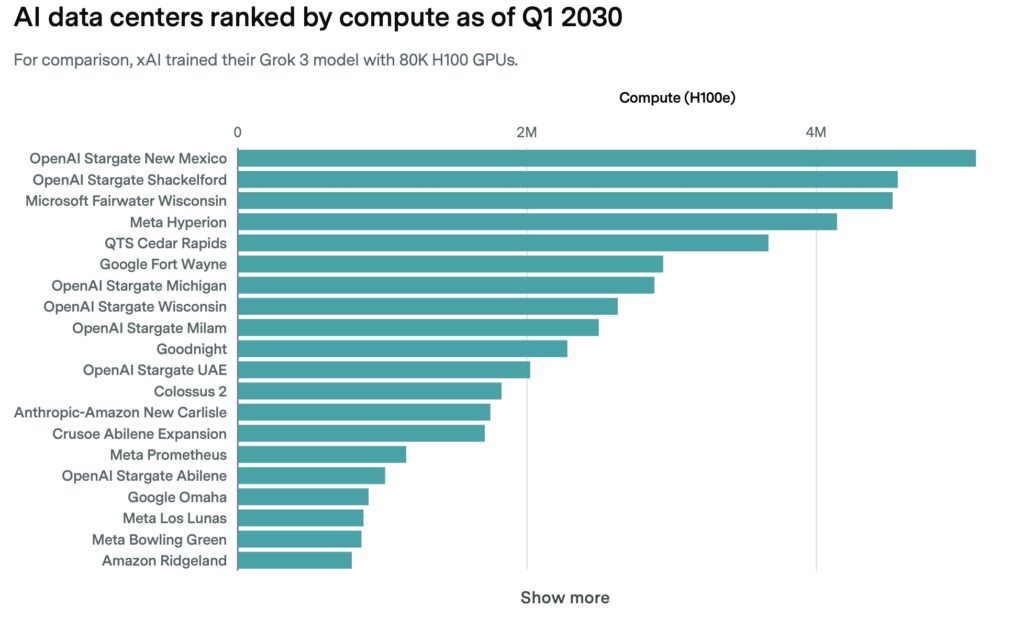
Chart: Epoch AI, AI Data Centers, projection for Q1 2030. Estimates are subject to revision.