
 Leggi in Italiano
Tariffs are often presented as a deviation from a “normal” condition of free trade. This seems a simplification that does not withstand scrutiny against economic history.
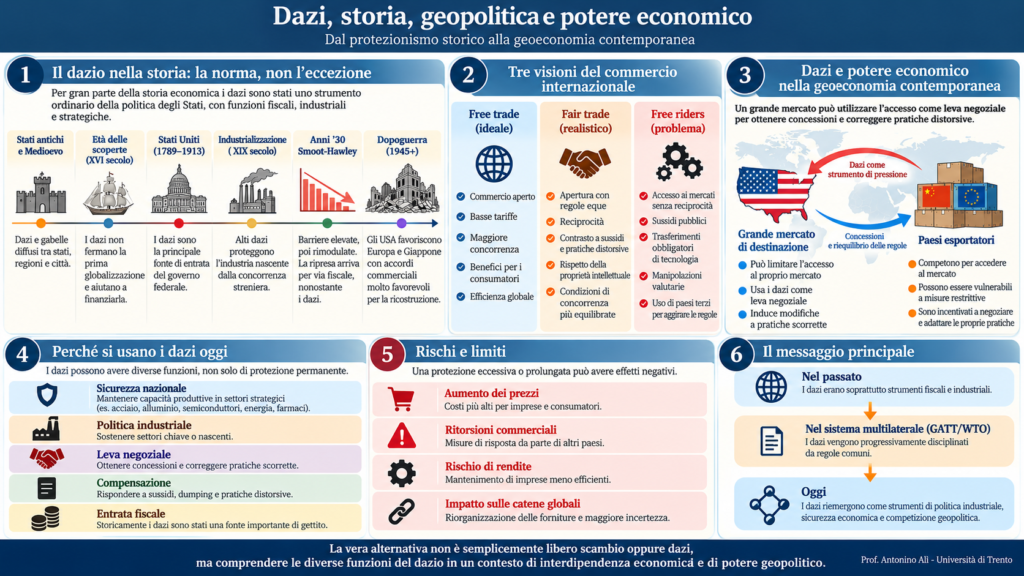
For much of the modern and contemporary era, customs duties were an ordinary instrument of state policy: they served to finance public budgets, protect domestic industries, support industrialisation processes, and — something that tends to be underestimated — exert pressure in international economic relations. In the United States, for example, tariffs constituted one of the federal government’s main revenue sources for over a century. American industrialisation in the nineteenth century took place in a context of significant tariff protection. This does not mean that tariffs “produced” that industrialisation, but it prevents us from describing that period as a free trade experience.
The commercial order built after 1945 did not eliminate tariffs either. The GATT, and subsequently the WTO, rather sought to discipline them: negotiated tariff reduction, reciprocity, non-discrimination, binding of commitments, and control of trade restrictions. The multilateral system, then, does not coincide with absolute “free trade.” It is a system of regulated and negotiated liberalisation — a distinction that is often overlooked in public debate.
From here, another point emerges that seems decisive: the difference between free trade and fair trade. Market opening can be formally reciprocal but substantively asymmetric. Public subsidies, state-owned enterprises, mandatory technology transfers, intellectual property appropriation, local content requirements, discriminatory industrial policies, and other non-tariff barriers can profoundly alter the conditions of competition. The 2018 debate focused precisely on this problem with reference to China, subsidies, and technology transfers.
In this perspective, the tariff changes function. It is not necessarily just a barrier intended to permanently protect the domestic producer. It can become a negotiating lever: restricting access to a large market in order to induce another state to modify certain practices, open its own market further, or accept new trade conditions. And it is here that tariff policy fully enters the realm of geoeconomics.
The market itself becomes a resource of power. A state that controls a large market can use access to that market as an incentive or as an instrument of pressure. The tariff then becomes one of the forms through which economic interdependence is transformed into bargaining capacity.
To this dimension is added that of economic security. Steel, aluminium, semiconductors, energy, pharmaceuticals, and critical raw materials cannot be evaluated solely on the basis of the lowest price available on the world market. Depending entirely on foreign sources for a strategic productive capacity can become problematic in the event of war, geopolitical crisis, or supply chain disruption. This was a concern that already emerged clearly in the 2018 tariff debate and has strengthened in subsequent years.
Naturally, there is also the opposite problem, and it should not be evaded. Prolonged protection can reduce incentives for innovation, keep inefficient firms alive, increase costs for consumers and downstream industries, and generate rents sheltered from competition. Protectionism, if it becomes permanent, risks weakening precisely the productive system it claims to defend.
For this reason, the real alternative is not simply free trade versus tariffs. It is more useful to distinguish among the different functions a tariff can assume: fiscal instrument — industrial protection — safeguard — compensation for distortive practices — economic security — negotiating lever — economic coercion.
The history of tariffs can be read as a progressive transformation of their function. In the nineteenth century they were primarily fiscal and industrial instruments. In the GATT/WTO system they became instruments subject to multilateral rules. In the contemporary phase they re-emerge as instruments of industrial policy, economic security, and geopolitical competition.
The most significant shift is perhaps precisely this: from the tariff as market protection to the market as an instrument of power.