
 Leggi in Italiano
When discussing the strategic, operational, and tactical levels, the first mistake to avoid is treating them as three rigidly separated steps in a hierarchy. It is not enough to say that the strategic level is “more important,” the operational level is “intermediate,” and the tactical level is “lower.” That representation may be useful as a first approximation, but it becomes misleading if taken as a complete description of military reality.
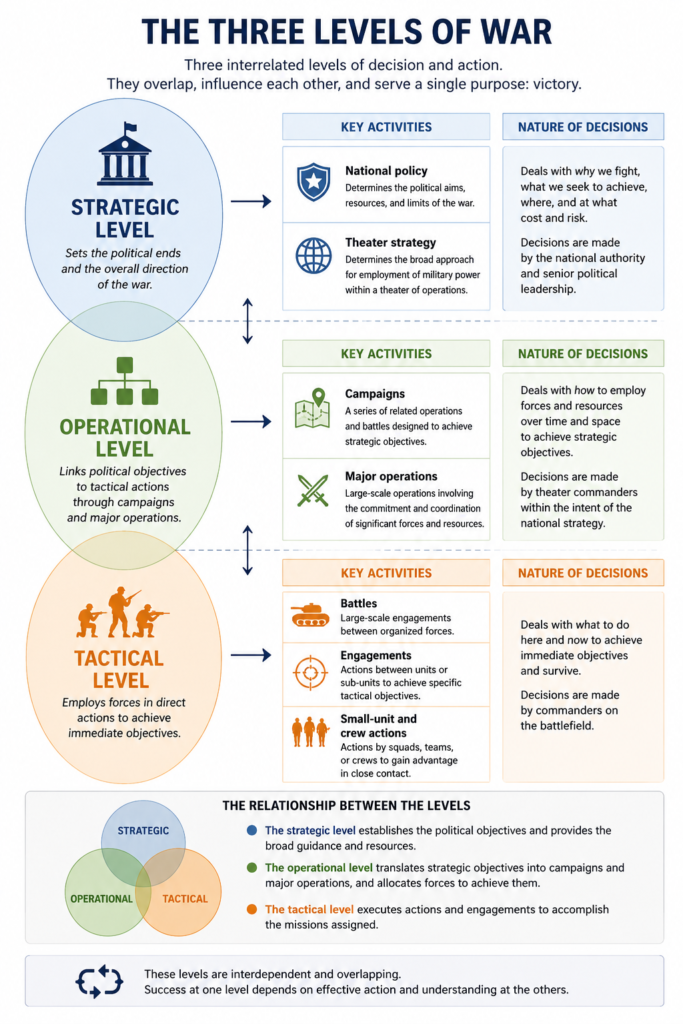
The three levels correspond to three different ways of looking at the same phenomenon: the organized use of force to achieve a political-military result. The lens changes, the scale changes, and the type of decision changes, but the object remains one. War, crisis management, and military operations are not made of three separate worlds. They are made of decisions that must be connected to one another.
Strategic vision must be capable of translation into operational plans. Operational plans must be capable of translation into tactical actions. Tactical actions must produce effects that make sense within the operational design and, ultimately, within the strategic purpose.
The correct formulation is therefore this: the strategic level defines the purpose; the operational level organizes the way to achieve it; the tactical level concretely produces military effects on land, at sea, in the air, in space, in cyberspace, and in the information environment.
The distinction among the levels does not exist to divide reality artificially. It exists to clarify who decides what, with what time horizon, under what responsibility, and with what expected effect.
The Strategic Level: Political Purpose and Overall Direction
The strategic level is where general political and military objectives are established. It is the level of “why”: why force is being used or threatened, what political result is sought, what costs are acceptable, what risks may be assumed, and what limits must not be crossed.
In the classical sense, the strategic level does not simply mean “high-level military activity.” Strategy is the point of connection between politics and the use of force. It is where the ultimate purposes of action are defined: deterrence, collective defence, coercion, stabilization, protection of a population, restoration of territorial integrity, containment of an adversary, preservation of international order, protection of critical infrastructure, protection of sea lines of communication, counterterrorism, or support to an ally or partner.
Its primary responsibility is to ensure coherence between political purpose, available means, and the use of force. A strategy that establishes unrealistic objectives without adequate means, or without a credible theory of success, exposes the entire operation to failure. Likewise, a strategy that does not clearly define the desired political result leaves the operational and tactical levels without proper orientation. In that case, forces may fight effectively, but they may not know what larger outcome their fighting is meant to serve.
The Operational Level: The Connection Between Strategy and Tactics
The operational level is the level of connection. It is not merely an administrative or logistical layer. It is the level that transforms strategic objectives into campaigns, major operations, lines of operation, lines of effort, sequencing, prioritization, and allocation of resources.
Its typical question is: how do we achieve the intermediate objectives required by the strategic purpose?
This is where operational art becomes central. Operational art is the ability to combine time, space, forces, functions, risks, and opportunities in order to build a coherent sequence of actions. It is not enough to win individual combats. Each combat, each manoeuvre, each support activity, each informational activity, each interdiction, protection, stabilization, or sustainment effort must contribute to a superior result.
In short, the operational level is the art of connection. Without it, tactical action risks becoming a sequence of local successes without direction. Without it, strategy risks remaining an elegant but unexecuted declaration of intent.
The Tactical Level: The Concrete Employment of Forces
The tactical level is the level of concrete action. It is where forces are directly employed to execute assigned tasks, conduct combat actions, carry out engagements, manoeuvre, apply fires, protect assets, control areas, sustain units, secure immediate effects, and produce measurable results in the short term.
The tactical level answers the question: how do I employ forces here and now to achieve the assigned effect?
This definition is more precise than a merely hierarchical one. The tactical level is not simply the “small” level. A tactical decision may concern a small unit, but it may also involve sophisticated systems, complex platforms, long-range fires, advanced sensors, air assets, naval capabilities, cyber tools, or informational effects. What makes a decision tactical is not only the size of the force involved, but its relationship to immediate action and to the concrete execution of an assigned task.
However, the tactical level must not be reduced to mechanical execution. This is one of the most important points. The tactical commander is not a mere implementer of orders. He or she interprets the assigned mission, understands the higher commander’s intent, evaluates the terrain or operating environment, observes the adversary, manages risk, coordinates available resources, reacts to the unexpected, and adapts action under pressure.
Two consequences follow. First, tactical success is necessary but not sufficient. One may win a combat and lose the campaign. One may seize a local objective and simultaneously produce a negative political effect. One may obtain superiority on the ground while undermining the legitimacy of the operation. Second, tactical failure may have effects far beyond its material dimension, especially when it produces political shock, media exposure, escalation, civilian harm, loss of consent, coalition fracture, or narrative advantage for the adversary.
A frequent error is to equate the tactical level with technical detail. It is true that the tactical level is close to execution and to military technique. But tactics is not merely technique. Technique concerns the functioning of the instrument. Tactics concerns the employment of that instrument in a conflictual situation.
Knowing how to operate a weapon system, sensor, vehicle, aircraft, ship, platform, or procedure is not yet the same as knowing how to conduct tactical action. Tactics requires the combination of different means under conditions of uncertainty, friction, threat, limited time, and imperfect information. It requires decisions about when to move, when to stop, when to strike, when to wait, when to disperse, when to concentrate, when to conceal, when to expose a force, when to assume risk, when to request support, and when to change the plan.
How the three levels connect
The relationship between the tactical and operational levels is the most delicate part of the whole architecture. The operational level assigns to the tactical level a task that must make sense within the campaign. The tactical level executes that task and produces effects that sustain, modify, or sometimes call into question the operational plan.
The operational level asks: which tactical actions, in what sequence, with what priorities, and under what conditions, will achieve the operational objective?
The tactical level asks: with the forces available, in this specific environment, against this concrete threat, how can I obtain the required effect?
The operational level must avoid two opposite errors. The first is excessive abstraction: planning effects without understanding the real conditions of tactical execution. The second is tactical micromanagement: interfering continuously with subordinate action and depriving commanders on the ground of initiative. The tactical level, in turn, must avoid acting as if local success were self-sufficient. It must understand that the value of action depends on its function within the operational design.
The relationship between the tactical and strategic levels is less direct, but no less important. In theory, the tactical level is mediated by the operational level. In practice, some tactical actions may produce immediate strategic effects.
This occurs especially when tactical action touches politically sensitive elements: civilian casualties, treatment of prisoners, use of particular weapons, perceived violation of international law, incident involving allied forces, border crossing, damage to critical infrastructure, destruction of cultural property, spectacular failure, capture of personnel, dissemination of images, humanitarian crisis, targeting error, or unwanted escalation.
In such cases, an apparently tactical decision becomes strategic because it changes the political perception of the entire operation. It does not merely alter the local result. It affects legitimacy, sustainability, consent, narrative, and sometimes the international position of the actors involved.
What Happens When Linkage Is Missing
The part of the scheme concerning broken linkage is essential. The three levels must be connected. When one of the connections breaks, military action loses coherence.
The first case is tactics without operations. Here the risk is technical success without direction. Units may fight well, obtain local successes, neutralize immediate threats, and solve technical problems, yet fail to contribute to a higher result. One obtains immediate success that does not advance the campaign. This is the case of a well-conducted action without operational value. The result is consumption of resources, exposure to risk, and possible local victory without overall progress.
The second case is operations without strategy. Here the risk is the administration of force without a clear political end. The operational command plans, coordinates, allocates resources, and conducts campaigns, but lacks a sufficiently clear definition of political purpose. The operation may become technically sophisticated but strategically empty. Activity is produced, but not necessarily result. The question “are we doing things well?” improperly replaces the question “are we doing the right things for the political purpose given?”
The third case is strategy without operations and tactics. Here strategy remains a declaration of intent. It may be elegant, politically coherent, and rhetorically persuasive, but it does not become reality because it has not been translated into plans, campaigns, resources, timelines, responsibilities, and executable actions. In this case, the purpose exists, but there is no practicable theory of success.
These three failures show why the correct relationship is indispensable. Tactics needs operations in order not to dissipate itself. Operations need strategy in order not to run in circles. Strategy needs operations and tactics in order not to remain abstract.
Or, more synthetically:
The strategic level is the art of purpose. The operational level is the art of connection. The tactical level is the art of immediate effectiveness.
This is, it seems to me, the key point of the lesson. The tactical level should not, I find, be taught as the “lower” level of war, but as the level at which war becomes reality. Yet precisely because it is the level of reality, it must remain connected to the operational and strategic levels. Without that connection, even the most effective action may become useless, counterproductive, or politically disastrous.