
 Leggi in Italiano
From commercial satellites to antisatellite weapons: competition in space and the questions it raises for international law.
We have grown accustomed to relying on satellite services without giving them much thought. Navigation, weather forecasts, communications and the invisible infrastructure that synchronises many economic activities have become part of everyday life. Yet it takes only a moment to imagine what would happen if some of these services were disrupted, even temporarily, to appreciate how much our societies and national security now depend on events hundreds of kilometres above us.
On July 2026, the US Defense Intelligence Agency (DIA) released the latest edition of Challenges to Security in Space: Congestion, Competition, and Cooperation. This is the third report in the series, following the 2019 and 2022 editions. Its perspective matters: it is an American intelligence assessment, framed around the threats Washington identifies principally in China and Russia, as well as Iran and North Korea. Beyond that geopolitical framing, however, the report exposes a problem that concerns everyone. Orbital space is becoming more crowded, commercial systems are integral to military operations, and an incident in orbit may have consequences far beyond the point where it occurs.
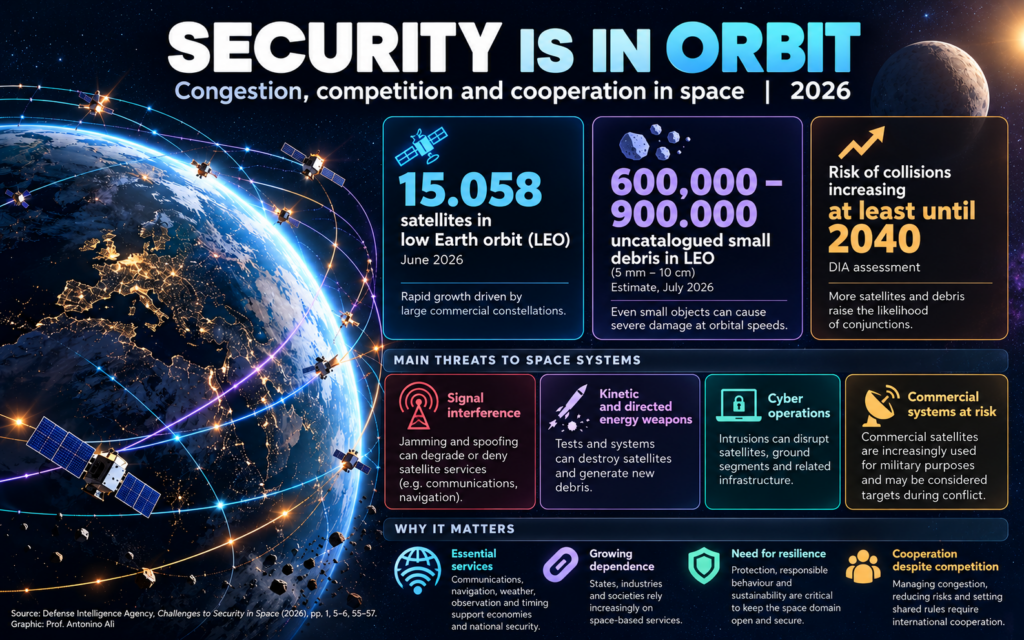
The figures convey the scale of the change. According to the report, 15,058 satellites were in low Earth orbit (LEO) in June 2026, the region where large constellations are expanding most quickly. By July, more than 35,000 objects measuring at least 10 centimetres had been catalogued across Earth’s orbits, a figure that also includes operational satellites. In LEO alone, the DIA estimates 600,000–900,000 smaller, uncatalogued pieces of debris, measuring between 5 millimetres and 10 centimetres. These fragments may be tiny, but at orbital speeds they can cause serious damage. The report expects collision risks to continue increasing until at least 2040. Fragments produced by the destruction of a satellite make no distinction between military, scientific and civilian infrastructure.
The threat is no longer limited to a missile striking a satellite. The report describes a broad range of counterspace capabilities: signal jamming, navigation spoofing, cyber operations, directed-energy systems and attacks on terrestrial ground stations. Some can interrupt a service without destroying the satellite; others may have irreversible effects and generate further debris. A crisis may therefore already be under way well before any visible destruction occurs.
The war in Ukraine has exposed another shift. Commercial satellite communications and imagery purchased from private operators can be operationally decisive. The DIA reports that Moscow has treated commercial satellites and infrastructure supporting Ukraine as potential military targets. But a state’s unilateral designation does not, by itself, establish that an object is a military objective. During armed conflict, the applicable international humanitarian law criteria must be met, with attention to the actual use of the system and the foreseeable consequences for civilians. As the International Committee of the Red Cross has stressed, disrupting space services may affect emergency communications, electricity and other essential civilian functions far from the battlefield.
This is where international space law faces problems that increasingly affect collective security. The 1967 Outer Space Treaty prohibits placing nuclear weapons and other weapons of mass destruction in orbit, but does not impose a general ban on all conventional weapons in outer space. The UN Charter’s rules on the threat or use of force remain applicable, as does the relevant law of armed conflict. Under Article VI of the Treaty, states bear international responsibility for national space activities even when those activities are conducted by private entities; non-governmental activities also require authorisation and continuing supervision. Article IX requires due regard for the corresponding interests of other states and provides for consultations over potentially harmful interference. These obligations matter, but applying them to vast satellite constellations and increasingly rapid operations is far from straightforward. The UN’s 2019 long-term sustainability guidelines and General Assembly resolution 77/41 on destructive direct-ascent antisatellite missile testing show the importance of developing common standards of conduct; neither, however, is itself a new binding treaty.
For the European Union, these questions have become immediate. The 2023 EU Space Strategy for Security and Defence has been followed by a 28 September 2026 decision through which the Council strengthened the EU Space Threat Response Architecture (STRA), including mechanisms to mobilise Common Foreign and Security Policy instruments. Negotiations are also under way on the proposed EU Space Act, introduced in 2025, which would establish common requirements for operational safety, resilience and sustainability. These are different instruments, and the Space Act remains a legislative proposal, but both respond to the same concern: protecting the infrastructure on which Europe’s freedom of action increasingly depends.
What stays with me after reading the report is a basic tension: the more dependent we become on space, the more its security requires cooperation among states that remain strategic competitors on Earth. No single country can manage the risks of orbital debris alone, and no country can secure global services by thinking exclusively within its borders. Space appears distant because we cannot see it. Much of our security already depends on what happens there.
Sources
- Defense Intelligence Agency, Challenges to Security in Space: Congestion, Competition, and Cooperation(2026), pp. 1, 5–6, 41–42, 55–57.
- DIA, press release, 26 October 2026.
- United Nations, overview of the 1967 Outer Space Treaty.
- ICRC, Military operations in space.
- United Nations, guidelines on the long-term sustainability of outer space activities.
- Council of the EU, strengthening the Space Threat Response Architecture, 28 September 2026.
- European Commission, proposed EU Space Act, COM(2025) 335 final.