
 Leggi in italiano
Understanding in science is often invoked as though it were a single, self-evident achievement—and this confusion matters far beyond the natural sciences. Anyone who works with legal reasoning knows how easy it is to mistake a well-structured argument for a complete explanation. In reality, understanding refers to at least two fundamentally different levels of explanation, and confusing them is one of the most common sources of misunderstanding about what science can and cannot offer.
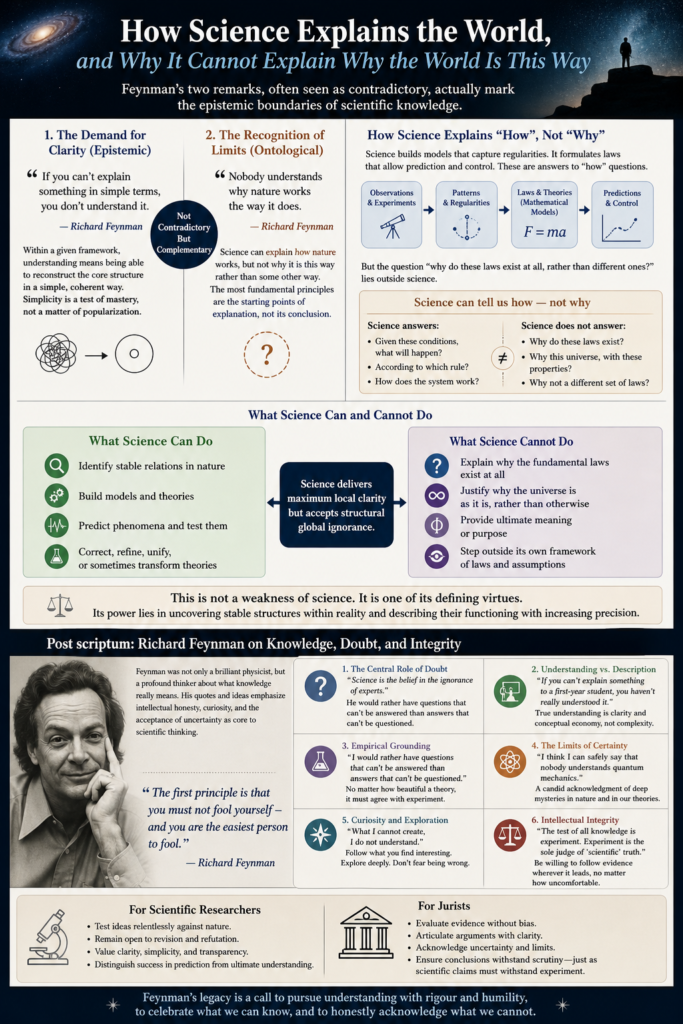
Richard Feynman famously captured this tension through two apparently contradictory remarks. On the one hand, he insisted that if you cannot explain something in simple terms, you do not truly understand it. On the other, he openly acknowledged that even when physicists can describe in detail how nature behaves, they cannot explain why nature is structured in that particular way. At first glance, these two claims seem to pull in opposite directions. In fact, they define, with remarkable precision, the epistemic boundaries of scientific knowledge.
The first claim expresses a demanding and deeply methodological view of understanding. To understand a phenomenon does not mean merely repeating sophisticated formulas, technical jargon, or computational procedures. It means being able to reconstruct the relevant causal and structural relations in a way that isolates what genuinely matters. Simplicity, in this sense, is not a matter of popularization. It is a test of conceptual mastery. If a theory cannot be expressed in a form that makes its internal logic intelligible, then the theory may be operationally useful, but it is not yet intellectually mastered by the person who uses it.
Scientific understanding, therefore, is not measured by complexity. It is measured by the ability to organize complexity into intelligible structure.
The second claim, however, introduces a much deeper and more uncomfortable limitation. Science can explain how nature works, but it cannot explain why nature works that way.
This distinction is not rhetorical. It reflects a fundamental feature of scientific explanation. Physics, and the natural sciences more broadly, construct models that capture regularities in the behavior of the world. They identify stable relations between quantities, formulate laws, and express them through mathematical structures that enable prediction and control. A scientific explanation answers questions of the form: given these conditions, what will happen, and according to which rule?
In this sense, science produces extremely powerful answers to “how” questions. It tells us how particles interact, how fields propagate, how matter behaves under certain constraints, and how complex systems evolve. These explanations can be refined, corrected, unified, and sometimes radically transformed. But they always remain internal to a framework of laws and theoretical assumptions.
The question “why do these laws exist at all, rather than different ones?” lies outside that framework.
When Feynman remarks that nobody understands why nature works the way it does, he is not denying the success of physics. He is identifying the precise point at which scientific explanation stops. Scientific theories explain phenomena by referring to more general principles. Yet the most fundamental principles themselves are not explained by deeper physical causes. They are the starting points of explanation, not its conclusion.
At that level, the demand for further explanation becomes a philosophical or metaphysical question, not an empirical one. It cannot be tested, measured, or settled by experiment. Science can refine the form of its fundamental laws. It cannot justify their ultimate existence.
Read together, Feynman’s two statements are not contradictory. They articulate a clear division between two dimensions of understanding. The first is epistemic. Within a given theoretical framework, genuine understanding requires clarity, conceptual economy, and the ability to express the core structure of a theory in simple and coherent terms. The second is ontological. The existence of the framework itself—the fact that nature obeys one set of fundamental regularities rather than another—remains beyond the reach of scientific explanation.
This distinction is especially important today, when scientific and technological systems have become extraordinarily sophisticated. The growing complexity of models, simulations, and artificial intelligence tools risks creating an illusion of understanding, where operational success is confused with conceptual insight—a risk that extends well beyond physics into fields like law, where algorithmic tools can produce results without anyone understanding why. Feynman’s standard remains uncompromising: if a result cannot be explained clearly, it has not been fully understood.
At the same time, his intellectual honesty prevents science from overreaching. The ambition of science is not to deliver an ultimate explanation of reality. Its strength lies in its ability to uncover stable structures within reality and to describe their functioning with increasing precision.
In short, scientific knowledge demands maximum local clarity and accepts structural global ignorance. This is not a weakness of science. It is one of its defining virtues.
Post scriptum
Richard Feynman was not only one of the most influential physicists of the 20th century, but also a powerful thinker about what knowledge really means. His words and ideas — collected in quotes and reflected in his speeches — repeatedly emphasize intellectual honesty, rigorous inquiry, and the acceptance of uncertainty as core principles of scientific thinking.
At the heart of Feynman’s approach is a simple but radical demand: don’t fool yourself. He insisted that self-deception is the greatest obstacle to genuine understanding, precisely because we are most capable of justifying exactly what we already believe. For him, intellectual integrity means being willing to follow evidence wherever it leads, even if it contradicts cherished assumptions.
From this stance arise several interlinked themes:
- The central role of doubt. Feynman famously juxtaposed science with certainty: science is a culture of doubt.Where belief systems demand certainty without question, scientific thinking thrives on questions that challenge assumptions. Feynman even said that he would rather have questions that can’t be answered than answers that can’t be questioned.
- Understanding vs. description. A recurring idea in his quotations is that explaining something clearly and simply often shows a deeper grasp than invoking complex formalisms. As he put it: If you can’t explain something to a first-year student, you haven’t really understood it. This is not an appeal to oversimplification, but a challenge to clarify what is essential.
- Empirical grounding. For Feynman, no matter how elegant or beautiful a theory may be, it must agree with experiment. In his view, observation and test are the ultimate arbiters of scientific truth. If a hypothesis conflicts with what can be measured, it must be rejected, no matter how conceptually pleasing it might be.
- The limits of certainty. Feynman readily acknowledged that there are deep mysteries even within well-established scientific frameworks. He quipped that nobody understands quantum mechanics, pointing not to a deficiency in physicists, but to the deep and persistent gap between mathematical description and intuitive comprehension of fundamental reality.
- Curiosity and exploration. Beyond technical points, Feynman celebrated curiosity itself. He encouraged pursuing what one finds interesting, exploring deeply without fear of being wrong, and embracing the joy of discovery even where definitive answers are elusive.
For scientific researchers, these ideas reinforce a research ethos grounded in rigour, transparency, and critical evaluation of evidence. Good science, according to Feynman, is not about defending theories at all costs, but about continuously testing them against nature and remaining open to revision.
For a jurist, Feynman’s thought offers a useful parallel in legal reasoning: the importance of evaluating evidence without bias, articulating arguments clearly, acknowledging uncertainty, and distinguishing between description and explanation. Just as in science a conclusion must withstand rigorous cross-examination by data and experiment, in law an argument must withstand scrutiny against facts, counterarguments, and principles of justice.
Ultimately, Feynman’s legacy is not just his technical contributions — though those were profound — but his insistence that the quest for understanding must be accompanied by humility, clarity, and unflinching honesty. In a world where complex issues often invite overconfidence, his voice remains a reminder that true knowledge acknowledges how much remains unknown.