
 Leggi in Italiano
Germany is entering a decisive phase in the reform of its intelligence law. The debate is no longer limited to technical adjustments after constitutional litigation. It now concerns the future institutional role of the federal intelligence services, especially the Bundesnachrichtendienst (BND), in an environment shaped by cyber operations, sabotage, hybrid threats, and renewed strategic competition.
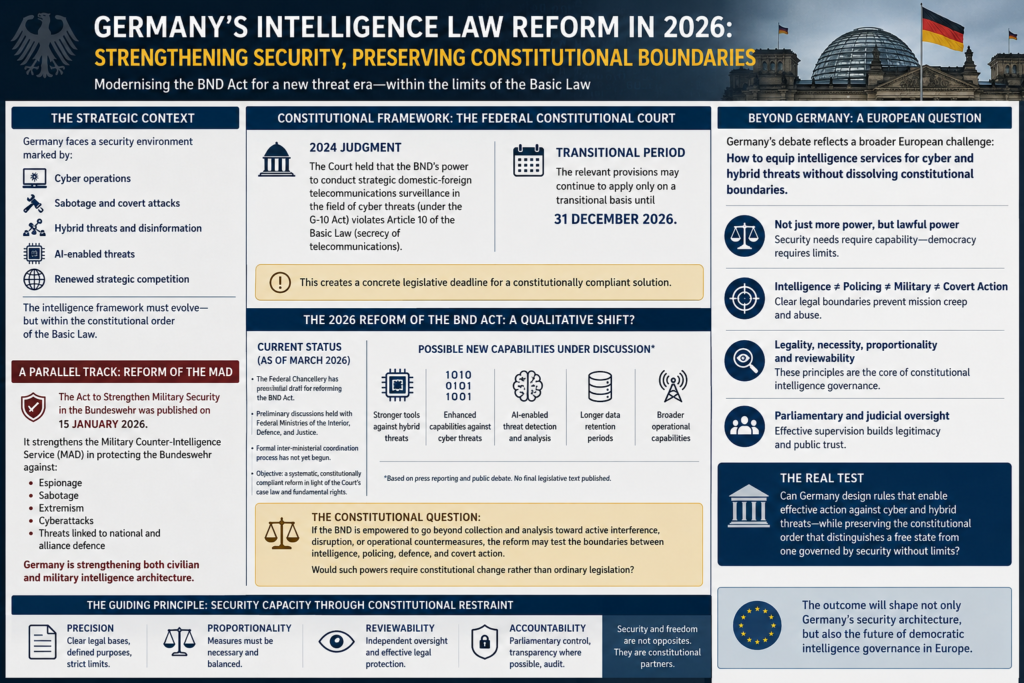
The central file is the planned reform of the BND Act. According to the Federal Government’s answer to a parliamentary question, the Federal Chancellery has prepared an initial draft for reforming the BND Act and has discussed it preliminarily with the Ministries of the Interior, Defence, and Justice. However, as of March 2026, the formal inter-ministerial coordination process had not yet begun. The stated objective is a systematic and constitutionally compliant reform of intelligence law, taking into account the case law of the Federal Constitutional Court and the implications for fundamental rights.
This reform must be read against the background of the Federal Constitutional Court’s increasingly detailed constitutional framework for intelligence surveillance. In 2024, the Court held that the BND’s power to conduct strategic domestic-foreign telecommunications surveillance in the field of cyber threats, under the G-10 Act, was incompatible with Article 10 of the Basic Law. The relevant provisions may continue to apply only on a transitional basis until 31 December 2026, which creates a concrete legislative deadline.
What makes the 2026 debate particularly significant is its potential qualitative shift. Previous reforms, including the 2023 reform of the BND Act, focused largely on legal clarity, data transmission rules, self-protection measures, and compliance with constitutional standards. The 2026 project appears more ambitious. Press reporting indicates that the reform could give the BND stronger tools against hybrid threats, including cyber threats, sabotage, AI-enabled threats, longer data retention, and potentially more operational capabilities.
This is where the constitutional question becomes sharper. If the BND is granted powers that move beyond intelligence collection and analysis toward active interference, disruption, or operational countermeasures, the reform may test the boundaries between intelligence, policing, defence, and covert action. Some commentators have even questioned whether certain forms of active BND capability could be introduced by ordinary legislation alone, or whether they would require constitutional change.
A second reform track is already in force: the reform of the Military Counter-Intelligence Service (MAD). The Act to Strengthen Military Security in the Bundeswehr was published in the Federal Law Gazette on 15 January 2026. It strengthens the MAD’s role in protecting the Bundeswehr, including against espionage, sabotage, extremism, cyberattacks, and threats linked to national and alliance defence.
Taken together, these developments show that Germany is not merely updating intelligence law. It is recalibrating the relationship between security capacity and constitutional restraint. The real issue is not whether intelligence services should be modernised; it is whether modernisation can be designed through rules that are sufficiently precise, proportionate, reviewable, and compatible with fundamental rights.
The German case is, it seems to me, highly relevant beyond Germany. It illustrates a broader European problem: how to equip intelligence services for cyber and hybrid threats without dissolving the constitutional boundaries that distinguish intelligence from law enforcement, military operations, and executive emergency power.
The key question for 2026 is this: can Germany strengthen its intelligence architecture while preserving the constitutional discipline that has historically defined its post-war security model?