
 Leggi in Italiano
This is, in the proper sense of the term, a useful critical reading for my students taking The Use of Force in International Law at the College of Europe in Natolin. I am referring to Might Unmakes Right: The Catastrophic Collapse of Norms Against the Use of Force, an article by Oona A. Hathaway and Scott J. Shapiro published in Foreign Affairs in its July/August 2025 issue. I find it particularly interesting because it raises a question that is easy to lose sight of when teaching the rules governing the use of force: what happens when a fundamental prohibition remains firmly established in law, while confidence in its enforcement begins to falter?
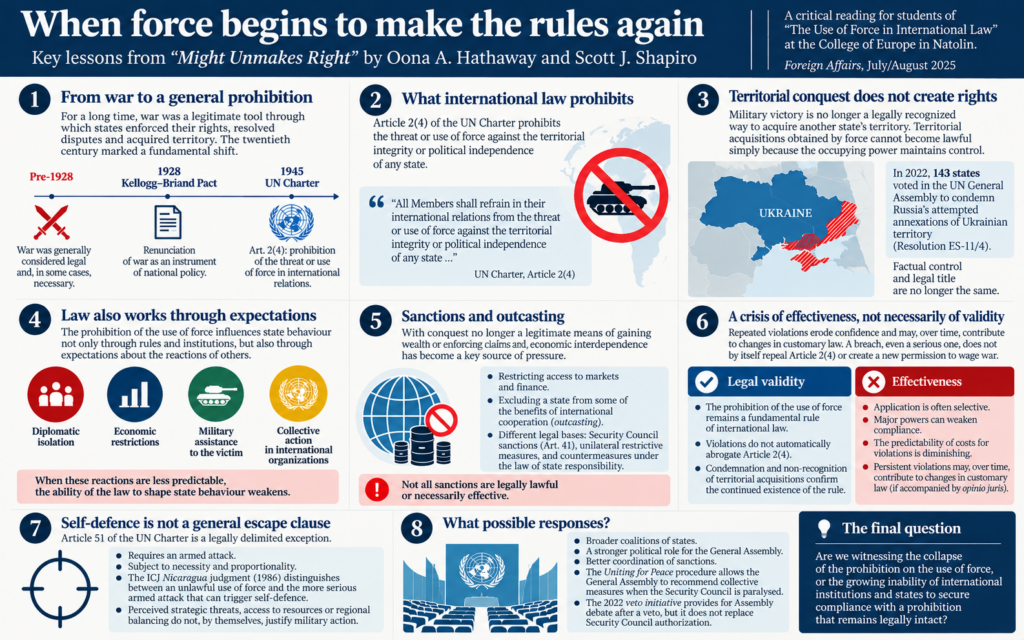
The authors begin with a historical reminder. For a long time, war was not necessarily understood as a failure of the international legal order. It was one of the means through which states asserted their rights, collected debts, secured concessions and acquired territory. The transition to the contemporary system was gradual. The 1928 Kellogg–Briand Pact marked a decisive step by renouncing war as an instrument of national policy; the United Nations Chartersubsequently established, in Article 2(4), the much broader prohibition of the threat or use of force in international relations. That distinction is worth preserving: the Charter did not simply repeat the 1928 commitment in different words.
One consequence of this transformation deserves more attention than it usually receives. Military victory ceased to be an accepted legal route to acquiring another state’s territory. The principle of non-recognition of territorial acquisitions brought about by force means that an occupation or annexation cannot become lawful merely because the occupying power succeeds in maintaining control. The point is not that territorial aggression has disappeared. Russia’s invasion of Ukraine makes the contrary painfully obvious. The point is that factual control and lawful title are no longer the same thing. In October 2022, 143 states voted in the UN General Assembly to condemn Russia’s attempted annexations of Ukrainian territory in resolution ES-11/4. That vote matters even if the resolution did not itself compel a withdrawal.
Hathaway and Shapiro make a second observation that I find especially valuable. International law influences conduct not only through rules and institutions, but also through expectations. A government considering the use of force must assess how others are likely to react. Will there be diplomatic isolation, economic restrictions, military assistance to the victim, or collective action through international institutions? The prohibition has never operated in a world of perfect compliance. Its practical strength has depended, to a considerable extent, on whether violations were expected to carry costs. That is why the authors are particularly concerned about the conduct of powerful states, including the United States: their behaviour can alter the calculations of many others.
Their discussion of sanctions develops this argument further. Once conquest was no longer recognized as a legitimate means of gaining wealth or enforcing claims, economic interdependence also became a source of pressure. States could respond to certain violations by restricting access to markets, finance and international cooperation. The authors call attention to the logic of outcasting: excluding a state from some of the benefits of cooperation rather than confronting it militarily. This is an important insight, although the legal position requires care. Measures adopted by the Security Council under Article 41 of the Charter, unilateral restrictive measures and countermeasures under the law of state responsibility do not have identical legal bases or conditions. Greater recourse to sanctions does not make every sanction lawful, or necessarily effective.
Here, however, is where I would introduce a reservation about the article’s deliberately provocative thesis. A crisis in the effectiveness of the prohibition is not necessarily a crisis in its legal validity. Repeated violations may erode confidence, expose selective enforcement and even contribute over time to changes in customary law if accompanied by the relevant opinio juris. Yet a breach, even a serious one, does not by itself repeal Article 2(4) or establish a new permission to wage war. Reactions to aggression — including condemnation and refusal to recognize territorial gains — remain legally significant. The distinction between a rule losing its grip on behaviour and a rule ceasing to exist is, in my view, central to the discussion.
It also helps clarify why Article 51 of the Charter cannot be treated as a general escape clause. Self-defence is a legal exception subject to requirements, including an armed attack and the conditions of necessity and proportionality. The International Court of Justice’s 1986 Nicaragua judgment remains essential here, not least for the distinction between an unlawful use of force and the more serious armed attack capable of triggering self-defence. A state’s conviction that it faces a strategic threat, needs access to resources or wishes to reshape a regional balance cannot, by itself, supply the legal basis for military action.
I also think the authors’ account of the post-1945 order should be read critically. The United States has sometimes supported the prohibition on conquest and collective responses to aggression; it has also participated in military operations whose legality was deeply contested, notably the 2003 invasion of Iraq. The relative decline in interstate conquest cannot be explained by one factor alone: deterrence, political changes, economic integration and the law have interacted. Recognizing these complications does not diminish the significance of the prohibition. It prevents us from turning a persuasive historical argument into an overly tidy story.
The article ends by asking who might sustain the system if the major powers no longer do so consistently. It suggests broader coalitions, a stronger political role for the General Assembly and better coordinated sanctions. These proposals are worth discussing, provided we distinguish institutional reform from the law as it currently stands. The General Assembly can recommend collective measures, notably through the Uniting for Peace procedure, but it does not possess the Security Council’s Chapter VII authority to adopt binding enforcement measures. The 2022 veto initiativeprovides for Assembly debate following a veto; it is not a substitute for Security Council authorization.
I would therefore ask my students one question after reading Hathaway and Shapiro: Are we witnessing the collapse of the prohibition on the use of force, or the growing inability of international institutions and states to secure compliance with a prohibition that remains legally intact? The distinction may appear technical. It determines how we diagnose the problem, and what kinds of solutions we should even be discussing.