
 Leggi in Italiano
A Hungarian singer, Kozsó, had not given up his dream of bringing dolphins to an aquarium near Lake Balaton. A local news website reported the story. Then someone asked Gemini to summarise that article in Hungarian. The chatbot produced a detailed answer, drawing on information that had also appeared on other websites belonging to the same publisher. The episode became part of a dispute between the Hungarian company Like Company and Google Ireland, which eventually reached the Court of Justice of the European Union. The dolphins, at least on paper, had made it to Luxembourg.
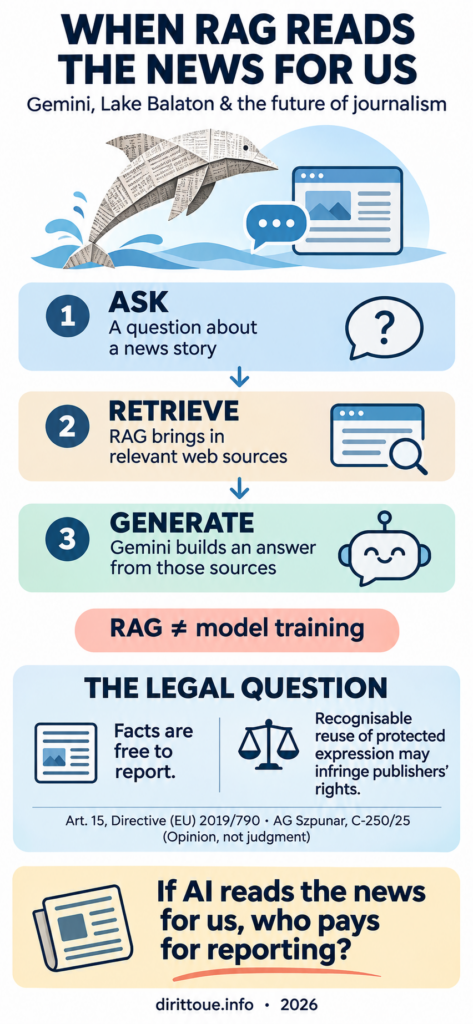
On 3 November 2026, Advocate General Maciej Szpunar delivered his Opinion in Like Company, Case C-250/25. The proceedings concern press publishers’ rights when their publications are used by AI chatbots. What caught my attention, though, was the technology behind the dispute: RAG, or Retrieval-Augmented Generation. The name is hardly inviting. The underlying idea is quite straightforward, and understanding it helps explain why services such as Gemini have become so useful.
A large language model is trained on enormous amounts of data, learning linguistic patterns and relationships that allow it to produce answers. That does not mean it contains an orderly archive of newspaper articles that it can look up like books on a library shelf. Nor does training ensure that the model knows what happened this morning. If we ask about a recent story, the system may need information from outside the model. This is where RAG comes in. Relevant material is retrieved and made available to the model, which uses it to construct its response. The answer is still generated by the model, but the model now has additional information in front of it, selected for that particular question.
Gemini can connect text generation to web search, using an approach Google also calls grounding. Google’s technical documentation describes a workflow in which the system decides whether a search would help, retrieves relevant results and uses them to produce an answer, sometimes with links to supporting sources. Not every question triggers a search, and the details differ across products and versions. The essential point is that we are no longer dealing only with a chatbot answering from patterns acquired during training. It can also bring material from the outside world into the conversation at the moment we ask.
Consider the dolphin story. A conventional search engine would have offered us links. We would then have opened the pages, read the articles and worked out a summary. A chatbot with access to external sources can do much of that work for us and deliver the result directly. That is a genuine convenience, particularly when the relevant information is scattered across several websites. Grounding can also make answers more current and easier to check against sources. RAG does not, however, make an answer automatically accurate. A system can retrieve unreliable material, misunderstand it or produce a misleading synthesis.
The legal problem is that what feels like a convenient answer to the reader may represent a use of something into which a publisher has invested time and money. Article 15 of Directive (EU) 2019/790 gives press publishers certain rights over online uses of their publications by information society service providers. Hyperlinks, individual words and very short extracts are excluded from its scope, among other limitations. Crucially, publishers do not own the facts they report. The question is therefore whether an AI-generated answer merely conveys information or reproduces the protected way in which a publication has expressed it.
Szpunar focuses on what happens when Gemini retrieves material in order to answer, rather than treating the issue as simply another dispute about training data. According to his Opinion, an infringement of the publisher’s reproduction right may arise depending, in particular, on how the content was accessed — for example, where effective technical restrictions such as a paywall were circumvented — and whether the generated answer recognisably reuses the expression of the original publication to such an extent that the reader has little reason to consult it. As regards making material available to the public, he attaches particular importance to the systematic appearance of that protected expression in chatbot responses. The provider’s potential responsibility also depends on whether those uses are inherent in its commercial strategy or whether it failed to take credible and effective measures to prevent them. This is not an argument that every AI-generated news summary is unlawful.
What Szpunar proposes not to decide is equally important. He recommends finding the two questions concerning model training inadmissible. The proceedings contain no evidence that Like Company’s publications were actually used to train Gemini’s models, and he considers training not to amount, as such, to an ‘online use’ of press publications within the meaning of Article 15. For completeness, he suggests that the text-and-data-mining exception in Article 4 of the Directive will normally cover the use of protected material for training, subject to that provision’s conditions, including the possibility for rights holders expressly to reserve such uses. His Opinion should not be mistaken for a definitive ruling on all the copyright issues raised by AI training.
I find the gap between the legal and economic questions particularly interesting. A chatbot might give an accurate account of the facts without reproducing protected expression, yet still persuade us that there is no need to visit the publisher’s website. Conversely, a system that identifies sources clearly and encourages readers to follow them may send traffic back to news organisations. Much depends on how the service is designed and on what we do with it. RAG changes the relationship because journalistic content can contribute to an answer that is consumed somewhere else, inside the chatbot rather than on the website that produced the original reporting.
For years, looking for news meant finding a story and deciding which page to open. Increasingly, we simply ask for the answer. I do that too, and I see little point in giving up such a useful tool. But I do wonder what will happen to news organisations, especially smaller ones, if a growing share of the value they create is used without producing enough visits or revenue to sustain their work. Publishers’ rights can address some forms of reuse. They cannot, on their own, guarantee a viable economic model for journalism.
For the moment, these are the Advocate General’s conclusions, which are not binding on the Court. The judgment will come later. As for the dolphins of Lake Balaton, I have no idea whether they will ever see that aquarium. They have already brought a rather less exotic question into focus: when the chatbot has read the newspaper for us, who will keep paying for someone to write it?
Sources and further reading: Court of Justice of the European Union, Opinion of Advocate General Maciej Szpunar of 3 November 2026, Like Company, Case C-250/25, Press Release No 155/26; official case record; summary of the preliminary reference, including the dolphin story; Directive (EU) 2019/790, Articles 4 and 15; Google, Grounding with Google Search; Google Cloud, What is Retrieval-Augmented Generation?.