

 Leggi in Italiano
The Council of Europe launched in 2026 an intergovernmental process to develop a legal instrument on foreign information manipulation and interference (FIMI). It is a process I follow closely, because it touches an unresolved problem in contemporary international law: how to regulate hostile conduct that can undermine democratic processes without necessarily breaching existing norms, and how to do so without turning the language of democratic security into a general clause for suppressing dissent.
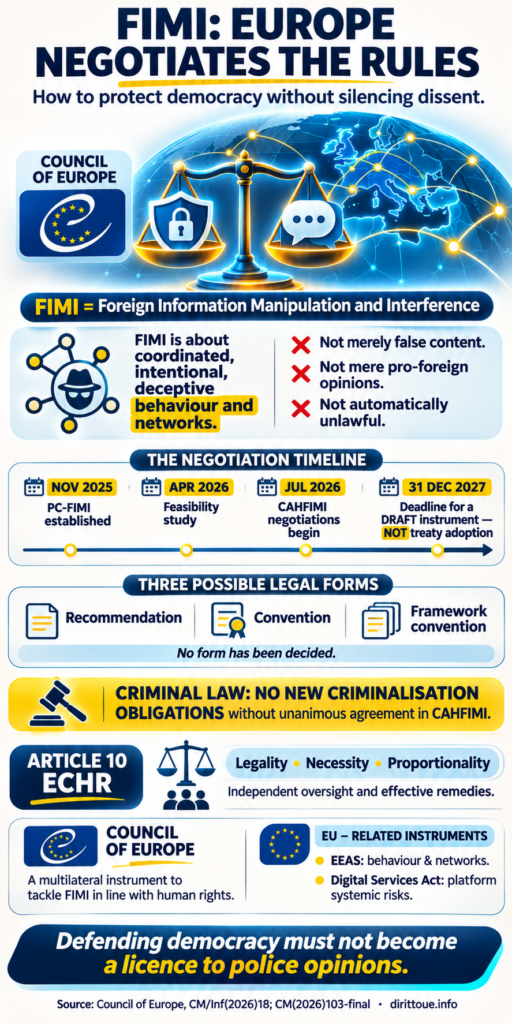
The institutional sequence matters for understanding where things stand. On 18 November 2025, the Committee of Ministers established the Committee of Experts on Foreign Information Manipulation and Interference (PC-FIMI), placing it under the authority of the European Committee on Crime Problems (CDPC) — a choice that was not accidental, as it explains why the mandate expressly included examining whether FIMI-related conduct should be criminalised. The group, composed of twelve national representatives, held four meetings between January and March 2026 and produced a feasibility study (CM/Inf(2026)18, 10 April 2026). The study was transmitted to the Committee of Ministers, which at its Chi?in?u session on 15 May 2026 endorsed it and tasked the Secretary General with submitting negotiation proposals. On 8 July 2026, the Ministers’ Deputies established the Ad hoc Committee on Foreign Information Manipulation and Interference (CAHFIMI), with a mandate to prepare an appropriate draft legal instrument by 31 December 2027. [1][2][3]
It is essential to clarify what the study does and does not say. FIMI is not a uniformly defined category of international law. The PC-FIMI takes as its reference the model developed by the EU’s European External Action Service, which treats FIMI as mostly non-illegal patterns of intentional and coordinated manipulative conduct involving deceptive practices, attributable to state or non-state actors. The defining feature is not the falsity of any particular content — authentic information can be selected, amplified or disseminated through covert networks and fictitious identities — and an opinion favourable to a foreign government is not, in itself, indicative of a FIMI operation. The study expressly states that its analytical framework does not constitute a legal definition and does not automatically render the conduct it describes unlawful. [1]
The scope of the interference element also remains contested. Some states confine it to the information environment; others place it within hybrid threat strategies that combine information manipulation, cyber-attacks, corruption and sabotage. The divergence is not academic: regulating coordinated information behaviour cannot be framed in the same way as regulating sabotage. The study acknowledges this openly.
The gaps identified by the feasibility study deserve attention. There are inconsistent definitions and varying national exposure to FIMI operations; a fragmentation of competences among electoral authorities, security agencies and media regulators; the absence of shared methodologies for measuring resilience and of coordinated procedures for identifying operations that cross jurisdictions and platforms. To these one must add the difficulties of cooperation with private operators, the growing use of artificial intelligence to produce and amplify manipulative campaigns, and the intersection with corruption and opaque financing. [1]
The study’s conclusion is positive on feasibility but deliberately inconclusive on the legal form of the future instrument. A Committee of Ministers recommendation would set principles and good practices with greater flexibility, without creating conventional obligations. A convention would establish more determinate obligations and binding cooperation mechanisms. A framework convention, while remaining a binding treaty, would leave wider margins in implementation. The CAHFIMI is tasked with producing an appropriate draft legal instrument, including a possible draft framework convention: the convention is one of the forms envisaged, not one already decided. The deadline of 31 December 2027 is for the draft, not for the adoption of a treaty. [3]
The criminal law question is where the process shows its sharpest discontinuity — and, in my view, the one most revealing of the tensions at play. The PC-FIMI considered that criminal law should be a response of last resort, reserved for conduct of particular gravity defined with sufficient precision. States could not agree on new criminalisation obligations: some feared excessive restrictions on freedom of expression, others believed that conventional recognition of certain offences could facilitate extradition and mutual legal assistance. On 8 July 2026, the compromise became an explicit condition: the future instrument shall not contain criminal law provisions creating obligations to criminalise FIMI-related conduct, unless by unanimous agreement of the committee’s members. This is a significant constraint that steers negotiations toward prevention, cooperation and administrative regulation — and it demands close scrutiny of precisely these measures, because even without criminal sanctions they can substantially affect pluralism and freedoms. [1][3]
The relationship with general international law raises difficulties that political language tends to understate. Foreign interference is a broad descriptive notion; internationally wrongful intervention requires additional legal elements. In the ICJ’s Nicaragua jurisprudence, the element of coercion is central. Many information influence operations, however hostile and intentional, do not necessarily meet that threshold. Attribution must also be kept distinct: the investigative reconstruction of an operation, its public or political attribution, and its legal attribution to a state under the rules of state responsibility are different analyses. The proposal for shared criteria for public attribution, with evidentiary thresholds and safeguards against erroneous attributions, can have practical value without automatically resolving questions of international responsibility. [1]
The ECHR system represents the limit that will condition the legitimacy of the entire exercise. Article 10 requires an accessible and foreseeable legal basis, a legitimate aim, and a restriction that is necessary and proportionate in a democratic society. The distinction between manipulative behaviour and expressed content is decisive: the presence of narratives similar to those used by a FIMI network does not on its own remove the protection of freedom of expression. An indiscriminate regime for foreign funding risks penalising civil society organisations, independent media and activities of public interest. The study specifically invokes the European Court’s case law on “foreign agent” regimes and the Venice Commission’s concerns, highlighting the risks of arbitrary application. The point of balance is more demanding than a generic declaration of human rights compliance: the instrument will need to target verifiable conduct, clearly allocate powers and competences, provide for independent oversight and effective remedies. [1]
At the EU level, the EEAS analytical tools have contributed to a conduct-and-network-centred approach; the Digital Services Act imposes on very large platforms obligations on systemic risk assessment, including risks to civic discourse and electoral processes. A pan-European Council of Europe instrument could define common principles and cooperation obligations also for states outside the EU, and provide for the accession of states that are not Council of Europe members. Complementarity, however, will not be automatic: the project must avoid duplicating existing regimes and clarify the distribution of responsibilities among public authorities, platforms, electoral bodies and independent actors. [1][10]
A little over a year into the process, the decisive question remains open: whether states will accept transforming the relatively shared ground of resilience and cooperation into legal obligations that are sufficiently precise and enforceable. The Council of Europe is attempting to bridge a gap that the feasibility study describes clearly — between an operationally recognisable threat and legal instruments that remain sectoral and fragmented. The consensus on the need to act, however, is broader than the consensus on how to act. The quality of the future instrument will depend on the ability to make hostile operations concretely addressable without granting authorities an indeterminate power to classify or restrict public discourse.
Documents and sources
[1] Council of Europe, PC-FIMI, CM/Inf(2026)18, Feasibility study on the possible elaboration of a legal instrument on foreign information manipulation and interference (FIMI), including disinformation, 10 April 2026.
[2] Committee of Ministers, CM/Del/Dec(2026)135/3b, New Democratic Pact for Europe – Foreign Information Manipulation and Interference, Chi?in?u, 15 May 2026.
[3] Ministers’ Deputies, CM(2026)103-final, CAHFIMI – Terms of reference, 8 July 2026.
[4] Committee of Ministers, CM(2025)131-addfinal, Terms of reference of the PC-FIMI, 18 November 2025.
[5] CDPC, Bureau and ad hoc Plenary meeting on FIMI, 2 April 2026.
[6] Ministers’ Deputies, CM/Del/Dec(2026)1566/10.1, CAHFIMI – Terms of reference, 8 July 2026.
[7] CDPC, 89th plenary meeting, 9–11 June 2026; cf. eucrim, 30 July 2026.
[8] Parliamentary Assembly, Monegasque presidency address, 30 September 2026.
[9] CDMSI, Resisting disinformation: Ten building blocks to strengthen information integrity, 2025.
[10] EEAS, Fourth Report on FIMI Threats, March 2026; Regulation (EU) 2022/2065 (Digital Services Act), Arts. 34–35.