
 Leggi in italiano
What happens when a military strike exposes the fragility of the entire global energy architecture? The joint U.S.–Israeli strike on Iran at the end of February 2026 has answered that question with uncomfortable clarity: what initially appeared as a regional military escalation has quickly evolved into a broader energy confrontation, affecting supply chains, strategic reserves, diplomatic alignments and global markets.
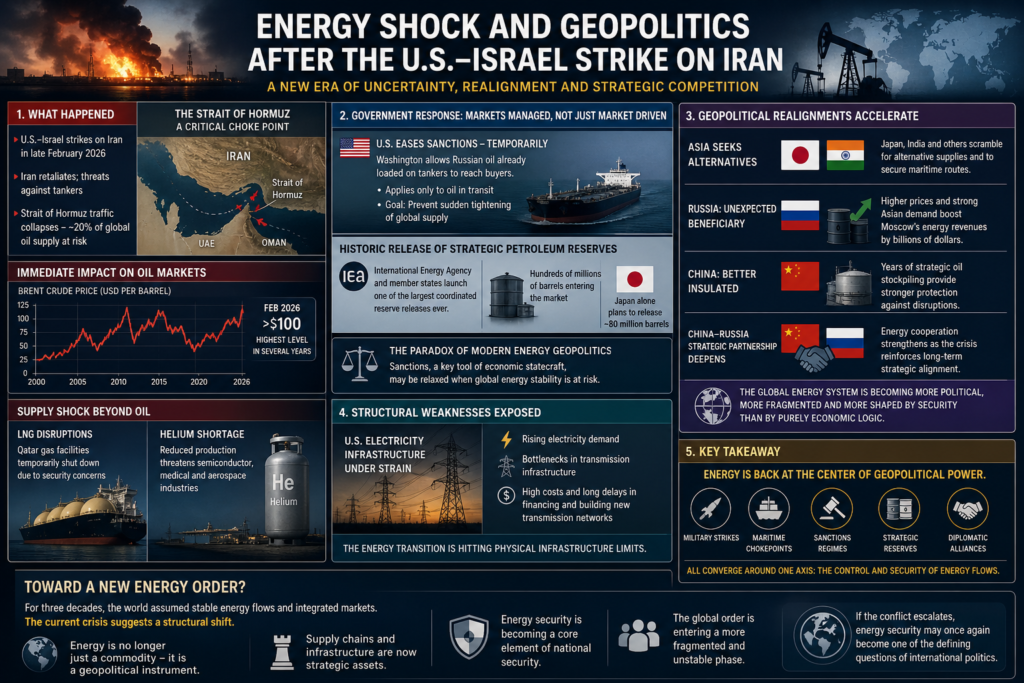
The immediate epicenter of the crisis is the Strait of Hormuz, the most important maritime choke point in the global oil trade. Following the strikes, Iranian retaliation and the threat of attacks on tankers effectively halted traffic through the strait, through which roughly 20% of the world’s oil supply normally flows. Tanker traffic rapidly collapsed and many vessels anchored outside the strait rather than risk entering the war zone.
The consequences for energy markets were immediate. Brent crude prices surged above $100 per barrel, the highest level in several years, reflecting fears of a prolonged disruption of Gulf exports. Yet the price increase, although rapid, remains moderate in historical terms, roughly in line with the long-term average when adjusted for inflation. Markets appear to be pricing in uncertainty rather than a complete breakdown of the global oil system.
In response to the supply shock, governments have begun deploying emergency measures that reveal the extent to which energy markets are now managed through strategic intervention rather than purely through market mechanisms.
One of the most controversial decisions came from Washington, which temporarily eased sanctions on Russian oil already loaded onto tankers, allowing those shipments to reach buyers in order to stabilize global supply. The measure applies only to oil already in transit and is designed to prevent a sudden tightening of the market, even if it partially weakens the sanctions regime imposed after Russia’s invasion of Ukraine.
At the same time, the International Energy Agency and its member states have initiated what may become the largest coordinated release of strategic petroleum reserves in history, with hundreds of millions of barrels being injected into the market. Japan alone plans to release around 80 million barrels from its reserves in order to stabilize prices and maintain supply security.
These actions highlight a striking paradox of modern energy geopolitics. Sanctions, which have become one of the main tools of economic statecraft, may be temporarily relaxed when the stability of the global energy system itself is at risk.
The energy shock is not limited to crude oil. The conflict has also disrupted production of liquefied natural gas and helium, particularly in Qatar, where security concerns forced temporary shutdowns of gas facilities. Helium, a by-product of gas production essential for semiconductor manufacturing, medical imaging and aerospace technologies, has suddenly become scarce, exposing the fragility of highly specialized industrial supply chains.
At the geopolitical level, the crisis is accelerating several strategic realignments. Countries highly dependent on Middle Eastern imports, such as Japan and India, are scrambling to secure alternative supplies and to protect maritime shipping routes. Meanwhile Russia has emerged as an unexpected beneficiary of the crisis. Higher oil prices and increased demand from Asian buyers have significantly boosted Moscow’s energy revenues, providing billions of dollars in additional budget income despite Western sanctions—a paradox that raises serious questions about the long-term effectiveness of the EU’s sanctions architecture when energy markets can so easily redirect the flows.
In parallel, the crisis appears to be reinforcing the long-term strategic partnership between China and Russia, particularly in the energy sector. China, which spent years accumulating large strategic oil reserves, now finds itself relatively better insulated from short-term disruptions.
The global energy system is therefore entering a period of heightened geopolitical fragmentation, in which supply chains, diplomatic alignments and infrastructure decisions are increasingly shaped by security considerations rather than by purely economic logic.
The current crisis also exposes structural weaknesses in advanced economies. In the United States, rising electricity demand and bottlenecks in electricity transmission infrastructure are becoming central concerns for policymakers. The difficulty of financing and building large transmission networks illustrates how the energy transition itself may become constrained by physical infrastructure limits.
Yet beyond the immediate crisis lies a deeper transformation.
The events unfolding in the Gulf suggest that energy is once again becoming a central instrument of geopolitical power, much as it was during the oil shocks of the 1970s. Military strikes, maritime chokepoints, sanctions regimes, strategic reserves and diplomatic alliances are all converging around a single axis: the control and security of energy flows.
In this sense, the U.S.–Israel confrontation with Iran may represent more than a regional conflict. It may mark the beginning of a new phase in the global energy order.
For three decades, the international energy system operated under the assumption that markets were broadly integrated and that supply disruptions would remain temporary. The current crisis challenges that assumption. The emerging system appears far more political, far more strategic, and far more unstable.
Energy is no longer merely a commodity traded on global markets. It is increasingly a geopolitical instrument, a lever of pressure, and potentially a decisive factor in the balance of power between states.
If the conflict continues to escalate, the world may be entering an era in which energy security once again becomes one of the defining questions of international politics.
The current crisis suggests a structural shift. For three decades, globalization assumed relatively stable energy flows. The events triggered by the U.S.–Israel strike on Iran indicate that the world may be entering a new era in which energy security once again shapes the global balance of power.